What are the core symptoms of psychosis?
The symptoms of psychosis are not one fixed list; each person goes through their own set depending on the cause of the episode and their circumstances. But the UK's National Health Service groups them into three main symptoms: hallucinations, delusions, and disorganized thinking and speech. Hallucinations occurring together with delusions are what usually cause the severe distress and the obvious change in behavior.
Doctors add two more groups that are no less important in daily life: negative symptoms, meaning what has been “taken away” from the person, such as enthusiasm and expression, and cognitive symptoms, such as poor concentration and planning. The latter are often what the family notices first, before the hallucinations or delusions clearly appear.
How do hallucinations and delusions appear?
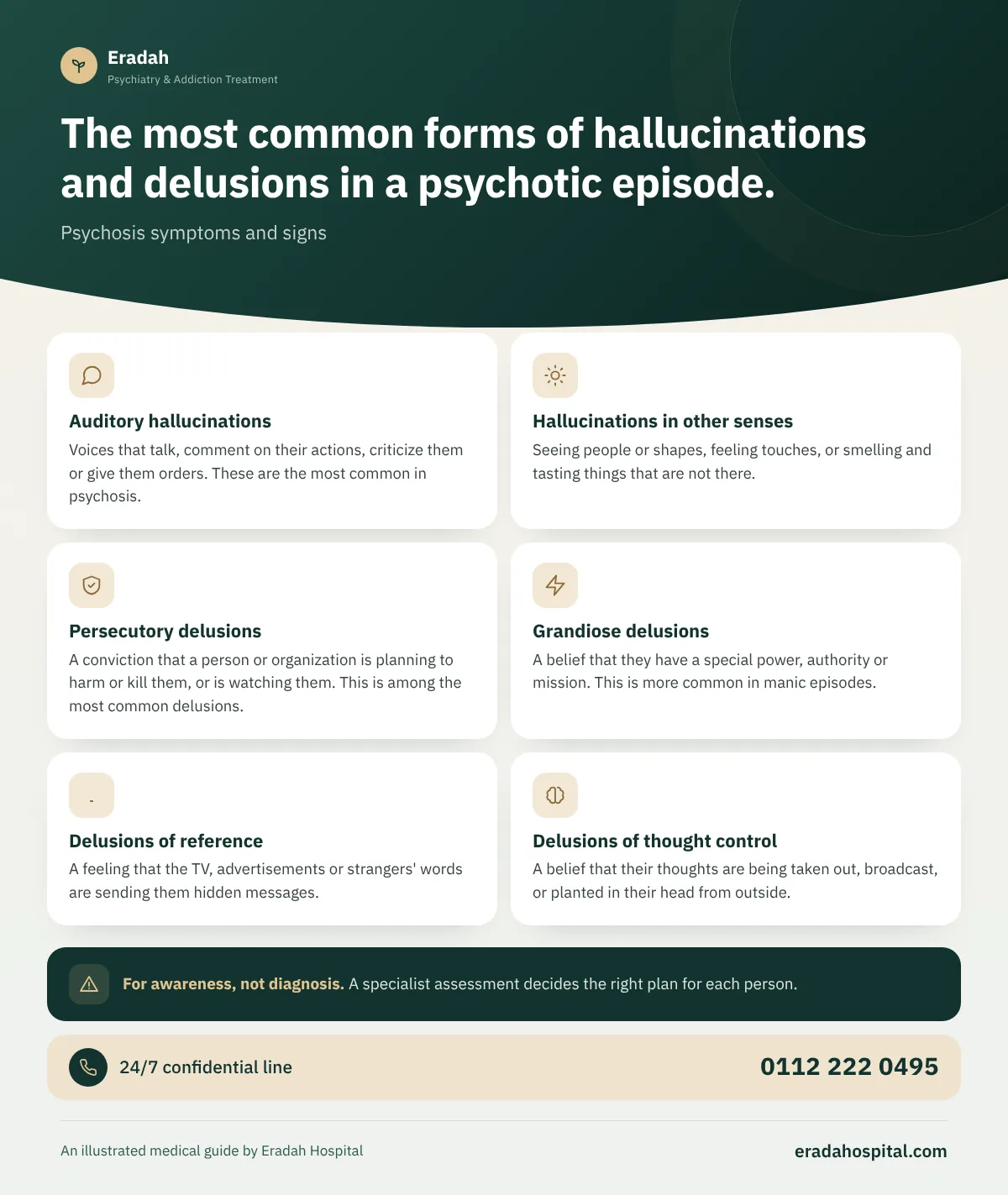
Doctors call hallucinations and delusions “positive symptoms” because they are experiences “added” to perception and thinking, not because they are good. These are the most common forms:
Voices that talk, comment on their actions, criticize them or give them orders. These are the most common in psychosis.
Seeing people or shapes, feeling touches, or smelling and tasting things that are not there.
A conviction that a person or organization is planning to harm or kill them, or is watching them. This is among the most common delusions.
A belief that they have a special power, authority or mission. This is more common in manic episodes.
A feeling that the TV, advertisements or strangers' words are sending them hidden messages.
A belief that their thoughts are being taken out, broadcast, or planted in their head from outside.
The UK's National Health Service explains that the type of delusion is sometimes linked to the cause: grandiose delusions are closer to bipolar disorder, while persecutory delusions are closer to schizophrenia and depression. To go deeper into each symptom, read our guides to hallucinations and paranoia.
How are thinking and speech disturbed in psychosis?
No one else may hear the voices the patient hears, but everyone notices their speech. Signs the UK's National Health Service lists include:
- Rapid, continuous speech that is hard to interrupt or follow.
- Jumping between topics in the middle of a sentence, with no connection clear to the listener.
- Sudden stops in speech or activity, as if the thread of the thought had suddenly snapped.
- Answers that do not fit the question, or strange words the person makes up.
This does not mean the patient is “deliberately” being vague; the thoughts themselves crowd together or scatter before they turn into speech, and the person may feel frustrated that no one understands them.
What are the negative and cognitive symptoms of psychosis?
These symptoms are less eye-catching than hallucinations, but they are often the longest lasting and have the most effect on school and work, and parents mistake them for laziness or rudeness:
- Flattened emotions and less facial expression and vocal tone.
- Speaking little and giving brief replies.
- Loss of motivation and difficulty starting or finishing simple tasks.
- Withdrawing from people and losing interest in enjoyable activities.
- Poor concentration and memory, and difficulty planning and making decisions.
Why doesn't the patient see that they are ill?
The UK's National Health Service says that people going through a psychotic episode often do not realize that their delusions or hallucinations are not real, which is what makes them frightened and distressed. Doctors call this lack of insight, a symptom of the condition and not a moral stance. This is why some patients refuse to see a doctor, saying “I'm not crazy,” and the most suitable way in is to talk about what troubles them: insomnia, fear or tension.
What are the early signs before a first psychotic episode?
NIMH notes that a person's behavior often changes before psychosis clearly appears. Catching these signs is what shortens the period of untreated psychosis, and the most prominent include:
- Suspicion, paranoid thoughts or unjustified uneasiness around others.
- Difficulty thinking clearly and logically.
- Social withdrawal and spending much more time alone.
- Strange or very intense ideas, strange feelings, or a lack of feelings.
- A decline in self-care and personal hygiene.
- Disturbed sleep, such as trouble falling asleep or sleeping briefly.
- Difficulty telling reality from fantasy, or confused speech.
- A sudden drop in grades or work performance.
This list is taken from NIMH for awareness and is not a diagnostic tool; any single sign may have ordinary causes, but several signs together, and their worsening or persistence, call for a consultation.
What do the symptoms of psychosis look like to a family?
A family cannot see hallucinations or read thoughts; it sees behavior. This table links what you notice to what it might mean, and is no substitute for an assessment:
| What you notice | What it may mean |
|---|---|
| Talks or laughs alone, or turns suddenly as if someone is calling | Auditory hallucinations |
| Closes the windows, checks the phone and refuses food made at home | Persecutory delusions or fear of being poisoned |
| Interprets news headlines or car license plate numbers as messages to them | Delusions of reference |
| Speech is disjointed or sentences break off suddenly | Disorganized thinking |
| Stays up for days, performance declines and they have isolated themselves from friends | Early signs or negative symptoms |
Psychosis symptoms in special situations
After childbirth: The UK's National Health Service estimates that postpartum psychosis affects about one woman in every thousand who give birth. It usually appears in the first weeks, with sharp swings between mania and depression. It is an emergency that calls for contacting the doctor right away, and the details are on the postpartum depression page.
In older adults: NIMH notes that psychosis can be part of illnesses that appear in later life, such as Parkinson's, Alzheimer's and related types of dementia, so any new psychosis at this age deserves a full medical examination.
After substance use: The picture differs depending on the substance; stimulants, for example, are linked to strong suspicions and a feeling of insects under the skin. The details are on the substance-induced psychosis symptoms page.
When are psychosis symptoms an emergency?
- Voices commanding the person to harm themselves or others, or talk of death.
- Agitation or aggression that is growing and cannot be calmed.
- Refusing food and drink for fear of being poisoned.
- Sudden psychosis with fever, confusion, severe headache or seizures, since the cause may be physical.
- Hallucinations after suddenly stopping alcohol or sedatives.
In these situations, call the ambulance (123) or the mental health support line 16328 (24 hours). Once the danger has passed, the path begins on the psychosis treatment page, and may start with an assessment at a psychiatric hospital if the case needs intensive care.
An acute psychotic episode or danger to self? Get help now
- Hearing voices that command them to harm themselves or others, or talk of death or suicide
- Severe agitation or threats toward those around them, or behavior that puts them in danger in the street or at home
- Complete refusal to eat or drink, often out of fear of poisoning
- Psychosis that appeared suddenly with fever, confusion, severe headache or seizures
- Hallucinations and suspicion after using a drug or after suddenly stopping alcohol
Do not leave them alone. Speak calmly in short sentences without arguing with their ideas, and quietly keep sharp objects and medication out of their reach without confronting them. Call ambulance (123) or take them to the nearest emergency department, and you can call the mental health support line 16328 (24 hours) for advice. If they are aggressive, do not stay alone with them in a closed space, and tell the medical team about any substance they have used.
Ambulance 123 Mental health support line 16328