What are the main symptoms of drug-induced psychosis?
This condition combines two core symptoms: hallucinations, which means perceiving things that are not there, and delusions, which are fixed false beliefs. They are usually accompanied by disturbed behavior, mood and sleep:
| Area | How it appears |
|---|---|
| Thoughts | Suspicion of family and friends, a belief of being watched, followed or poisoned, pathological jealousy, sometimes grandiose ideas |
| Cognition | Voices that speak or threaten, seeing shadows or people, a sensation of insects or worms crawling under the skin |
| Behavior | Agitation, hiding, repeatedly checking windows and doors, carrying objects for self-defense, sudden flight |
| Speech | Rapid or incoherent speech, or silence, wariness and refusing to answer |
| Mood and body | Severe anxiety, anger or terror, insomnia for days, dilated pupils and a fast pulse with stimulants |
Why do suspicions take over a person who uses drugs?
Suspicion is the most common symptom in drug-induced psychosis, especially with stimulants and cannabis. It often starts with a mild feeling that people are looking at them or talking about them, then grows into certainty that someone is watching them with cameras, that the police are after them, that their wife is cheating, or that their family is putting something in their food.
Suspicions become more dangerous when the person acts on them, attacking someone they believe is an enemy or fleeing the house in the middle of the night. That is why strong suspicions after drug use are a sign that needs attention and assessment, and should not be treated as a “passing hallucination” to laugh at.
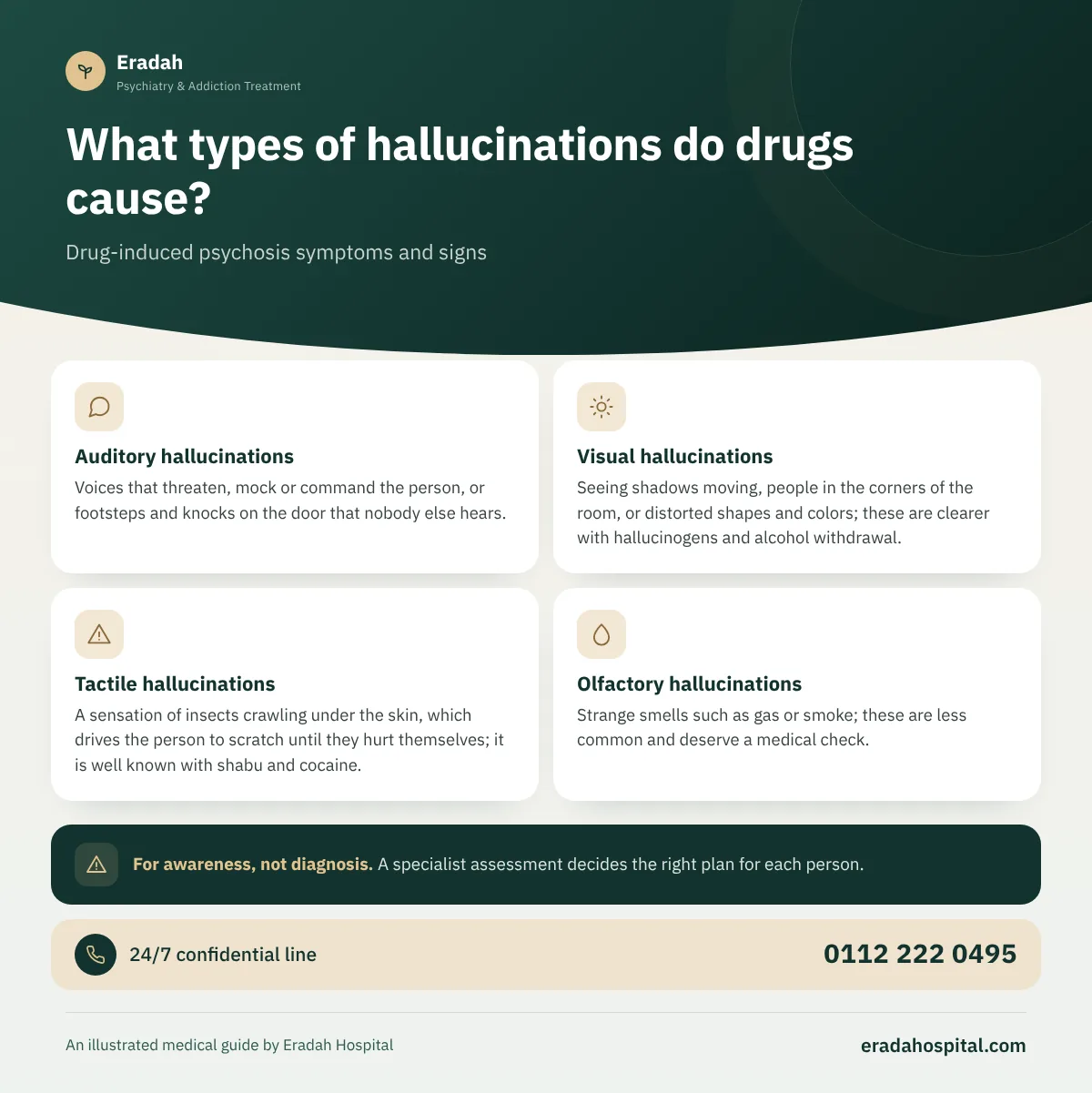
What types of hallucinations do drugs cause?
Voices that threaten, mock or command the person, or footsteps and knocks on the door that nobody else hears.
Seeing shadows moving, people in the corners of the room, or distorted shapes and colors; these are clearer with hallucinogens and alcohol withdrawal.
A sensation of insects crawling under the skin, which drives the person to scratch until they hurt themselves; it is well known with shabu and cocaine.
Strange smells such as gas or smoke; these are less common and deserve a medical check.
How do symptoms differ by substance?
| Substance | Predominant features | Accompanying signs |
|---|---|---|
| Shabu and stimulants | Intense suspicion and persecution, insects under the skin, aggression | Sleeplessness for days, loss of appetite, weight loss, dilated pupils, repetitive movements |
| Strox | Sudden agitation, unpredictable behavior and detachment from reality | Fast pulse, vomiting, sometimes seizures, stiffness or limpness |
| Hashish | Paranoia, ideas of reference and severe anxiety | Red eyes, slowness, increased appetite, poor concentration |
| Cocaine | Acute, relatively brief suspicions that recur with every session | Dilated pupils, frequent nosebleeds, rapid swings between activity and crash |
| LSD and hallucinogens | Marked visual distortions, terror and bizarre ideas | Dilated pupils, shifting emotions, a sense of time changing |
| Alcohol withdrawal | Visual and auditory hallucinations after stopping drinking | Tremor, sweating, fast pulse; it may progress to confusion and fever |
People who use drugs often mix more than one substance, so the picture overlaps and is hard to attribute to a single one. That is why the doctor asks for a drug test along with an honest medical history.
Do symptoms appear during use or after stopping?
Doctors distinguish two types: psychosis that starts during intoxication, meaning under the influence of the substance, such as shabu, cannabis and hallucinogens, and psychosis that starts during withdrawal, the best known being withdrawal from alcohol and sedatives after long-term use. This difference has practical importance, because withdrawal psychosis may be a sign of severe withdrawal that needs hospital care.
In alcohol withdrawal in particular, hallucinations may appear within the first or second day after the last drink while the person remains conscious, and after two to four days it may develop into delirium tremens, with confusion, fever, sweating and a fast pulse, a life-threatening emergency. The details are on the alcohol withdrawal page.
How can families tell psychosis from acute delirium?
In psychosis the person usually knows where they are and who is around them, despite holding unrealistic beliefs. In delirium, consciousness itself is disturbed: they do not know the time or place, their attention fluctuates, they may not recognize those closest to them, and physical signs usually accompany it. Any of these signs means going to the emergency department immediately:
- Does not know where they are or what day it is, or does not recognize family.
- High fever, heavy sweating or severe tremor.
- Seizures, chest pain or shortness of breath.
- Intermittent extreme drowsiness with agitation, or difficulty waking them.
- Weakness on one side of the body or sudden difficulty speaking.
What signs does the family notice before an episode?
Many families say after an episode: “There were signs we didn't understand.” The most prominent are:
- Staying up for several nights in a row with excess activity or irritability.
- Isolating in the room, closing the door and covering the windows.
- Strange questions such as “Who was talking about me?” or “Why are you all looking at me like that?”
- Searching the phone or the house for listening devices.
- Sudden accusations against family or spouse with no evidence.
- Scratches and wounds on the skin from constant scratching.
These signs are for awareness and are not a diagnostic tool, and some may have other causes. But when they occur together with a suspicion of drug use, they deserve urgent psychiatric assessment.
How do you deal with someone in a psychotic episode after drug use?
- Keep yourself safe first, leave an open way out for you and for them, and do not corner them.
- Lower the lights and noise, keep onlookers away, and let one person they trust talk to them.
- Speak slowly in short sentences, do not argue with the suspicions or mock them, and reassure them that you want to help.
- Do not try to restrain them by force except to save a life, because resistance may raise their temperature and strain their heart.
- Call ambulance (123) at any sign of danger, and tell them what you know about the substance the person took.
Once the episode has passed, the page on treating drug-induced psychosis explains the next steps.
An acute psychotic episode after substance use, or suicidal thoughts? Get help now
- Severe agitation or suspicion that leads the person to attack others or run into the street unaware of the danger
- Voices commanding them to harm themselves or others, or talk about death or ending their life
- Confusion and not knowing the place or time, together with a high temperature, heavy sweating or severe shaking
- Seizures, chest pain or loss of consciousness
- Not eating, drinking or sleeping for days in a row
Call the ambulance on 123 or go to the nearest emergency room, and tell the medical team honestly what the person took, if you know. Stay with them in a quiet place with low light and little noise, speak calmly, and do not argue with them or restrain them by force, and move dangerous objects out of their reach without confronting them. You can call the mental health support line 16328 around the clock.
Ambulance 123 Mental health support line 16328