How is psychosis treated?
Treating psychosis is not a pill you swallow to make the voices disappear. It is a plan with two goals: settling the acute episode safely, then regaining life and preventing a return. The details differ by cause; treating psychosis caused by cannabis is not the same as treating psychosis within a manic episode or as part of schizophrenia.
The UK's NICE guidelines recommend that the plan combine antipsychotic medication with psychological interventions, namely individual cognitive behavioral therapy and family intervention, and that early intervention services be available to everyone who has a first episode regardless of age or how long the symptoms have lasted.
What is done in an acute episode?
The first step is an urgent medical assessment to rule out physical causes and intoxication, and then deciding the most suitable place for treatment. Many cases are followed in an outpatient clinic with a supportive family, while others need admission to a psychiatric hospital for a short period, such as:
- Danger to themselves or others, or voices commanding harm.
- Refusing food and drink, or severe self-neglect.
- Psychosis after substance use with agitation, or alcohol withdrawal.
- Refusing treatment with a rapid deterioration that cannot be managed at home.
Residential care provides a calm, safe environment and daily monitoring until the condition stabilizes, after which the patient moves gradually to outpatient follow-up; it is not isolation.
How do antipsychotics work, and when do they take effect?
The UK's National Health Service says that antipsychotics are usually the first treatment, and they work by blocking the effect of neurotransmitters such as dopamine. They may ease anxiety within hours, but need days or weeks to reduce hallucinations and delusions. They are given by mouth or by injection, including long-acting forms given every week to every four weeks.
Possible side effects the NHS lists include drowsiness, tremor, weight gain, restlessness, muscle spasms, blurred vision, dizziness, constipation, dry mouth and reduced sex drive. Not everyone experiences them, and if they bother the patient the doctor may switch to a gentler alternative. NICE recommends offering clozapine to people with schizophrenia who have not improved enough despite trying at least two different antipsychotics.
Does psychotherapy help in psychosis?
Yes. NICE recommends offering cognitive behavioral therapy for psychosis to all patients, and it can begin during the acute episode or after it, even in the hospital. It is delivered individually over at least 16 planned sessions following a tested treatment manual.
This therapy does not work by convincing the patient that they are “wrong,” but by understanding how they interpret their experiences and why those experiences distress them, then trying other ways of understanding them. The aim, as the UK's National Health Service describes it, is for the patient to achieve goals that matter to them: less distress, returning to work or school, or regaining a sense of control over their life.
Why is family intervention part of treatment?
An Egyptian family lives with the patient day by day, so its role is truly therapeutic. A Cochrane review pooled 53 randomized trials and found, in 32 trials covering 2,981 patients, that family intervention was linked to about 45% fewer relapses compared with usual care, with fewer hospital admissions and better adherence to medication, although the researchers cautioned that the weak quality of some trials may exaggerate the size of the effect.
NICE recommends offering family intervention to every family who lives with the patient or is in close contact with them, over three months to a year and with at least 10 sessions, covering understanding the illness, solving practical problems and planning for crises. Eradah's family program offers this type of session.
What is early intervention in psychosis?
NIMH regards coordinated specialty care as the current standard for treating psychosis in its early stages. It is a single team that provides psychotherapy, family education and support, medication management, support in returning to school and work, and follow-up on practical problems, while involving the patient in decisions.
In the U.S. RAISE trial, which included 404 patients at 34 clinics, those who received this care stayed in treatment longer, and their quality of life, symptoms, and participation in work and school improved more than with usual care. The average duration of untreated psychosis was 74 weeks, and the greatest benefit was seen in those who started treatment before that point.
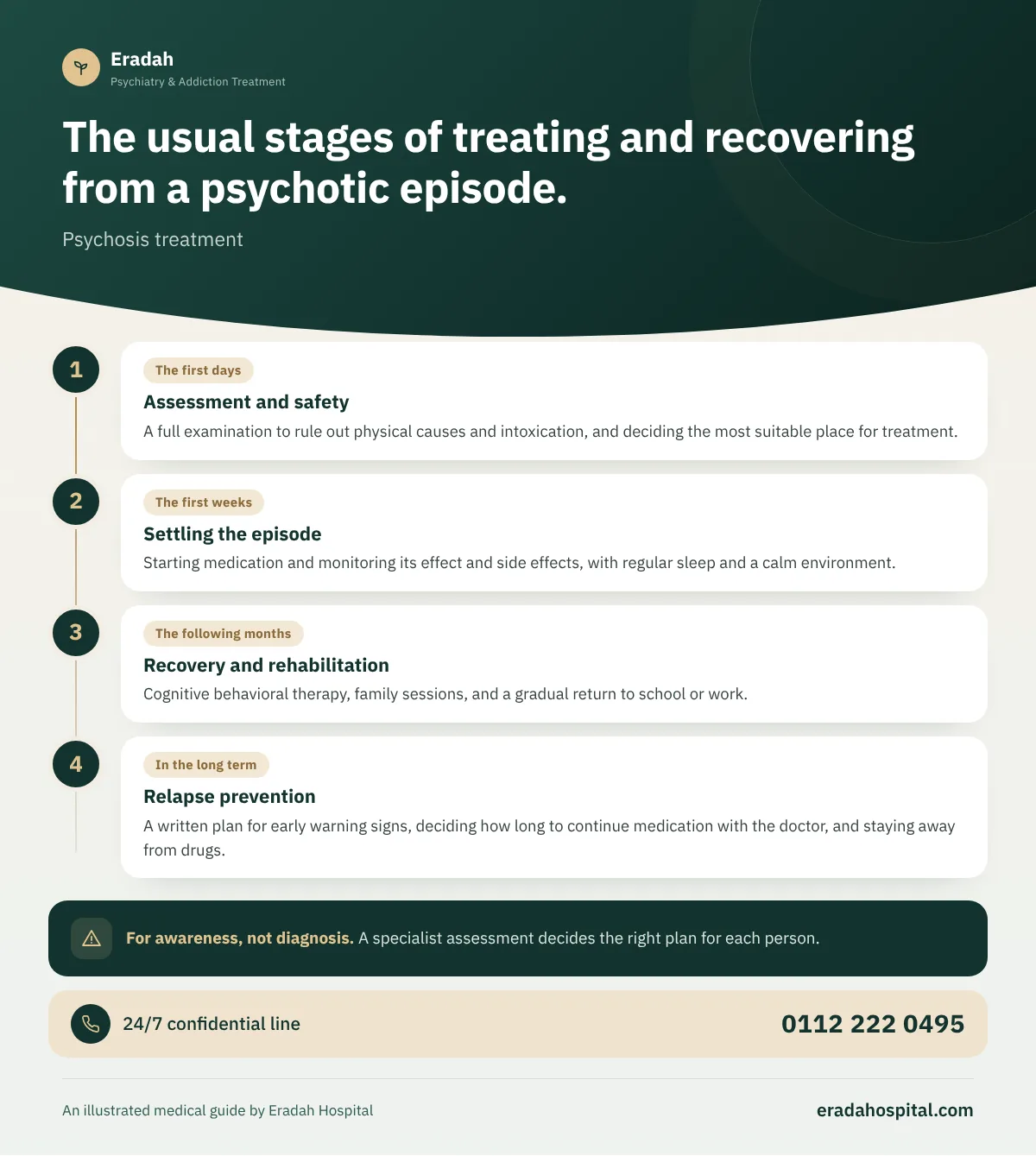
What are the stages of psychosis treatment?
- The first daysAssessment and safety
A full examination to rule out physical causes and intoxication, and deciding the most suitable place for treatment.
- The first weeksSettling the episode
Starting medication and monitoring its effect and side effects, with regular sleep and a calm environment.
- The following monthsRecovery and rehabilitation
Cognitive behavioral therapy, family sessions, and a gradual return to school or work.
- In the long termRelapse prevention
A written plan for early warning signs, deciding how long to continue medication with the doctor, and staying away from drugs.
Basic rules for dealing with the patient during treatment
What best keeps the patient's trust and keeps them in treatment: do not argue with the delusion or confirm it, speak to their fear and not their idea, speak calmly in short sentences in a home with little noise, and write down the signs that came before the previous episode, such as little sleep and isolation, so you can act early if they return. If they refuse to see the doctor, suggest it in terms of what troubles them, like insomnia or tension.
We explain what the family does before, during and after an episode in practical terms in the guide Dealing with a person who has psychosis: a family guide.
What if psychosis occurs together with substance use?
The UK's National Health Service notes that people with a history of psychosis are more prone to alcohol and drug problems, and that some use substances to calm symptoms and end up making them worse. Here, treating each problem on its own does not work; the patient needs a single plan that combines detox when needed, treatment of the psychosis and relapse prevention, as in a dual diagnosis program. If a substance is the direct cause, the details are on the substance-induced psychosis treatment page.
How long does psychosis treatment last? And how do we prevent relapse?
There is no single duration for everyone. According to the UK's National Health Service, some patients are advised to stay on medication for a long time, while others can reduce it gradually and then stop if symptoms clearly improve. NICE recommends monitoring for signs of relapse for at least two years after stopping antipsychotics.
What best protects against a return: sticking to the plan, regular sleep, staying away from cannabis and stimulants, follow-up sessions, and a family that knows the early warning signs. At Eradah the journey begins with a confidential consultation with a psychiatrist, then a plan that suits the case, whether in the outpatient clinic or residential treatment.
An acute psychotic episode or danger to self? Get help now
- Hearing voices that command them to harm themselves or others, or talk of death or suicide
- Severe agitation or threats toward those around them, or behavior that puts them in danger in the street or at home
- Complete refusal to eat or drink, often out of fear of poisoning
- Psychosis that appeared suddenly with fever, confusion, severe headache or seizures
- Hallucinations and suspicion after using a drug or after suddenly stopping alcohol
Do not leave them alone. Speak calmly in short sentences without arguing with their ideas, and quietly keep sharp objects and medication out of their reach without confronting them. Call ambulance (123) or take them to the nearest emergency department, and you can call the mental health support line 16328 (24 hours) for advice. If they are aggressive, do not stay alone with them in a closed space, and tell the medical team about any substance they have used.
Ambulance 123 Mental health support line 16328