Is psychosis the same as schizophrenia?
“The doctor said our son had a psychotic episode. Does that mean he has schizophrenia now?” This is one of the questions families ask most after a first episode, and the short answer is: no, not necessarily.
The relationship between the two can be compared to the relationship between a fever and pneumonia: a fever is a symptom that can come from many causes, and pneumonia is one of those causes. Likewise, psychosis is a group of symptoms and schizophrenia is one of the illnesses that cause them. This is why the UK's National Health Service (NHS) describes schizophrenia as “a type of psychosis,” which doctors classify within it, and not the other way around.
What is psychosis?
The U.S. National Institute of Mental Health (NIMH) defines psychosis as a group of symptoms affecting the mind, with some loss of contact with reality, making it hard for the person to tell what is real from what is not. Its most prominent symptoms are hallucinations, delusions, and disorganized speech and behavior.
More importantly, NIMH stresses that a person can go through psychosis and never be diagnosed with schizophrenia or any other disorder. The NHS and NIMH list among its causes: schizophrenia, bipolar disorder, severe depression, drug or alcohol use, the effects of some medications, sleep deprivation, trauma and stress, head injuries, medical illnesses such as brain tumors and dementia, and also childbirth. You can find the details in causes of psychosis.
What Is Schizophrenia?
Schizophrenia, according to the NHS, is a long-term mental health condition that causes a range of symptoms. The MSD Manuals describe it as combining hallucinations, delusions and disorganized speech and behavior with negative symptoms such as emotional blunting and reduced motivation, cognitive problems in thinking and problem solving, and a decline in social and occupational functioning. In other words, psychosis is part of the picture of schizophrenia, not the whole picture.
The World Health Organization says schizophrenia affects about 1 in 300 people worldwide. By contrast, NIMH estimates that 15 to 100 people per 100,000 develop psychosis each year, from all causes combined.
What is the difference between psychosis and schizophrenia in a table?
| Point of comparison | Psychosis | Schizophrenia |
|---|---|---|
| Definition | A group of symptoms: a partial loss of contact with reality | A specific chronic mental disorder |
| Causes | Many: mental illnesses, drugs, medications, medical illnesses, lack of sleep | An interplay of genetics, brain development and environment |
| Duration | May be hours, days or weeks depending on the cause | Signs persisting for at least 6 months for diagnosis |
| Symptoms | Hallucinations, delusions and disorganized thinking | Psychotic symptoms with negative and cognitive symptoms and a decline in functioning |
| Treatment | Treating the cause, and antipsychotics when needed | Long-term antipsychotics, psychotherapy and rehabilitation |
| Outlook | The episode may never recur if the cause is treated | Chronic, and at least a third of patients reach complete remission of symptoms |
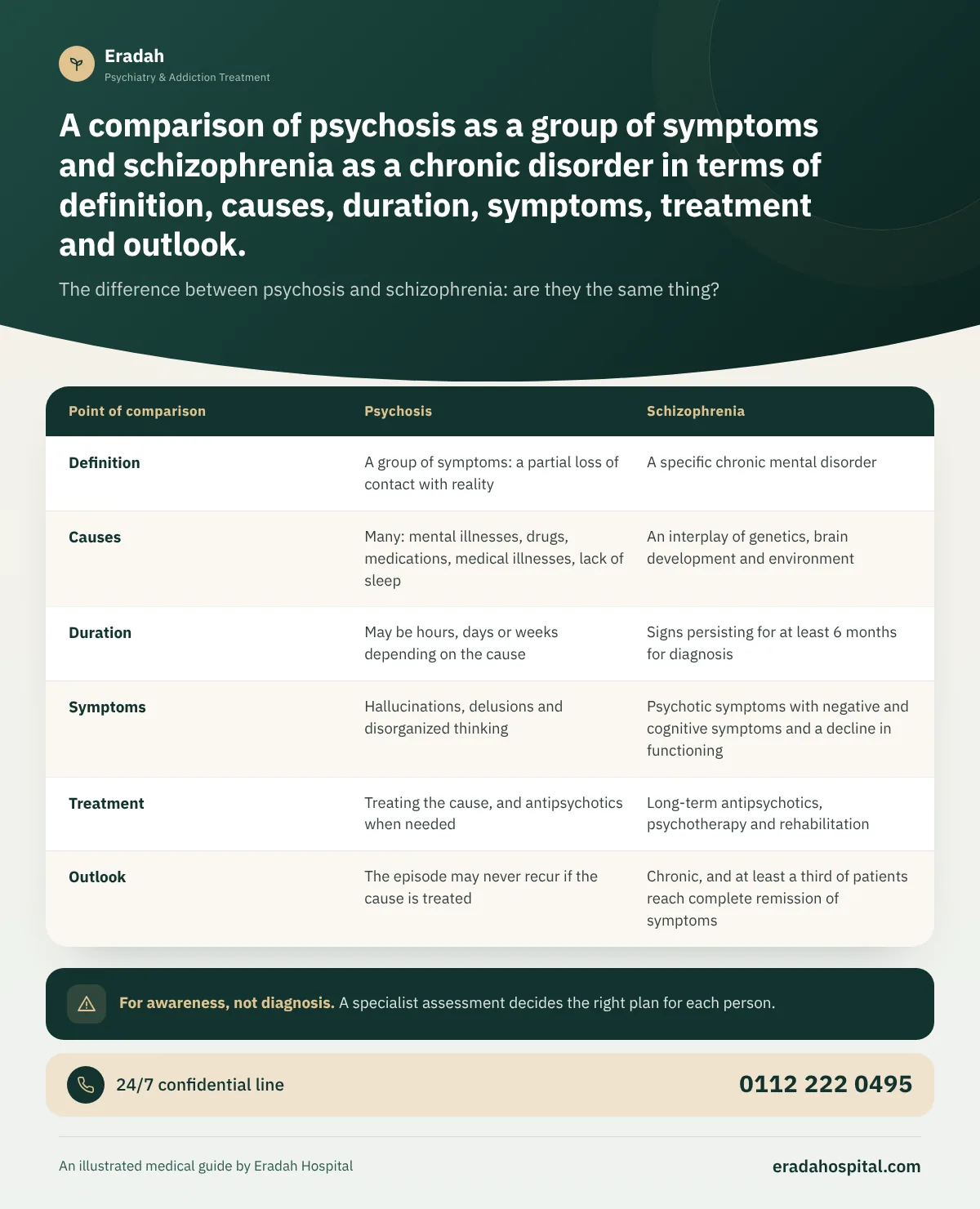
Duration makes the difference: how does the doctor decide the diagnosis?
Hallucinations or delusions appearing is not enough to diagnose schizophrenia; the doctor takes the duration and the context into account. According to the MSD Manuals pages on schizophrenia and related disorders, which rely on U.S. criteria:
- One day to less than a monthBrief psychotic disorder
Psychotic symptoms lasting at least a day and less than a month, after which the person returns to their previous level.
- One month to 6 monthsSchizophreniform disorder
Symptoms resembling schizophrenia but lasting less than the time required to diagnose it.
- 6 months or moreSchizophrenia
Signs of the illness persisting for at least 6 months, with a clear decline in work, relationships or self-care.
Before that, the doctor rules out physical causes and substance use through the medical history, examination and tests, and sometimes brain imaging. NIMH explains that schizophrenia is usually diagnosed after other causes of psychosis have been ruled out.
Does a first psychotic episode turn into schizophrenia?
Not always. An analysis published in the journal Schizophrenia Bulletin in 2016 pooled data on 14,484 patients with a first psychotic episode whom researchers followed for an average of 4.5 years, and found that the schizophrenia diagnosis was the most stable over time, while other diagnoses changed a great deal: brief psychotic disorder stayed the same in only about 56%, and schizophreniform disorder in about 29%, with the shift mostly toward schizophrenia.
In practical terms, this means the picture becomes clearer with follow-up. Some people who have a first episode recover and it does not recur, and NIMH notes that some who are treated early never have another episode. Others turn out later to have schizophrenia or bipolar disorder. This is why regular follow-up after a first episode matters even when the symptoms have disappeared.
Substance-induced psychosis: where does it fit?
Among the most common forms of psychosis in emergency departments are episodes that follow high-potency cannabis or stimulants such as shabu. This is psychosis caused by the substance, and it may go away when the substance clears, but in some cases it reveals a predisposition to schizophrenia. In the same analysis, the diagnosis of substance-induced psychosis stayed unchanged in only about 66%. Its details are in substance-induced psychosis.
Why does this difference matter to the family?
- Do not rush to judgment: a first episode is not a verdict of lifelong illness.
- Do not underestimate it either: every psychosis needs an urgent assessment, because early treatment means a better recovery.
- Follow-up reveals the diagnosis: stay with the doctor even after improvement.
- Stay away from drugs: they are among the strongest factors that turn a passing episode into a longer course.
At Eradah you can get a free, confidential first consultation to assess the episode and its causes, with residential treatment for men at the psychiatric hospital when needed, and outpatient follow-up afterward. You can find the options in psychosis treatment.
An acute psychotic episode, or danger to the person or others? Get help now
- Voices commanding them to harm themselves or others, or acting on them
- Severe agitation, or threats toward someone they believe is plotting against them
- Refusing food and drink for days, or neglect that threatens their health
- Talk of death or suicide, or saying goodbye to family
- Confusion, fever and stiffness after substance use or after starting a new medication
Speak calmly and in short sentences, do not argue with their ideas, and give them space without cornering them. Quietly remove sharp objects and medications without confrontation. Call an ambulance on 123 or go to the nearest emergency room, and if they talk about death, do not leave them alone, and contact the mental health support line 16328, available around the clock.
Ambulance 123 Mental health support line 16328