Does psychosis have a single cause?
When a family faces a first psychotic episode, its first question is: “What suddenly happened to him?” The honest answer is that psychosis rarely has a single cause. NIMH describes it as the product of a complex mix of genetic predisposition, differences in brain development, and exposure to stress or trauma, and it can appear as a symptom of a mental or physical illness, or as the effect of a substance, a medication or lack of sleep.
It helps here to distinguish between predisposition and a trigger. Predisposition makes the brain more susceptible to psychosis, and the trigger sets off the episode at a particular moment. Two people can go through the same experience, such as sleepless nights or cannabis use, and one has an episode while the other does not.
Which mental illnesses can involve psychosis?
The UK's National Health Service notes that psychosis can be part of several mental health conditions, and that the cause affects the shape of the episode itself:
| The situation | What the psychosis usually looks like |
|---|---|
| Schizophrenia | Auditory hallucinations and persecutory delusions, with symptoms that last a long time |
| Bipolar disorder | Psychosis within a manic episode, where grandiose delusions are more common |
| Major depression | Delusions consistent with the low mood, such as guilt, illness or persecution |
| Postpartum | A sudden episode in the first weeks, more likely in women with a previous mental disorder |
| Severe stress and acute anxiety | Can set off an episode in some people, especially when there is a prior predisposition |
The detailed classification of these disorders and their types belongs on the psychotic disorders page.
Do drugs and alcohol cause psychosis?
Yes. The UK's National Health Service notes that an episode can happen during intoxication with a substance, after heavy drinking, or on sudden stopping after long-term use. The substances it lists include cocaine, amphetamine, methamphetamine (shabu), ecstasy, cannabis, LSD, magic mushrooms and ketamine.
Cannabis gets special attention because it is the most widely used. In the EU-GEI study, which included 901 patients with a first psychotic episode and 1,237 people from the general population at 11 sites, daily cannabis use was linked to about 3.2 times the likelihood of a psychotic disorder compared with people who had never used it, rising to 4.8 times with daily use of high-potency types. Assuming the relationship is causal, the researchers estimated that the absence of high-potency cannabis would have prevented about 12% of first episodes across all the sites, about 30% in London and 50% in Amsterdam.
When a substance is the direct cause of the episode, doctors call it substance-induced psychosis, and we devote a separate series to it. When substance use coexists with an independent psychotic illness, the details are on the schizophrenia and addiction page.
What are the medical and medication-related causes of psychosis?
Not all psychosis begins in the mind. The UK's National Health Service lists physical conditions known to set off psychotic episodes in some people, including:
- Brain and nervous system diseases: Alzheimer's, Parkinson's, multiple sclerosis, brain tumors and head injuries.
- Infections: HIV, malaria and syphilis, and a sudden high fever.
- Other conditions: low blood sugar and lupus.
- Medications: psychosis rarely appears as a side effect of some medications or with an overdose of them.
What happens in the brain during psychosis?
The UK's National Health Service notes that psychosis may be linked to increased activity of certain neurotransmitters, chiefly dopamine. Among the strongest evidence is that medications that reduce the effect of dopamine reduce psychosis symptoms. Excess dopamine in some pathways is thought to make the brain give “too much importance” to ordinary things, so a passing sound or a glance seems like a deliberate message.
This partly explains why stimulants that raise dopamine are linked to episodes of suspicion and hallucinations. But dopamine is not the whole story; research also points to brain networks and other neurotransmitters, and the picture is still being studied.
What factors raise the risk of psychosis?
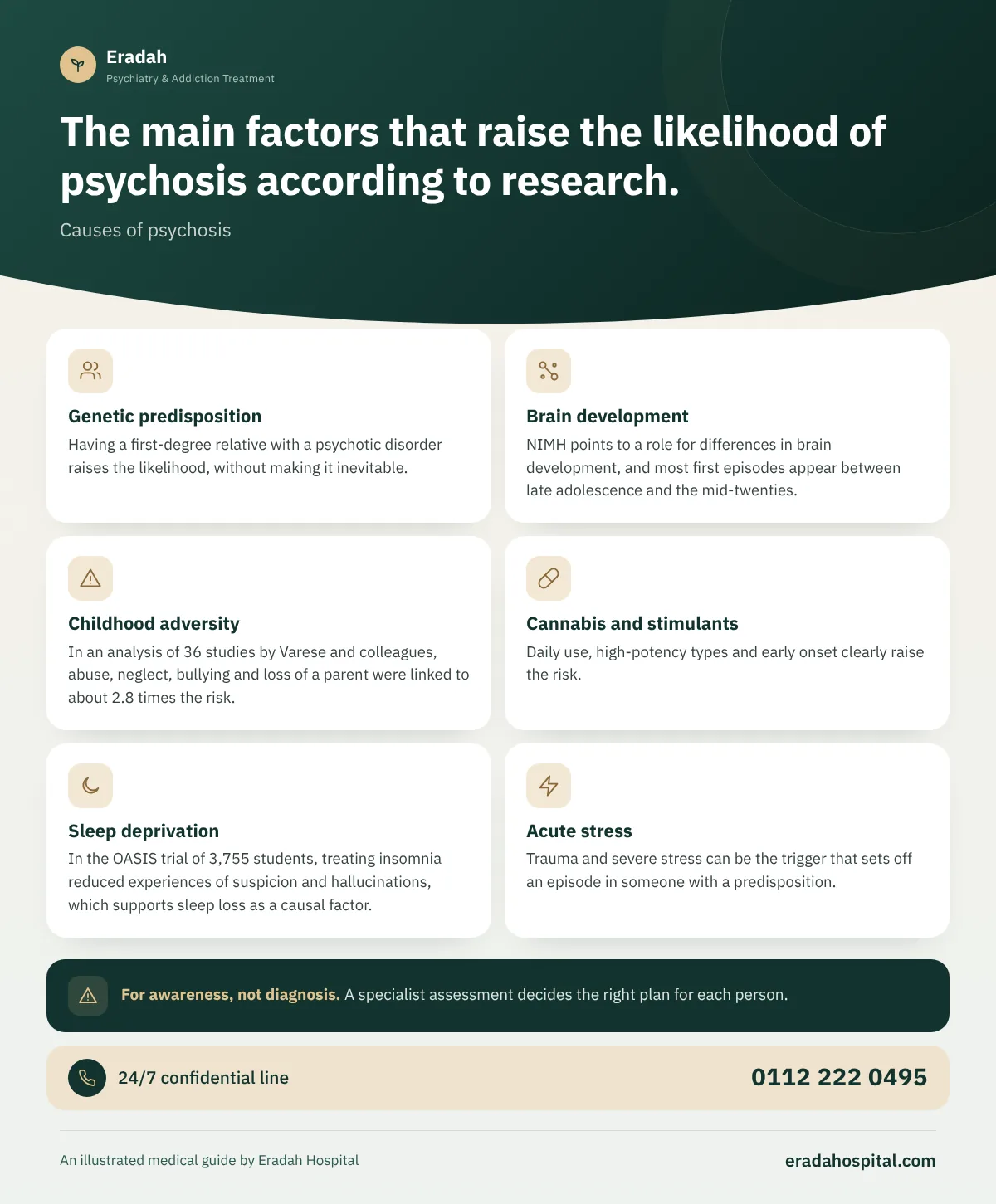
Having a first-degree relative with a psychotic disorder raises the likelihood, without making it inevitable.
NIMH points to a role for differences in brain development, and most first episodes appear between late adolescence and the mid-twenties.
In an analysis of 36 studies by Varese and colleagues, abuse, neglect, bullying and loss of a parent were linked to about 2.8 times the risk.
Daily use, high-potency types and early onset clearly raise the risk.
In the OASIS trial of 3,755 students, treating insomnia reduced experiences of suspicion and hallucinations, which supports sleep loss as a causal factor.
Trauma and severe stress can be the trigger that sets off an episode in someone with a predisposition.
Sources: NIMH; Varese and colleagues (Schizophrenia Bulletin, 2012); Freeman and colleagues, the OASIS trial (Lancet Psychiatry, 2017). The figures come from studies abroad and describe an association at the group level, not the fate of any individual.
How does the doctor determine the cause of a psychotic episode?
NIMH says that a diagnosis of a mental illness such as schizophrenia is usually made after other causes have been ruled out. This is why a good assessment follows a structured series of steps:
- A detailed medical history: when the symptoms began, whether early signs came before them, and whether there are mental disorders in the family.
- Direct questions about substances: the type, the amount and the last time, and any sudden stopping of alcohol or sedatives, with a drug test when needed.
- A review of current medications and any medication started recently.
- A physical examination and tests to look for infection, a blood sugar disturbance or other causes.
- Brain investigations such as imaging or an EEG when the picture suggests a neurological cause.
The family's honesty helps a great deal at this stage; hiding substance use for fear of scandal can lead to a wrong diagnosis and longer treatment.
Can the risk of psychosis be reduced?
Genetics cannot be changed, but some factors are in our hands, especially for someone with an affected relative or a previous episode:
- Staying completely away from cannabis, synthetic cannabinoids and stimulants, especially in adolescence.
- Protecting sleep and treating chronic insomnia early.
- Seeking psychological support after trauma instead of keeping it to yourself.
- Not ignoring early warning signs, because early assessment shortens the road to psychosis treatment.
An acute psychotic episode or danger to self? Get help now
- Hearing voices that command them to harm themselves or others, or talk of death or suicide
- Severe agitation or threats toward those around them, or behavior that puts them in danger in the street or at home
- Complete refusal to eat or drink, often out of fear of poisoning
- Psychosis that appeared suddenly with fever, confusion, severe headache or seizures
- Hallucinations and suspicion after using a drug or after suddenly stopping alcohol
Do not leave them alone. Speak calmly in short sentences without arguing with their ideas, and quietly keep sharp objects and medication out of their reach without confronting them. Call ambulance (123) or take them to the nearest emergency department, and you can call the mental health support line 16328 (24 hours) for advice. If they are aggressive, do not stay alone with them in a closed space, and tell the medical team about any substance they have used.
Ambulance 123 Mental health support line 16328