Where do you start in dealing with a person who has psychosis?
“For a week he's stopped sleeping, and he keeps saying the phone is being watched and that people want to hurt him, and when we tried to calm him down he shouted at us.” This is how many families describe the moment an episode begins. The first rule in dealing with a person who has psychosis is that what they are living through seems completely real to them, and that their fear is genuine even if its cause is not real.
Psychosis, as the UK's National Health Service (NHS) describes it, is a condition in which a person loses some of their contact with reality, hearing or seeing things others do not perceive, or becoming convinced of ideas no one else shares. The illness itself and its causes are covered in the psychosis guide. Here we focus on the practical questions families ask: What do we say? What do we do? And when do we ask for help?
When you notice the first signs: how do you start the conversation?
NIMH notes that behavior often changes before outright psychosis appears, and among the early signs it lists are: suspicion and distrust of others, withdrawal, disturbed sleep, neglect of personal hygiene, difficulty thinking clearly, and a sudden decline in school or work. It advises contacting a professional if these changes intensify or do not go away.
At this stage, talking is easier than it will be later. Choose a quiet time and a private place, and begin with what you have noticed, not with what he is “suffering from”:
- “I've noticed you haven't been sleeping well these days, and that worries me.”
- “You seem upset and uneasy. Would you like to talk?”
- “What do you think about seeing a doctor who can help with your sleep and the stress?”
Avoid words like “you've gone crazy” or “you have a mental illness” at first; the goal is for him to accept help, not to accept a diagnosis.
How do you act during a psychotic episode?
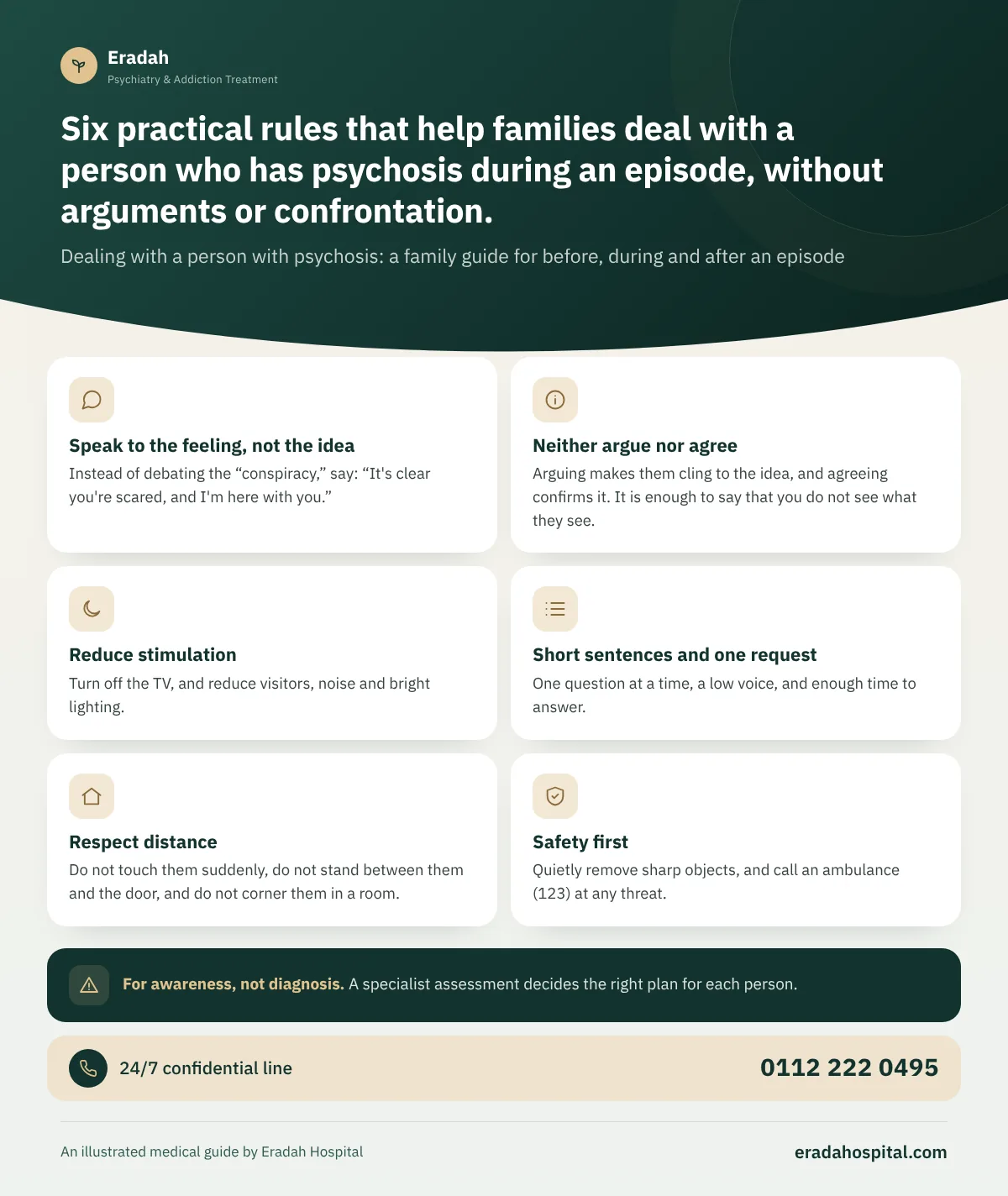
In an acute episode the person is frightened and distracted, and any extra pressure can turn fear into anger. These six rules are what you need to remember:
Instead of debating the “conspiracy,” say: “It's clear you're scared, and I'm here with you.”
Arguing makes them cling to the idea, and agreeing confirms it. It is enough to say that you do not see what they see.
Turn off the TV, and reduce visitors, noise and bright lighting.
One question at a time, a low voice, and enough time to answer.
Do not touch them suddenly, do not stand between them and the door, and do not corner them in a room.
Quietly remove sharp objects, and call an ambulance (123) at any threat.
NIMH notes that a person in a psychotic episode may sometimes act unpredictably, may harm themselves or become a threat to others, and that the risk of violence and suicide falls with treatment. So the purpose of staying calm is not to postpone the doctor, but to reach one with the least possible conflict.
How do you persuade a person with psychosis to see a doctor?
The NHS recommends seeing a doctor right away when psychosis symptoms appear, because early treatment is more effective. If you are worried about someone else, you can contact their doctor yourself, take them to the nearest emergency room if they agree, or call an ambulance if the symptoms are severe and put them in danger.
- Tie the visit to what troubles them: insomnia, exhaustion, or the fear they are living with, not the “madness” others see.
- Offer a choice, not an order: “Would you like to go today or tomorrow morning?”
- Take someone they trust: a close friend or a calm relative may succeed where a father or mother fails.
- Do not trick them: taking them “for a drive” and then leaving them at the hospital destroys the trust you will need later.
The family can also start the consultation alone to learn how to persuade them, as the guide to convincing a patient to accept treatment explains. When refusal comes together with serious danger, Egyptian law regulates admission without the patient's consent, and we explain this in involuntary treatment.
What if the psychosis follows drug use?
The NHS lists drug use and alcohol addiction among the things that can trigger an episode of psychosis, and notes that people who have experienced psychosis are more prone to substance use problems and that substances can make symptoms worse. Among the most common things we see in Egypt are episodes after shabu or high-potency hashish.
- Do not raise the subject of drug use during the episode; confronting them now only increases the agitation.
- Tell the doctor honestly everything you know about the substances they used; this changes the assessment and the treatment.
- Seizures, loss of consciousness, a very high temperature or difficulty breathing are emergencies that call for an ambulance (123) right away.
The details of this type and how it differs from others are on the substance-induced psychosis page.
After the episode ends: weeks that call for patience
Many families think the crisis is over as soon as the hallucinations disappear, then are surprised by a son who is quieter than usual, sleeps a lot, thinks slowly and seems sad. This is common after an episode, and may be related to the illness itself or to the medication early on. It deserves telling the doctor, not blame.
There is also something that deserves serious attention: a systematic review published in the journal Schizophrenia Research in 2018 pooled the results of 13 studies covering 3,002 patients and found that depressive symptoms during a first psychotic episode were linked to a higher risk of suicidal behavior later. So do not treat sadness after an episode as “fussiness,” and see the suicidal thoughts page to learn how to ask and how to respond.
- A gradual return to school or work, with fewer hours at first.
- Small daily tasks they can complete, and praise for every step.
- Fixed times for sleep, meals and medication.
- An honest conversation with the doctor about drowsiness, weight gain or any side effect that bothers them.
How do you prevent the next episode?
NIMH says that some people who receive treatment early never go through another episode, and that for others recovery means a productive life even if symptoms occasionally return. The NHS cautions against suddenly stopping prescribed medication because this can bring the symptoms back. The decision to continue or to taper gradually belongs to the doctor alone, and you should not start or stop any medication without a doctor. Learn about the options in psychosis treatment.
While the person is stable, write down together a list of their own warning signs that came before the episode, such as staying up late, isolation or suspicion, and agree on what you will do if they return: call the doctor within days, rather than waiting for a full episode. Staying away from drugs and alcohol is an essential part of this plan.
The family is a partner in treatment, so who looks after the family?
The UK's NICE guidelines recommend offering family intervention to the families of people with psychosis, and research has pointed for decades to an atmosphere of excessive criticism and emotional intensity at home being linked to relapse. A pooled analysis of 27 studies published in Archives of General Psychiatry in 1998 concluded that this atmosphere is a strong predictor of relapse. This does not mean the family is the cause of the illness, but that it is able to protect its course.
And do not forget yourself: share the responsibility, take breaks and ask for support. Eradah's family program offers sessions on understanding and communication, along with a free, confidential first consultation, and residential treatment for men at the psychiatric hospital when the episode is severe or comes with substance use.
An acute psychotic episode, or danger to the person or others? Get help now
- Voices commanding them to harm themselves or others, or acting on them
- Severe agitation, or threats toward someone they believe is plotting against them
- Refusing food and drink for days, or neglect that threatens their health
- Talk of death or suicide, or saying goodbye to family
- Confusion, fever and stiffness after substance use or after starting a new medication
Speak calmly and in short sentences, do not argue with their ideas, and give them space without cornering them. Quietly remove sharp objects and medications without confrontation. Call an ambulance on 123 or go to the nearest emergency room, and if they talk about death, do not leave them alone, and contact the mental health support line 16328, available around the clock.
Ambulance 123 Mental health support line 16328