Does social anxiety have a single cause?
Scientists describe social anxiety as the product of a “predisposition” a person is born with or acquires early, meeting “stressors” and experiences in childhood and adolescence. Usually neither is enough alone, which is why one brother may develop social anxiety while his brother, raised in the same home, does not.
The purpose of understanding causes is to know why the fear persists and where to intervene to break its cycle, not to look for someone to blame.
Does genetics play a role in social anxiety?
Yes, to a moderate degree. Family and twin studies show that social anxiety is more common among first-degree relatives of people who have it, and that part of this similarity is genetic. But researchers stress that the effect of genes depends heavily on the environment, and that there is no single “social anxiety gene.”
And part of what looks genetic is actually “learning”: a child who sees his father avoid people and worry about what they say may pick up this pattern by imitation, even if he did not inherit it genetically.
How is inborn temperament in childhood related to social anxiety?
Some children are born with a temperament researchers call “behavioral inhibition”: a cautious child who stops and watches before approaching anything new, and who is more upset by strangers and unfamiliar places than his peers. These children are more likely to develop social anxiety later, though this does not mean all of them will.
How this temperament is handled makes a difference: calm encouragement to try things protects the child, while overprotection or mocking his shyness increases the risk.
What is the role of the brain and neurotransmitters in social anxiety?
The brain’s alarm center, which shows overactivity in people with social anxiety when they face critical faces or evaluative situations.
A neurotransmitter involved in regulating anxiety and mood, and affected by the medications used for this disorder.
Linked to the sense of reward from social contact, and some studies point to differences in its system in people with social anxiety.
A relative weakness in the frontal cortex’s ability to “calm” the alarm system when the situation turns out to be safe.
These findings do not mean the brain of a person with social anxiety is “broken,” but that their alarm system is more sensitive than necessary to social situations, a sensitivity that can be reset through training.
How do painful experiences and bullying contribute to social anxiety?
Many people with social anxiety remember a specific incident as the starting point: the class laughing when they made a mistake reading, a public reprimand from a teacher, a hurtful comment about their looks or voice, or repeated bullying at school or online. These experiences plant a conviction that people are dangerous and that making a mistake in front of them is a catastrophe.
- Bullying and repeated ridicule at school or among relatives.
- Public embarrassment in an important situation, especially in adolescence.
- Social rejection or exclusion from peer groups.
- Constant criticism from parents or teachers about appearance or performance.
- Speech or appearance difficulties such as stuttering or visible skin conditions, when they are met with comments.
Is parenting one of the causes of social anxiety?
Parenting alone does not “create” social anxiety, but it can raise or lower susceptibility to it. Patterns linked to it in studies include:
| Pattern | Possible effect | The healthier alternative |
|---|---|---|
| Overprotection | Deprives the child of experiencing situations and learning that he can handle them | Supporting him to try, while staying close when needed |
| Criticism and ridicule | Reinforces the idea that he is constantly being judged | Calm correction in private |
| Focusing on “what people will say” | Makes others’ opinion the first measure of worth | Focusing on his values and effort, not on society’s view |
| Social isolation of the family | Few chances to learn communication skills | Regular visits and activities with peers |
| Visible parental anxiety | The child learns fear by imitation | The parent works on his own anxiety and models facing situations |
In our culture, the question “What will people say?” comes up very often in upbringing. Its motives are understandable, but overusing it may raise a child with excessive sensitivity to others’ judgment.
How do patterns of thinking and avoidance keep fear going?
Even after the first cause has disappeared, social anxiety continues through a closed cycle explained by the cognitive model developed by the researchers Clark and Wells:
- 1Expecting danger
Before the situation the person thinks: “It’ll show that I’m nervous, and they’ll think I’m weird.”
- 2Self-focused attention
In the situation he monitors himself instead of others, and feels every tremor and blush magnified.
- 3Safety behaviors
He avoids eye contact and speaks little, so he really does come across as reserved or cold.
- 4Post-event review
He replays the situation and focuses on its worst moments, confirming to himself that he “failed.”
- 5Greater fear
His conviction that situations are dangerous grows, so he avoids more next time.
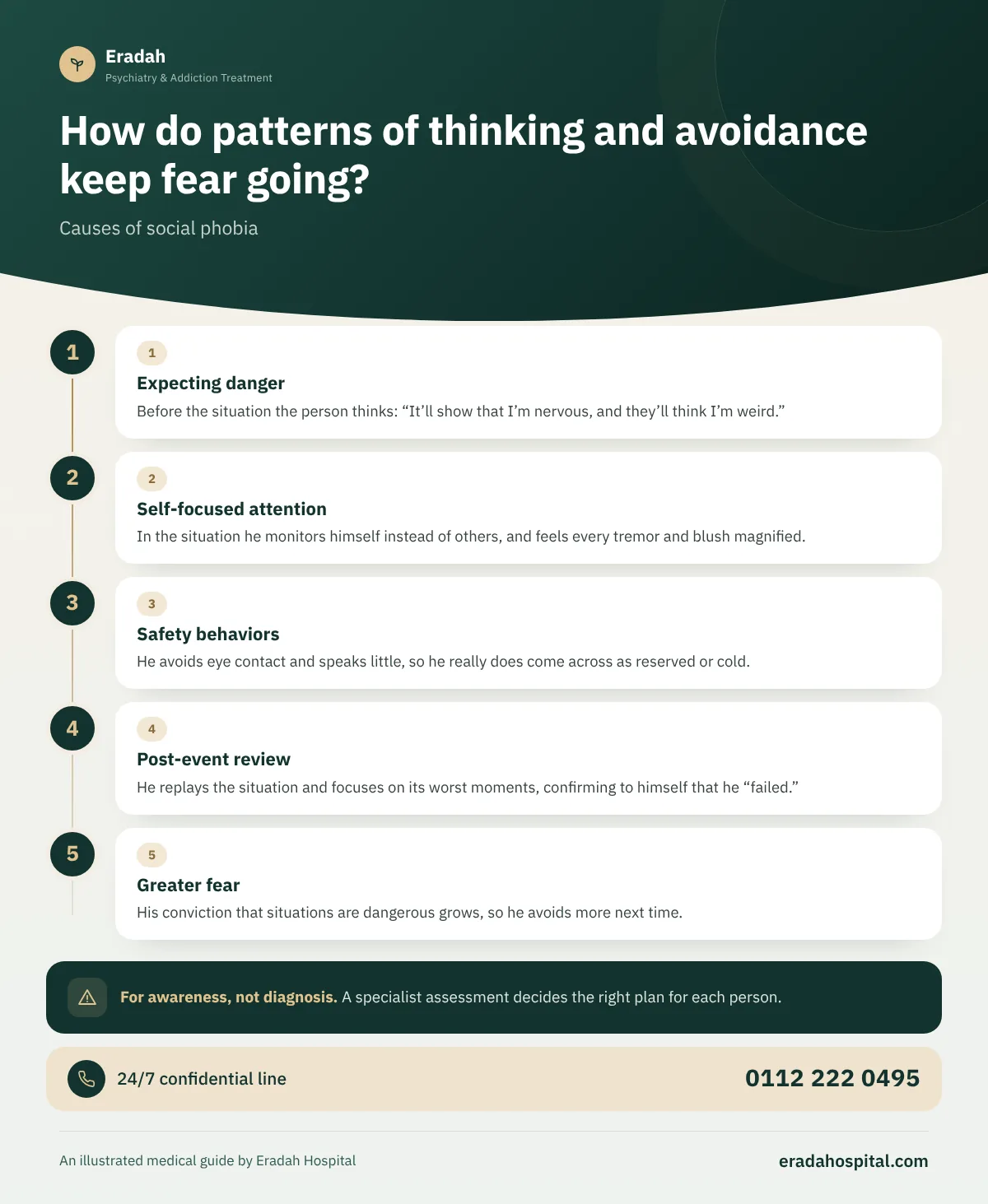
This cycle explains why many people with social anxiety do not improve even though they attend social situations: they attend while “hiding” behind safety behaviors, so the brain never learns that the situation was safe.
What is the difference between a cause and a trigger in social anxiety?
A cause is what makes a person vulnerable to social anxiety in the first place, such as genetic predisposition or early experiences. A trigger is what brings it out or intensifies it at a particular time: moving to a new school or university, a job that requires presentations and meetings, an engagement and the family gatherings that come with it, or emigrating and living among strangers.
Long periods of isolation, such as staying away from people for months or working from home for extended periods, may reveal social anxiety that was mild and hidden, because social skills weaken when unused and the fear of returning grows.
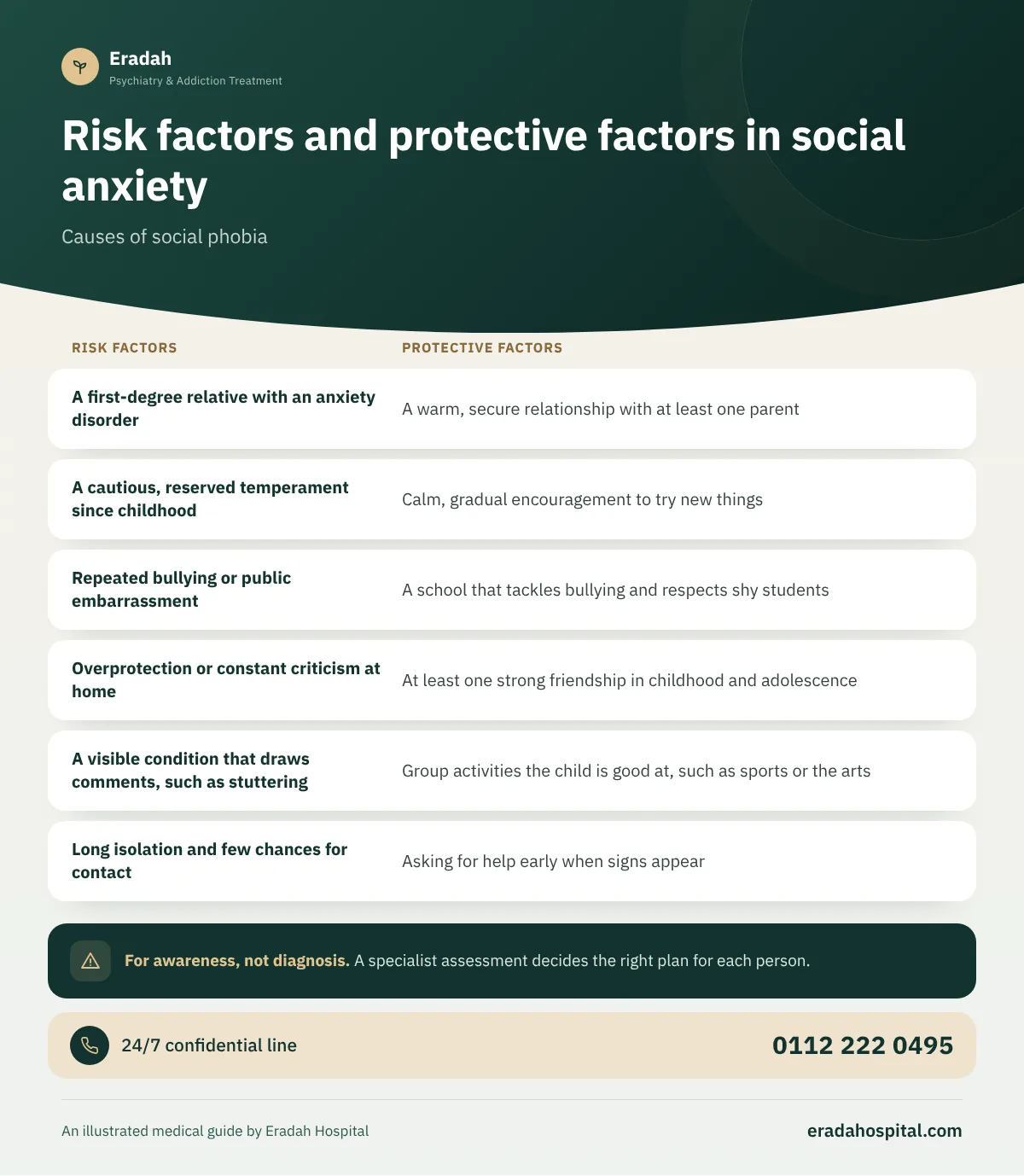
What are the risk factors and protective factors for social anxiety?
| Risk factors | Protective factors |
|---|---|
| A first-degree relative with an anxiety disorder | A warm, secure relationship with at least one parent |
| A cautious, reserved temperament since childhood | Calm, gradual encouragement to try new things |
| Repeated bullying or public embarrassment | A school that tackles bullying and respects shy students |
| Overprotection or constant criticism at home | At least one strong friendship in childhood and adolescence |
| A visible condition that draws comments, such as stuttering | Group activities the child is good at, such as sports or the arts |
| Long isolation and few chances for contact | Asking for help early when signs appear |
Myths about the causes of social anxiety
- “It is caused by weak faith or a weak personality”: social anxiety is a disorder with biological and psychological foundations, and it affects strong, religious, and successful people.
- “Parents are always to blame”: upbringing is one factor among several, and many people with social anxiety grew up in supportive families.
- “It is caused only by too little socializing”: limited socializing may be more a result of the fear than a cause of it.
- “Social media is the cause”: it may increase comparison and fear of comments, but it is not a sole cause of the disorder.
Most importantly, knowing the causes opens the door to hope: the factors that keep fear going, such as patterns of thinking and avoidance, are exactly what treatment targets.