Why is social anxiety not a minor problem?
Because its effect is cumulative: every avoided situation is a lost opportunity, and over the years those lost opportunities add up to a life path very different from the one that might have been.
Medical reviews describe social anxiety as mostly a chronic disorder if left untreated, and most people who have it experience another mental health condition at some point, which multiplies its impact.
How does social anxiety harm studies and education?
- Falling grades: not because of weak abilities, but because of avoiding participation, oral exams and presentations.
- Frequent absence: especially from lectures and activities that involve direct interaction.
- Choosing a field below one's abilities: avoiding colleges or tracks that require communication or interviews.
- Dropping out: some people withdraw from education altogether when daily confrontation becomes more than they can bear.
- Missing scholarships and activities: those that require an interview, a presentation or teamwork.
How does social anxiety affect work and career?
At work the harm is often silent: a capable person turns down a promotion because it means running meetings, avoids job interviews and stays in a role that does not match their qualifications, or cannot ask for a raise or leave they are entitled to. Their silence in meetings may be read as lack of interest, so their evaluation suffers despite good work.
How does social anxiety affect relationships and marriage?
Relationships are built through communication, and social anxiety strikes communication at its root. A person with it may live without close friends even though they want them, postpone an engagement or refuse introductions, and feel helpless at family occasions, which are a core part of Egyptian social life.
After marriage, the burden of dealing with the outside world may fall entirely on the partner: talking with neighbors, following up with the school, handling government paperwork and making visits. Over time this can cause tension and arguments, especially if the partner does not understand that the cause is a disorder, not laziness.
What are the psychological complications of untreated social anxiety?
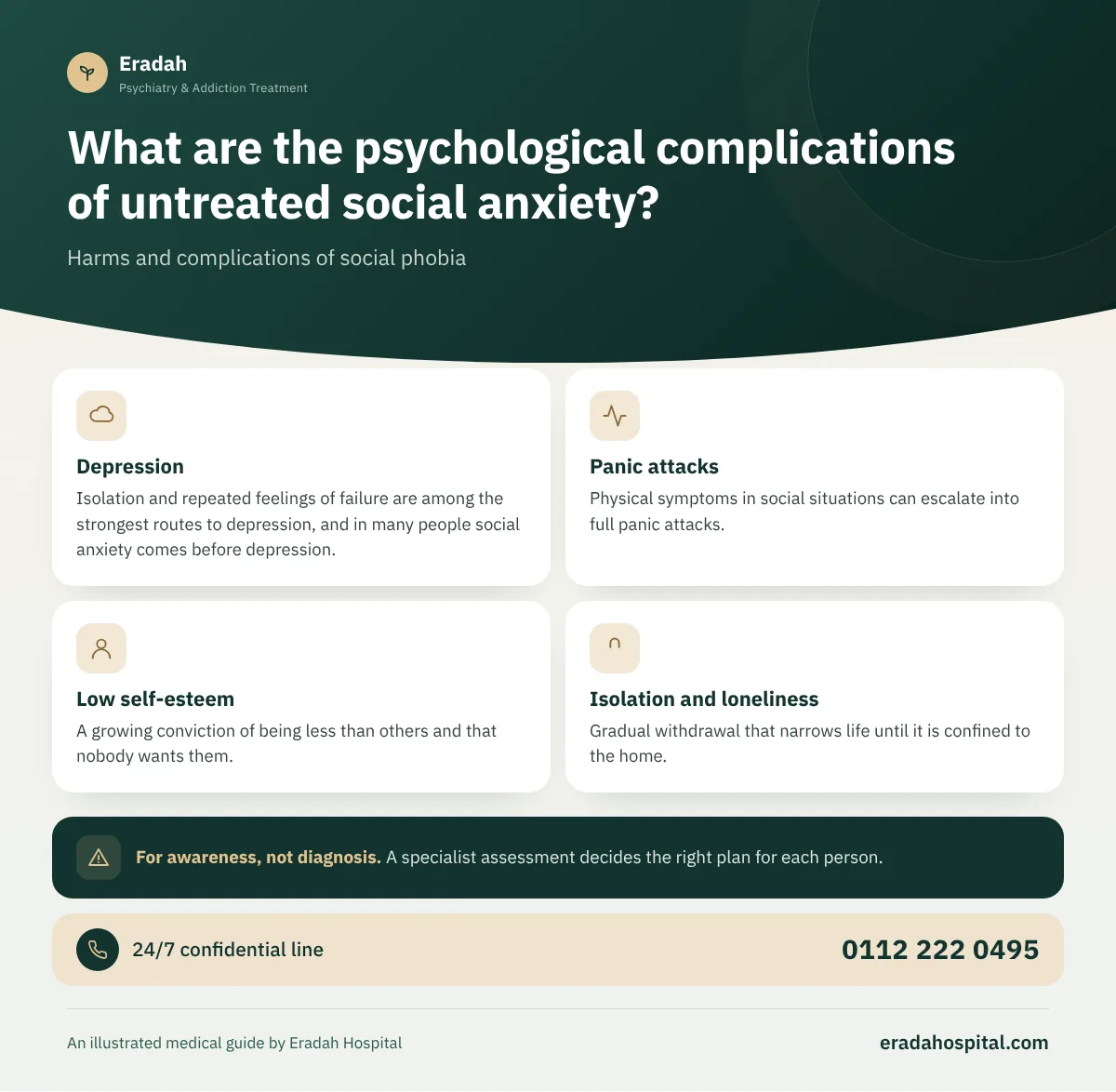
Isolation and repeated feelings of failure are among the strongest routes to depression, and in many people social anxiety comes before depression.
Physical symptoms in social situations can escalate into full panic attacks.
A growing conviction of being less than others and that nobody wants them.
Gradual withdrawal that narrows life until it is confined to the home.
Scientific reviews indicate that social anxiety predicts the later onset of depression, and that having both disorders makes recovery slower. This is why treating social anxiety early also helps prevent depression.
Does social anxiety lead to alcohol and drug use?
This is one of its most dangerous complications. A person discovers that a substance temporarily eases their fear, so they start using it before every situation, and then this “help” turns into dependence. The substances most linked to this are alcohol, sedatives, hashish and medicines such as pregabalin.
Does social anxiety increase the risk of suicidal thoughts?
It can in some people, especially when long isolation is combined with depression or dependence on alcohol or sedatives, or after a harsh experience of rejection or bullying. In this case, suicidal thoughts are a sign of severe pain and an urgent need for help, not of weakness or a wish for attention.
The important news is that these thoughts respond to treatment, and that talking about them openly with a specialist or a trusted person reduces their danger rather than increasing it. If you are having thoughts of harming yourself or of death, call the mental health support line 16328, available around the clock, or ambulance (123) if the danger is immediate.
Does social anxiety have physical harms?
The phobia itself does not damage the body's organs, but chronic, repeated tension leaves its mark: disturbed sleep before events, headaches and muscle tension, and stomach and bowel problems linked to anxiety. Avoiding people can also extend to avoiding doctor visits or tests, which delays treatment of other health problems.
How are family members and children affected?
- Extra burden on the family: a mother, husband or wife takes on everything that requires communication on the person's behalf.
- Parents' worry about the future: especially when a son struggles at school or refuses to work or marry.
- Passing the pattern to children: a child who sees their parents avoid people may learn the same avoidance.
- Financial pressure: when the person stays in a lower-paid job, or without work, for long periods.
What happens to social anxiety if it is neglected for years?
- AdolescenceAvoidance begins
Withdrawal from class participation and activities, with anxiety that gradually grows.
- UniversityNarrowing choices
Choosing a field or path that avoids interaction, and few friendships.
- Starting workLost opportunities
Avoiding interviews and promotions, and sometimes the start of reliance on a sedative substance.
- Later yearsComplications pile up
Isolation and depression or possible addiction, and a feeling that life has “passed me by”.
This path is not inevitable, but it is common enough that social anxiety should be taken seriously from the start. Doctors notice that many patients seek help only after a second complication appears, such as depression or dependence on alcohol, and they come for treatment of that, and the long-standing social anxiety is discovered behind it. Had the anxiety been recognized at the beginning, the road would have been much shorter.
Can the complications of social anxiety be avoided?
Yes, and the best prevention is early intervention. Treatment in adolescence or early adulthood prevents lost opportunities from piling up and lowers the chance of depression and addiction. Even people who have struggled for many years can recover much of what they missed once they start treatment.
- Do not wait for them to “grow out of it”; consult a specialist when avoidance starts to disrupt life.
- Watch for any repeated turning to alcohol or sedatives before social situations.
- Do not ignore persistent sadness or loss of hope that comes with isolation.
- Support small steps toward facing fears instead of pressuring or scolding.
Suicidal thoughts or danger to self? Get help now
- Talking about wanting to die or being a "burden" on those around them
- Severe hopelessness and a feeling that there is no way out of isolation and fear
- Complete withdrawal from people and refusing to leave the room for days
- Suddenly saying goodbye to family or getting rid of treasured belongings
- Heavy drinking or taking sedatives along with talk of the end
Stay with the person and don't leave them alone, and listen without blame or dismissing their feelings. Call an ambulance on 123 or take them to the nearest emergency room if danger is imminent, contact the mental health support line on 16328, and move medications and dangerous objects out of their reach.
Ambulance 123 Mental health support line 16328