What are the main symptoms of social anxiety?
All the symptoms of social anxiety revolve around one core: the fear of being seen negatively by others. From this fear branch worrying thoughts, physical reactions, and behaviors aimed at escaping or hiding.
Not every symptom appears in every person; some people mainly struggle with blushing and shaking, others with anticipatory anxiety and overthinking, and others with silent avoidance that nobody notices.
What are the psychological and cognitive symptoms of social anxiety?
- Intense fear of negative judgment: of seeming stupid, boring, anxious or inappropriate.
- Expecting embarrassment: an inner certainty that something shameful will inevitably happen.
- Anticipatory anxiety: starting days or weeks before the situation, such as worrying about an upcoming wedding from the moment the invitation arrives.
- Excessive self-focus: monitoring one's voice, face and hands throughout the situation instead of focusing on the conversation.
- Mind reading: being convinced that others notice their nervousness and think badly of them.
- Post-event rumination: replaying every word they said and blaming themselves for small details.
- Low self-esteem: a general feeling of being socially less than others.
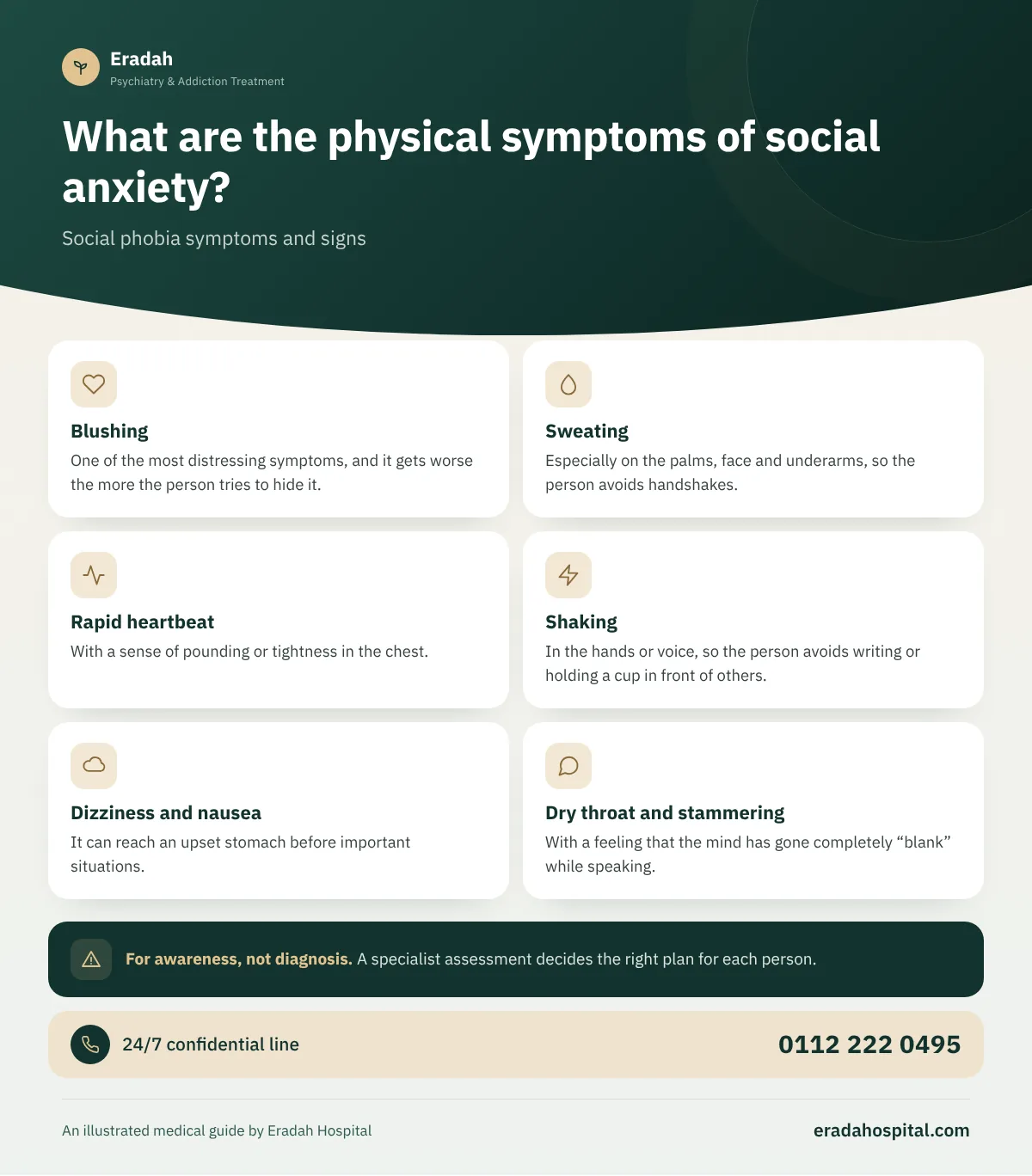
What are the physical symptoms of social anxiety?
The body responds to social fear as it does to any danger, releasing stress hormones and producing signs the person feels intensely, and may even become afraid of those signs themselves:
One of the most distressing symptoms, and it gets worse the more the person tries to hide it.
Especially on the palms, face and underarms, so the person avoids handshakes.
With a sense of pounding or tightness in the chest.
In the hands or voice, so the person avoids writing or holding a cup in front of others.
It can reach an upset stomach before important situations.
With a feeling that the mind has gone completely “blank” while speaking.
What behaviors reveal social anxiety?
Behavior is what others see of social anxiety, and it comes in two kinds: open avoidance of situations, and hidden “safety behaviors” the person uses to get through a situation without anyone noticing:
| Type | Common examples |
|---|---|
| Open avoidance | Declining weddings and invitations, refusing presentations, and skipping lectures that involve participation |
| Avoiding the phone | Leaving calls unanswered and relying on written messages only |
| Eating and drinking | Refusing to eat in restaurants or in front of coworkers for fear of shaking or embarrassment |
| Safety behaviors | Standing at the edges, staying busy on the phone, avoiding eye contact, and speaking quickly or in a low voice |
| Concealing | Wearing heavy clothes to hide sweat, or growing hair long or using makeup to hide blushing |
| Excessive mental preparation | Memorizing sentences in advance and repeating them in the mind before saying them |
The irony is that these safety behaviors make the person look more flustered and keep them from discovering that the situation would have passed safely without them, so they keep the fear alive.
What situations usually trigger social anxiety symptoms?
- Speaking in front of a group, or taking part in a class, lecture or meeting.
- Job interviews, introductions for marriage, and dealing with a manager or people in authority.
- Eating, drinking, writing or signing in front of others.
- Entering a room where people are already seated, or greeting guests at family occasions.
- Making or answering phone calls, especially with strangers.
- Returning an item to a shop, asking for directions, or complaining about a service.
- Using public restrooms, talking with the opposite sex, or group photos.
How do social anxiety symptoms appear in children?
A child does not say “I am afraid of being judged by others”; their distress shows in their behavior. The signs can sometimes look like stubbornness or “spoiled” behavior, but they are really fear:
- Crying, tantrums or clinging to the mother at family gatherings.
- Refusing to speak at all at school or in front of strangers, even though they talk fluently at home.
- Repeated physical complaints on school-day mornings, such as stomachache or headache.
- Refusing to take part in school parties, group games or birthday parties.
- Few friends, or being content with just one friend.
- Great discomfort when called on in front of the class or asked to repeat what they said.
What matters in children is that the signs continue with peers of the same age, not only with adults, because wariness of unfamiliar adults is normal at a young age.
What are the signs of social anxiety in teenagers and university students?
Adolescence and the university years are when peers' opinions weigh most and social anxiety peaks. Signs a family member or university lecturer may notice include:
- Frequently missing lectures that involve participation, presentations or group discussion.
- Avoiding student activities and trips, and staying in the dorm or at home most of the time.
- Relying entirely on the virtual world to communicate, with clear awkwardness in real-life meetings.
- Avoiding oral exams or applying for scholarships and activities that require an interview.
- Oversensitivity to comments, and removing photos or accounts for fear of comments.
- Starting to use cigarettes, alcohol or other substances at gatherings “to break the ice”.
How do symptoms look in adults at work and in family life?
At work, an adult with social anxiety may turn down a promotion because it requires leading a team or meetings, or stay in a job below their abilities because it does not require communication. In social life, they may delay proposing marriage or leave all public situations to the other person.
Doctors notice that men in Eastern societies often hide social anxiety behind the image of a “serious, quiet person”, while in women it may be read as socially accepted “shyness”, so recognition is delayed in both cases.
What is the difference between mild and severe symptoms?
| Level | What it looks like | Effect on life |
|---|---|---|
| Mild | Noticeable tension in certain situations, with the ability to take part | Clear distress, with the ability to perform most tasks |
| Moderate | Long anticipatory anxiety and avoidance of some important situations | Loss of academic, professional or social opportunities |
| Severe | Wide avoidance, isolation, panic attacks and turning to substances | Disruption of study or work, and sometimes accompanying depression |
Statistics from the US National Institute of Mental Health indicate that roughly a third of affected adults experience severe disruption in their lives, which confirms that the condition is not “just shyness”.
How can a family notice social anxiety when nobody tells them?
Many people with social anxiety do not talk about their fear out of shame. But a family may notice a pattern: repeated excuses before every occasion, obvious relief when a get-together is canceled, tension for days before an interview or oral exam, and long sleep or withdrawal after any gathering. When asked why, the person often answers that they are “busy” or “don't like crowds”.
Self-assessment questions: is what I feel social anxiety?
Answer the following questions honestly, knowing that they are for awareness only and not a diagnosis; diagnosis requires a doctor or a qualified therapist:
- Do you fear intensely that people will judge you badly or that you will be embarrassed in front of them?
- Do you avoid situations that matter to you because of this fear, or endure them with great distress?
- Does your anxiety start days before an event, and do you keep going over what happened for a long time afterward?
- Do you know your fear is bigger than the situation warrants, but you cannot control it?
- Has this been going on for six months or more?
- Do you need a sedative or alcohol to be able to face people?
If your answers are “yes” to most of the questions, that is a sign worth consulting a specialist about. You can find information about the available options on the social anxiety treatment page.
When do symptoms call for seeing a doctor quickly?
Seek help quickly if the symptoms come with persistent sadness, loss of hope or thoughts of death, if reliance on alcohol or sedatives starts to recur, or if withdrawal has reached the point of leaving school or work. If you are in danger of harming yourself, do not wait: call ambulance (123) or the mental health support line 16328.
Suicidal thoughts or danger to self? Get help now
- Talking about wanting to die or being a "burden" on those around them
- Severe hopelessness and a feeling that there is no way out of isolation and fear
- Complete withdrawal from people and refusing to leave the room for days
- Suddenly saying goodbye to family or getting rid of treasured belongings
- Heavy drinking or taking sedatives along with talk of the end
Stay with the person and don't leave them alone, and listen without blame or dismissing their feelings. Call an ambulance on 123 or take them to the nearest emergency room if danger is imminent, contact the mental health support line on 16328, and move medications and dangerous objects out of their reach.
Ambulance 123 Mental health support line 16328