What is the relationship between social anxiety and addiction?
The relationship between social anxiety and addiction is one of a “wrong solution to a real problem”: a person who suffers a painful fear of people finds a substance that eases this fear for a few hours, and keeps going back to it.
Medical reviews indicate that social anxiety predicts the later onset of alcohol use disorder, and that having both makes recovery harder. The UK’s NICE guidance also notes that alcohol or drug use in people with social anxiety is often an attempt to relieve anxiety in social situations, and that it should not prevent treatment of the social anxiety.
Having a mental disorder and a substance use disorder together is called “dual diagnosis,” and it is among the conditions we deal with most at Eradah.
Why do people with social anxiety turn to substances?
The substance lowers dread and self-focus, so he feels that he is finally “normal” and can talk.
In some gatherings, substance use becomes a way to fit in and avoid feeling different.
Some use the substance after a meeting to silence the painful review of every word they said.
When he does not know that social anxiety is treatable, the substance seems the only solution available.
Which substances are commonly used with social anxiety?
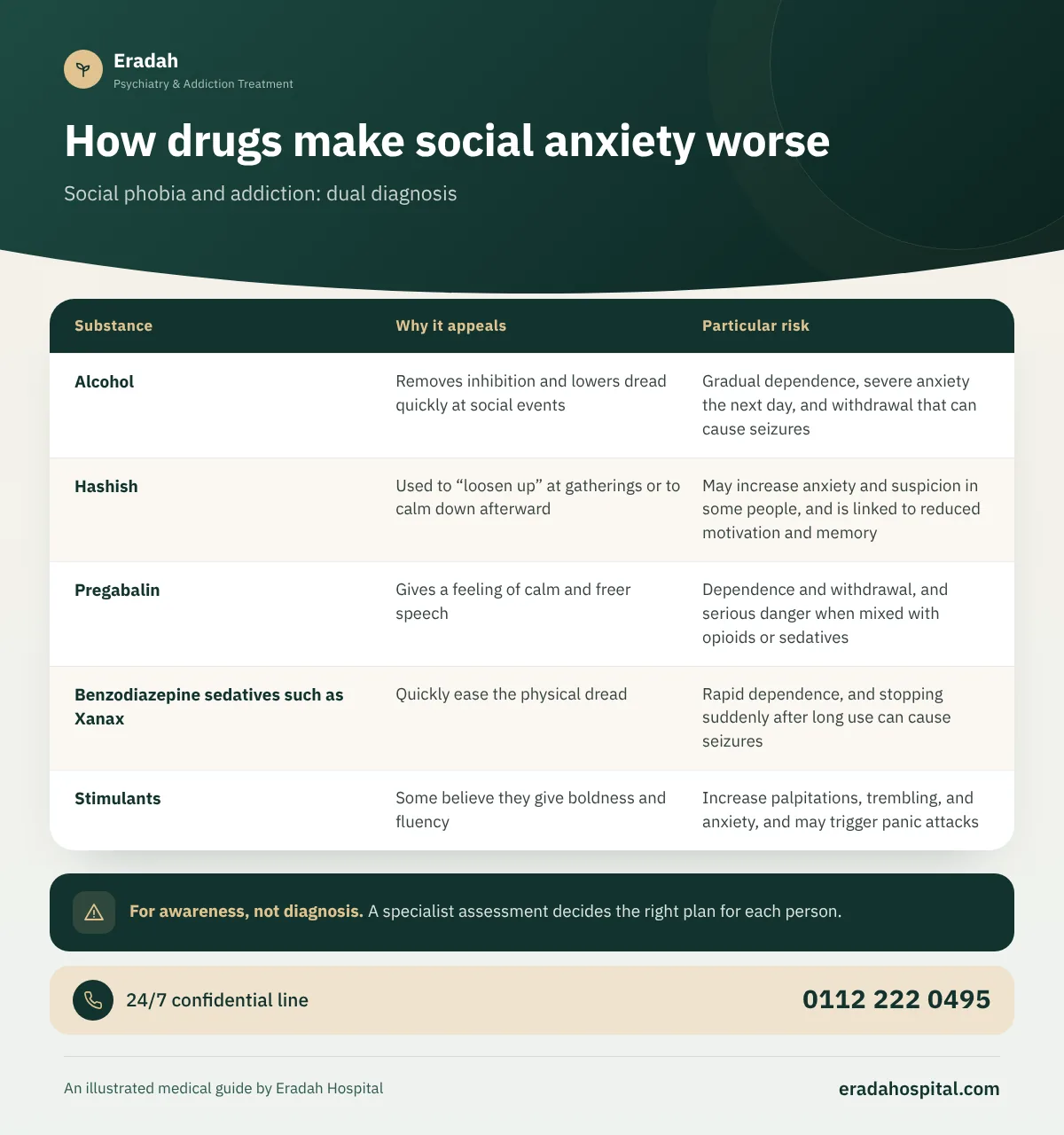
| Substance | Why it appeals | Particular risk |
|---|---|---|
| Alcohol | Removes inhibition and lowers dread quickly at social events | Gradual dependence, severe anxiety the next day, and withdrawal that can cause seizures |
| Hashish | Used to “loosen up” at gatherings or to calm down afterward | May increase anxiety and suspicion in some people, and is linked to reduced motivation and memory |
| Pregabalin | Gives a feeling of calm and freer speech | Dependence and withdrawal, and serious danger when mixed with opioids or sedatives |
| Benzodiazepine sedatives such as Xanax | Quickly ease the physical dread | Rapid dependence, and stopping suddenly after long use can cause seizures |
| Stimulants | Some believe they give boldness and fluency | Increase palpitations, trembling, and anxiety, and may trigger panic attacks |
How do substances make social anxiety worse?
- They prevent learning: someone who faces a situation under the influence of a substance never discovers that he could do it without it, so the fear stays the same or grows.
- Rebound anxiety: after the effect of alcohol or sedatives wears off, anxiety returns stronger, especially the next day, so the person needs the substance again.
- Real embarrassment: behavior under the influence can cause genuinely embarrassing situations, so social fears are fed with new evidence.
- Tolerance: with repetition the body needs larger amounts for the same effect, so the cycle speeds up.
- Depression: alcohol and sedatives are depressants that increase sadness and isolation in the long run.
Which comes first: social anxiety or addiction?
In most cases social anxiety comes before substance use, because it usually begins in early adolescence, while substance use begins later in secondary school, university, or the start of work. This is why many doctors regard social anxiety as a “hidden gateway” to substance use problems in young people.
But the relationship can sometimes run the other way: withdrawal from alcohol or sedatives causes severe anxiety that may resemble social anxiety. So the doctor needs to assess the condition after a period of abstinence to tell withdrawal anxiety from genuine social anxiety.
What are the warning signs that social anxiety has turned into substance use?
- Does not go to an event or a work meeting without first “getting himself sorted” with a substance.
- Keeps sedative tablets or pregabalin without a prescription, or asks friends for them.
- Drinks or uses long before the situation “just in case.”
- Gradually increases the amount to get the same effect.
- Feels anxiety, trembling, and severe insomnia if he does not use.
- Has started using alone at home, not only at events.
Having two or more of these signs calls for a consultation with a dual diagnosis specialist before dependence deepens.
How are social anxiety and addiction treated together?
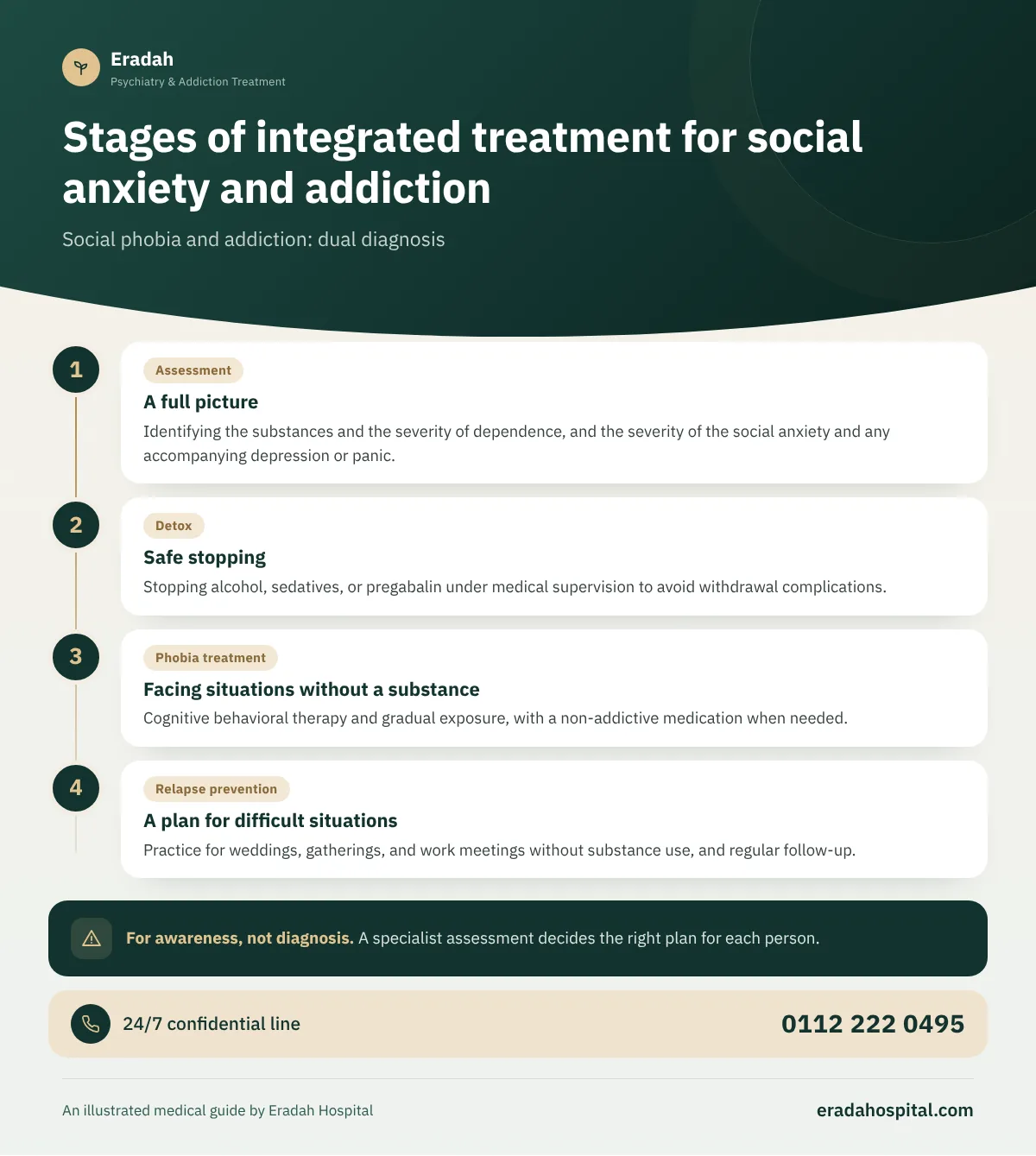
The most successful approach is integrated treatment: one team treating both conditions at the same time within one plan, rather than asking the patient to “stop first, then we’ll treat the social anxiety,” or the reverse. Treatment usually goes through the following stages:
- AssessmentA full picture
Identifying the substances and the severity of dependence, and the severity of the social anxiety and any accompanying depression or panic.
- DetoxSafe stopping
Stopping alcohol, sedatives, or pregabalin under medical supervision to avoid withdrawal complications.
- Phobia treatmentFacing situations without a substance
Cognitive behavioral therapy and gradual exposure, with a non-addictive medication when needed.
- Relapse preventionA plan for difficult situations
Practice for weddings, gatherings, and work meetings without substance use, and regular follow-up.
Why does stopping alcohol or sedatives need medical supervision?
Withdrawal from alcohol or benzodiazepines after long use can cause seizures or life-threatening delirium, and withdrawal from pregabalin can cause severe anxiety and insomnia and may cause seizures in some people. For this reason, stopping suddenly at home without a doctor is not advised; a gradual taper plan or supervision in an equipped setting is.
Also, withdrawal anxiety in the first days can make it seem as if the social anxiety has “gotten worse.” This is expected and temporary, and the treatment team helps the patient get through it without going back to the substance.
What does the doctor consider when prescribing for social anxiety in someone with a history of substance use?
- Prefers non-addictive medications such as SSRI antidepressants to treat the social anxiety itself.
- Avoids prescribing benzodiazepine sedatives, or limits them to special cases under strict monitoring.
- Asks frankly about any medications the patient gets without a prescription, such as pregabalin.
- Monitors mood and any thoughts of self-harm, especially at the start of treatment and after stopping the substance.
How can a family help a son with social anxiety and addiction?
Many families get angry about the substance use without seeing the fear behind it. Understanding that the son used the substance in order to face people does not justify the use, but it changes the conversation: from accusation to concern for him, and from punishment to finding treatment for both causes together.
- Talk to him at a calm time when he is not under the influence, and start with what you have noticed, not with judgments.
- Acknowledge how hard social fear is for him, and say clearly that it can be treated.
- Do not try to stop alcohol or sedatives suddenly by force at home; consult a specialist first.
- After treatment, help him attend events gradually, and do not put him in situations where substance use is offered.
Treating social anxiety and addiction at Eradah
Dual diagnosis is at the heart of Eradah’s work. We begin with a comprehensive assessment of the social anxiety and the substance used together, then safe detox when needed, then a program that combines cognitive behavioral therapy for the anxiety with rehabilitation and relapse prevention, and involves the family. All of it is completely confidential. You can also contact the addiction treatment hotline 16023 for a free, confidential consultation.
Suicidal thoughts or danger to self? Get help now
- Talking about wanting to die or being a "burden" on those around them
- Severe hopelessness and a feeling that there is no way out of isolation and fear
- Complete withdrawal from people and refusing to leave the room for days
- Suddenly saying goodbye to family or getting rid of treasured belongings
- Heavy drinking or taking sedatives along with talk of the end
Stay with the person and don't leave them alone, and listen without blame or dismissing their feelings. Call an ambulance on 123 or take them to the nearest emergency room if danger is imminent, contact the mental health support line on 16328, and move medications and dangerous objects out of their reach.
Ambulance 123 Mental health support line 16328