Why does chronic stress harm health?
The stress response was designed to work for minutes: it raises the pulse, tightens the muscles and mobilizes energy, and then switches off. Cleveland Clinic explains that the problem starts when this response stays activated with chronic stress, causing “wear and tear” on the body, with physical, psychological and behavioral symptoms, and over time several systems are affected.
Researchers add that stress does not tax the body only during the situation itself; worrying about it in advance, and thinking about it again and again afterward, prolong the period of activation. A review by Brosschot and colleagues published in the Journal of Psychosomatic Research suggests that this “perseverative thinking” about stress may be one of the bridges between stress and disease, because it is linked to excess activity in the heart, the endocrine system and immunity.
What does chronic stress do to the body's systems?
| System | Possible effect |
|---|---|
| Brain | Fatigue, sleep problems, headache, and difficulty concentrating |
| Heart | High blood pressure, a racing pulse and palpitations, and over time a link to coronary heart disease |
| Digestive system | Weight gain or loss, ulcers, and irritable bowel syndrome |
| Muscles | Constant pain and tension in the neck, shoulders and back, and clenching of the jaw |
| Immune system | Reduced resistance to infection, and links to conditions such as arthritis, fibromyalgia and psoriasis |
| Hormones | Problems with the reproductive system and fertility, and weaker sexual performance |
| Skin | Stress rash and hives, and flare-ups of some skin conditions |
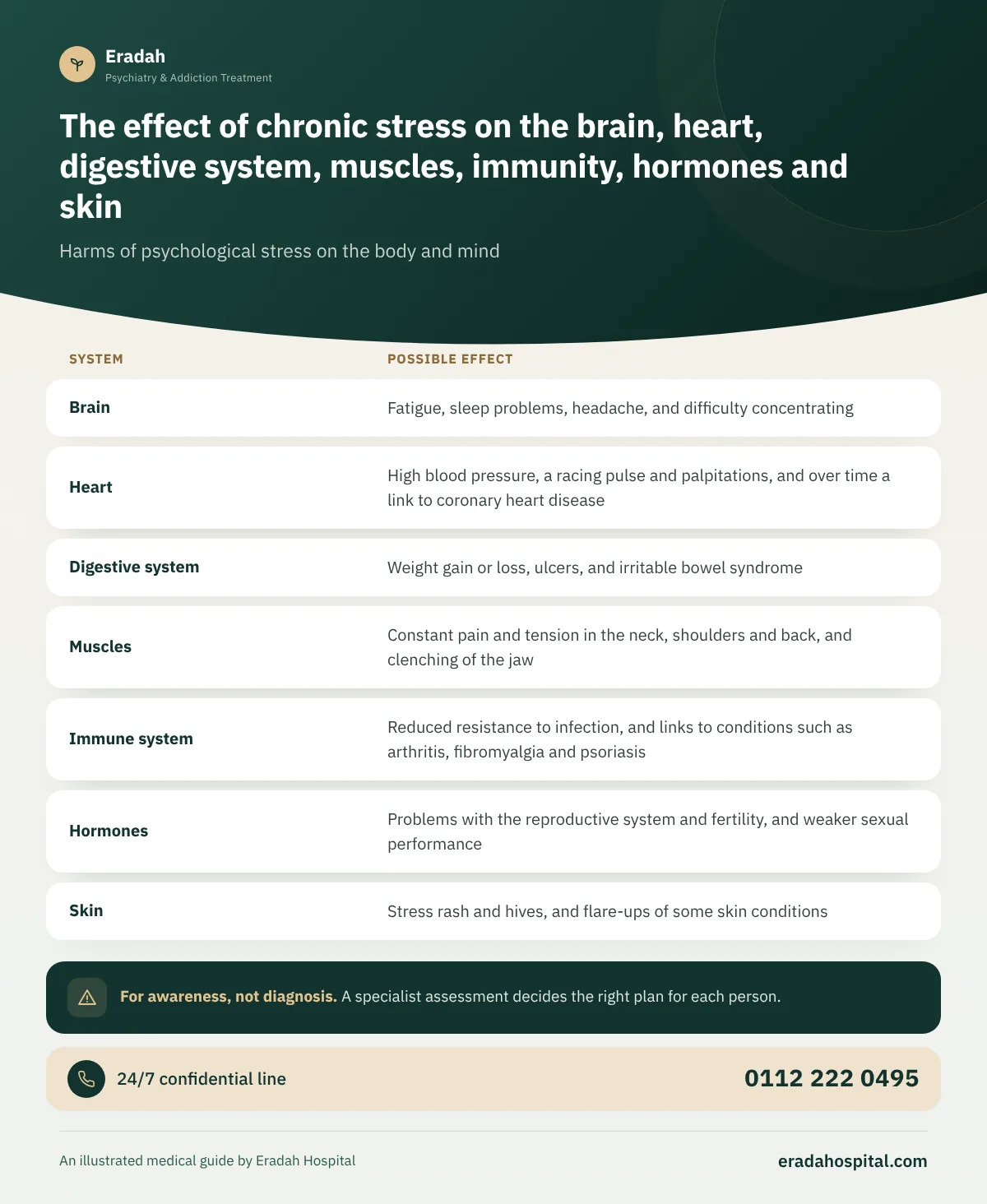
Cleveland Clinic lists these complications among the long-term effects of chronic stress, and the US National Institute of Mental Health adds that ongoing anxiety and stress can affect sleep and the immune, digestive, cardiovascular and reproductive systems. But it remains essential not to attribute any symptom to stress before a doctor has ruled out physical causes.
Does stress really harm the heart?
A review by researchers Andrew Steptoe and Mika Kivimäki in Nature Reviews Cardiology says epidemiological data show that chronic stress predicts the onset of coronary heart disease, and that employees under work stress, and people who are socially isolated or lonely, are more likely to have a first cardiac event. The review adds that brief emotional stress may trigger a cardiac event in people with advanced hardening of the arteries.
The same review mentions a heart condition specifically linked to stress, known as stress cardiomyopathy or “takotsubo”, and notes that European guidelines on heart disease prevention highlight the importance of managing stress. We mention this not to frighten: dealing with stress is a real part of protecting the heart, not a psychological luxury.
Does stress weaken immunity?
One of the best-known experiments in this field is a study published by Sheldon Cohen and colleagues in the New England Journal of Medicine in 1991: the researchers rated the level of psychological stress in 394 healthy volunteers, then deliberately exposed them to respiratory viruses under observation in quarantine. The rate of infection rose from about 74% to about 90%, and the rate of actual colds from about 27% to 47%, as the level of stress increased.
Notably, the association did not change after adjusting for factors such as age, weight and season, and it was not explained by factors such as smoking, alcohol, exercise and sleep quality, which suggests that stress has a direct link to the body's resistance to infection. Cleveland Clinic lists weakened immunity among the physical symptoms of stress.
What are the harms of stress to mental health?
The World Health Organization says stressful situations can cause mental health conditions or make them worse, the best known being anxiety and depression, and that this happens when stress symptoms become persistent and begin to affect daily functioning at work or school. Common pathways include:
- Anxiety disorders: when tension stays after the cause has gone and turns into a constant expectation of danger, as in generalized anxiety.
- Depression: when stress drains energy and pleasure and hopelessness replaces engagement. Read about the causes of depression.
- Burnout: physical, mental and emotional exhaustion after long or intense stress, as the UK's National Health Service describes it.
- Insomnia: it begins with anxious nights and may then continue with disturbed sleep habits.
- Acute psychological crisis: when stress goes beyond the ability to function in daily life, as in a nervous breakdown.
How does stress lead to substance use?
The World Health Organization notes that chronic stress can increase the use of alcohol, tobacco and other substances. A review by researcher Rajita Sinha summarizes the evidence that stress is a known risk factor for developing addiction and for relapse, and that regular substance use in turn changes the brain's stress and motivation systems, weakening the ability to regulate tension and control impulses, and keeping the person in a cycle of seeking the substance whenever things get tight.
This is why the dual diagnosis team treats stress and substance use together, because treating one and leaving the other makes relapse more likely.
Do the harms of stress go away?
Many effects of stress can improve, especially when it is dealt with early: sleep returns, the digestive system settles, and muscle pain eases as the load is lightened and calming skills are learned. Harms that have built up over years, such as high blood pressure, need physical medical follow-up alongside dealing with the stress. Cleveland Clinic advises seeing a doctor when symptoms do not ease with calming methods, or when a person turns to alcohol or drugs to cope.
Has stress turned into danger? Ask for help now
- Talking about death, wanting to disappear, or being a “burden” on others
- Severe or crushing chest pain, sudden shortness of breath, or fainting (treat as a heart problem until proven otherwise)
- Complete inability to sleep, eat or do any task for several days
- Excessive use of sedatives, or mixing them with alcohol or drugs “to calm the nerves”
- Fits of anger that reach threats or violence toward oneself or others
Do not leave the person alone. Calmly and frankly ask how they feel and what they are thinking, and listen without blame; asking directly does not plant the idea, it opens the door to help. For chest pain, fainting or any threat to life, call an ambulance (123) immediately. For suicidal thoughts, call an ambulance or take them to the nearest emergency room, or call the mental health support line 16328 (24 hours), and keep medications and anything they could use to hurt themselves away from them.
Ambulance 123 Mental health support line 16328