How do stress symptoms appear?
Stress does not announce itself with the sentence “I am stressed”. It creeps in as an afternoon headache, shortness of breath, a curt reply to the children, or a long night without sleep. The World Health Organization confirms that people do not respond to stress in the same way, so coping style and symptoms differ from person to person.
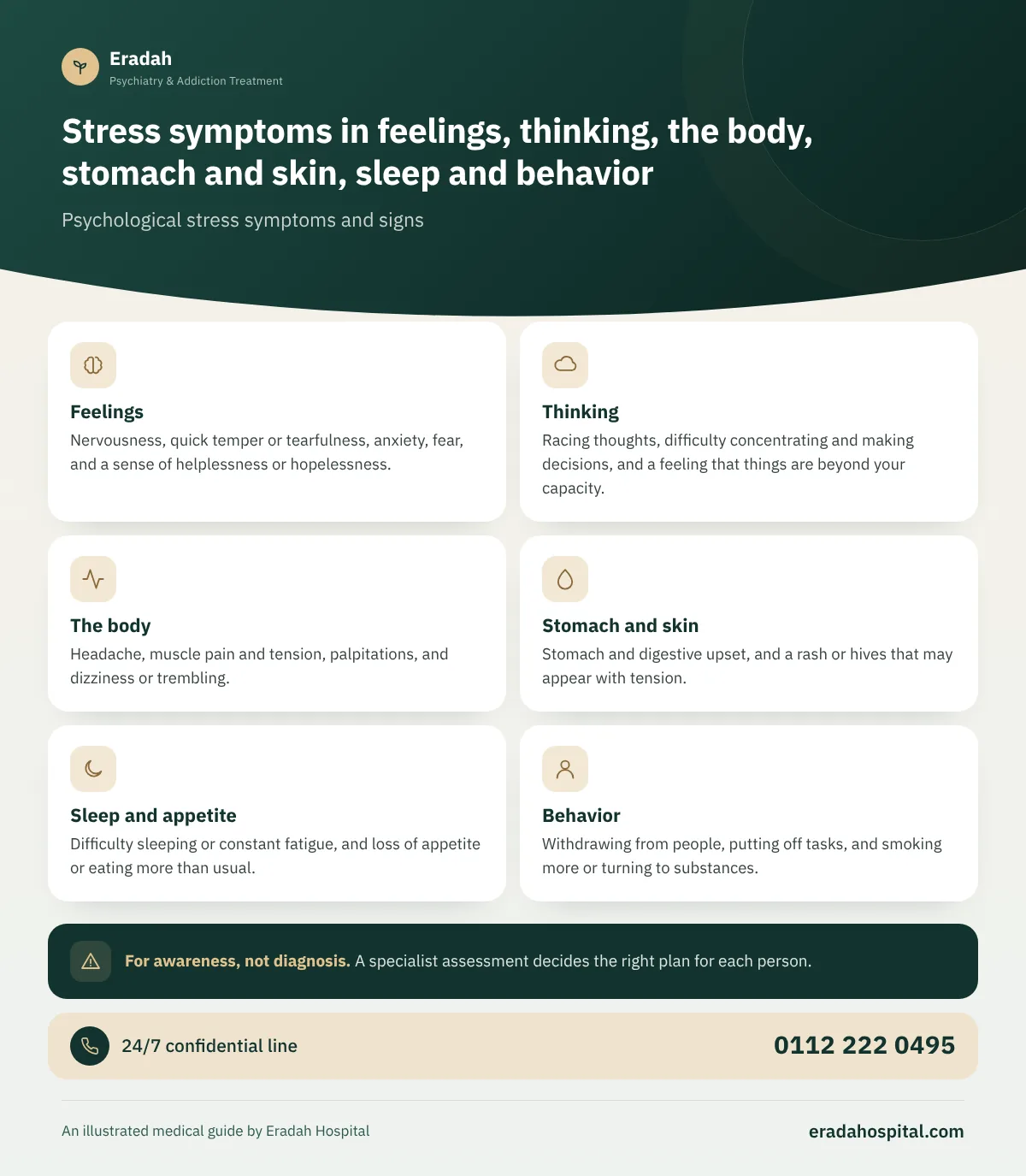
The signs can be grouped into six main categories, which may all appear or only some:
Nervousness, quick temper or tearfulness, anxiety, fear, and a sense of helplessness or hopelessness.
Racing thoughts, difficulty concentrating and making decisions, and a feeling that things are beyond your capacity.
Headache, muscle pain and tension, palpitations, and dizziness or trembling.
Stomach and digestive upset, and a rash or hives that may appear with tension.
Difficulty sleeping or constant fatigue, and loss of appetite or eating more than usual.
Withdrawing from people, putting off tasks, and smoking more or turning to substances.
What are the psychological and mental symptoms of stress?
The UK's National Health Service notes that stress can make a person irritable, angry or tearful, feel anxious, hopeless or afraid, and have trouble making decisions, with racing thoughts and a sense of being overwhelmed. Signs that people describe in the clinic include:
- A “short fuse”: you blow up in situations you would normally get past.
- Forgetting appointments and small things, and reading the same page twice.
- Long hesitation over simple decisions, or hasty decisions just to get rid of the tension.
- A constant feeling that you are behind and that the to-do list never ends.
- Falling self-confidence and the feeling that you are “not up to the responsibility”.
The US National Institute of Mental Health notes that stress and anxiety share symptoms such as excessive preoccupation, restlessness, tension, headaches, body aches and poor sleep, so it can sometimes be hard to tell them apart from symptoms alone.
What are the physical symptoms of stress?
The body is often the first to complain. Physical symptoms mentioned by the UK's National Health Service and Cleveland Clinic include:
| Area | What you may feel |
|---|---|
| Head | Tension headache, and sometimes dizziness, trembling or a feeling of faintness |
| Muscles | Pain and tension in the neck, shoulders and back, and clenched jaw |
| Heart | Palpitations or a sense of a racing pulse, and blood pressure may rise |
| Stomach and intestines | Nausea or upset stomach and digestion |
| Skin | Stress rash, which is raised bumps like hives that may itch or burn |
| General | Fatigue and sleep problems, and reduced sexual desire or performance |
Cleveland Clinic notes that hives are usually an allergic reaction to foods, fabrics or chemicals, but stress can sometimes trigger them. Dizziness, on tense days, may be linked to rapid breathing, lack of sleep and skipped meals; even so it has many physical causes that a doctor must rule out.
How does stress change daily behavior?
The UK's National Health Service notes that stress can change how much we eat and exercise, our habits of smoking, drinking and substance use, and how much we see people and do the things we used to enjoy. In daily life this shows up as:
- Staying up on the phone despite being tired, then waking up exhausted.
- Extra cigarettes or more cups of coffee “to get through the day”.
- Canceling outings and avoiding calls.
- Putting off tasks, then finishing them at the last minute under greater pressure.
- Repeated arguments at home over small things.
- Looking for “something to calm me down” from the pharmacy or from friends.
The last sign in particular deserves a pause, because calming stress with substances is one of the shortest routes to dependence. Cleveland Clinic notes that some people with chronic stress turn to coping methods that can become harmful habits, such as overeating, smoking, gambling, alcohol and substances. Read about the risks of sedatives such as Rivotril before you reach for them without a doctor.
Are these symptoms of stress, anxiety or depression?
The symptoms overlap a great deal, but three questions help you tell them apart at first:
| Question | More like stress | May point to another condition |
|---|---|---|
| Is the tension tied to a clear cause? | Yes, and it eases when the cause goes away | Anxiety with no specific cause that moves between topics: generalized anxiety |
| Do you still enjoy things? | Yes, when you find time for them | Loss of pleasure and persistent sadness for two weeks or more: symptoms of depression |
| Do sudden attacks of fear come? | Rarely | Palpitations, shortness of breath and intense fear that peaks within minutes: panic disorder |
This comparison is for awareness only, and diagnosis requires an interview with a psychiatrist.
Do stress symptoms differ from one person to another?
Yes. The UK's National Health Service says the level of stress one person is comfortable with may be higher or lower than what the people around them can tolerate. In some people stress shows up in the stomach, in others in sleep, irritability or overworking. So the most important yardstick is change more than the type of symptom: have you become different from how you were in your sleep, energy and the way you deal with people?
When are stress symptoms a warning sign?
Seek a medical assessment if:
- Symptoms last more than two weeks or get worse despite rest.
- Chest pain, shortness of breath, severe dizziness or fainting appears.
- Your sleep or work is clearly disrupted.
- Stress comes with deep sadness, hopelessness or thoughts of death.
- You have started to rely on a substance or medicine to calm down.
After physical causes are ruled out, a psychiatrist helps you understand what is happening and make a plan, and you can find practical first steps in stress treatment.
Has stress turned into danger? Ask for help now
- Talking about death, wanting to disappear, or being a “burden” on others
- Severe or crushing chest pain, sudden shortness of breath, or fainting (treat as a heart problem until proven otherwise)
- Complete inability to sleep, eat or do any task for several days
- Excessive use of sedatives, or mixing them with alcohol or drugs “to calm the nerves”
- Fits of anger that reach threats or violence toward oneself or others
Do not leave the person alone. Calmly and frankly ask how they feel and what they are thinking, and listen without blame; asking directly does not plant the idea, it opens the door to help. For chest pain, fainting or any threat to life, call an ambulance (123) immediately. For suicidal thoughts, call an ambulance or take them to the nearest emergency room, or call the mental health support line 16328 (24 hours), and keep medications and anything they could use to hurt themselves away from them.
Ambulance 123 Mental health support line 16328