What is the core symptom of generalized anxiety disorder?
The central symptom is excessive anxiety and apprehension: a constant preoccupation with what might go wrong, far out of proportion to the real likelihood, hard to stop or put off, and continuing on most days for at least six months.
What distinguishes this anxiety is that it does not stick to one subject. A day may begin with worry about a father's health, then move to a delayed salary, then to a news item heard on TV, then to a child's exam. The person feels their mind is “searching” for something to worry about even on calm days.
The accepted diagnostic criteria list six accompanying symptoms, and three or more of them are enough in adults along with the persistent anxiety, while one is enough in children, provided that it causes clear distress or impairment.
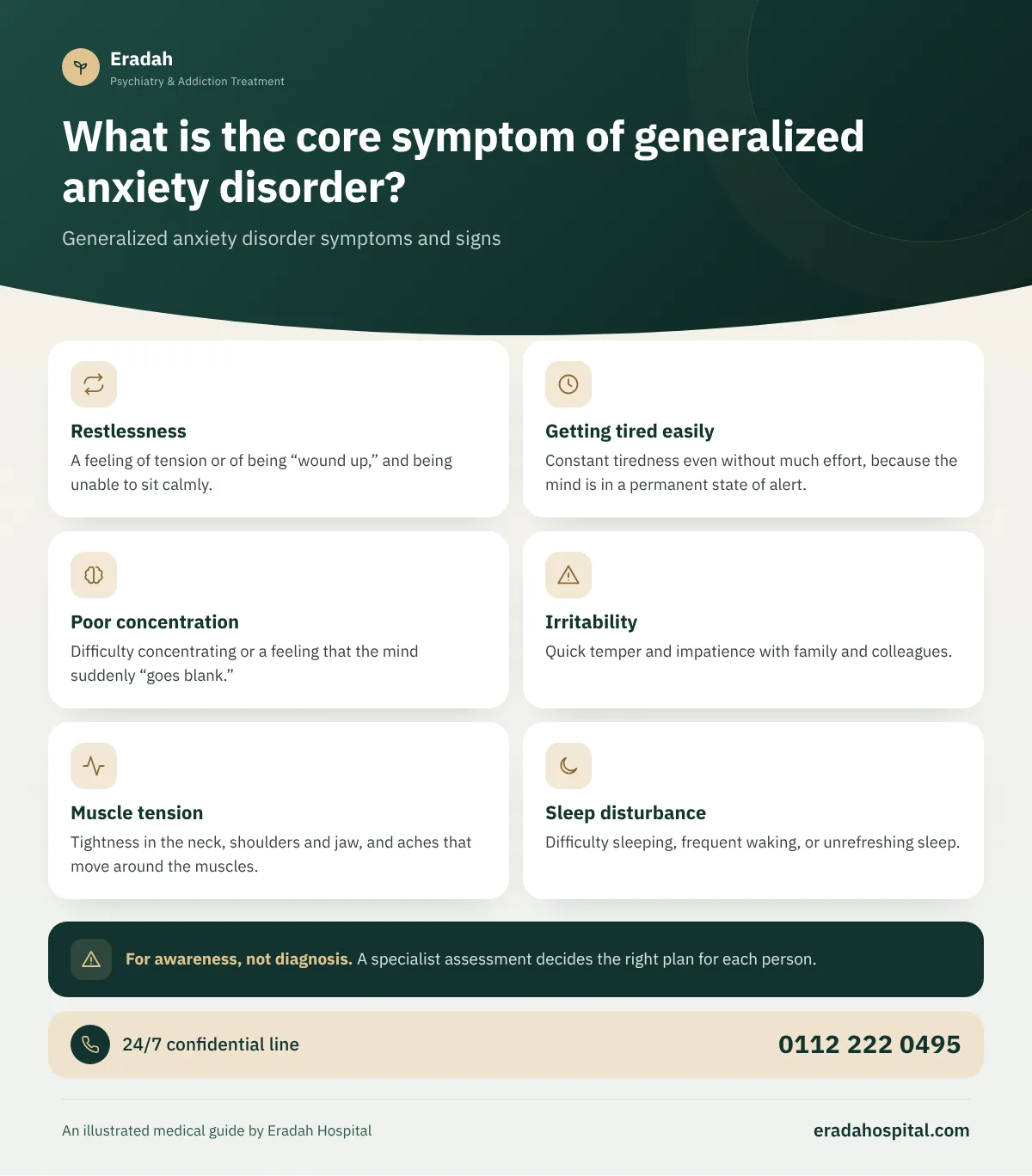
A feeling of tension or of being “wound up,” and being unable to sit calmly.
Constant tiredness even without much effort, because the mind is in a permanent state of alert.
Difficulty concentrating or a feeling that the mind suddenly “goes blank.”
Quick temper and impatience with family and colleagues.
Tightness in the neck, shoulders and jaw, and aches that move around the muscles.
Difficulty sleeping, frequent waking, or unrefreshing sleep.
What are the psychological and mental symptoms of chronic anxiety?
- Catastrophic thinking: expecting the worst outcome in every situation and magnifying small problems.
- Difficulty tolerating uncertainty: needing to know every detail in advance to feel safe.
- Indecision and difficulty making decisions for fear of the wrong one.
- A constant feeling that “something bad will happen” for no clear reason.
- Ruminating on thoughts before sleep and replaying the day's events again and again.
- Anxiety about the anxiety itself: fear that this tension will harm the health or the mind.
The person may realize their worry is exaggerated, but this realization alone does not stop it, a point people often misunderstand when they say “just don't think about it.”
What are the physical symptoms of generalized anxiety disorder?
Anxiety is not only in the mind; the body lives in a state of constant alertness, and physical symptoms may be the first thing a patient notices:
| System | What a person may feel |
|---|---|
| Muscles | Tightness and aches in the neck, back and shoulders, teeth grinding, and tension headaches |
| Digestive system | Nausea, stomach pain or bloating, diarrhea or constipation, and cramps resembling irritable bowel syndrome |
| Heart and breathing | Frequent palpitations and a mild feeling of breathlessness, usually without sudden acute attacks |
| Nervous system | Mild dizziness, trembling, sweating, and sometimes tingling |
| General | Constant fatigue, frequent urination, and dry mouth |
How does anxiety show up in everyday behavior?
- Repeatedly seeking reassurance from family or doctors about the same thing.
- Constantly searching online for symptoms and diseases.
- Avoiding news, calls or situations that might carry a “bad surprise.”
- Postponing and procrastinating, or on the contrary over-planning and preparing in advance for every small thing.
- Calling family members repeatedly to check on them.
- Overworking or excessive perfectionism to avoid any mistake.
Do the symptoms of generalized anxiety differ by age and sex?
| Category | How it may appear |
|---|---|
| Children | Excessive worry about grades, performance, appointments and parents' safety, many questions and reassurance-seeking, stomachaches and headaches before school |
| Teenagers | Exhausting perfectionism, fear of failure, insomnia, irritability with parents, and sometimes withdrawal or trying substances to calm down |
| Women | Affected about twice as often, and symptoms may intensify with family stress and during periods such as pregnancy and after childbirth |
| Men | May appear as irritability, fatigue and physical complaints, with delay in seeking help because of embarrassment |
| Older adults | Worry about health, money and children, and many physical complaints that may be confused with illnesses of aging |
In children and teenagers, a specialist assessment is needed with the parents taking part, while avoiding blame or dismissing the child's fears.
When is anxiety mild and when is it severe?
| Level | What it looks like |
|---|---|
| Mild | Bothersome, persistent anxiety, but the person does their work and keeps their relationships with extra effort |
| Moderate | Clear difficulty with sleep and concentration, declining performance, and avoidance of some tasks |
| Severe | Anxiety that dominates most of the day, severe exhaustion and insomnia, clear disruption of work or study, and often accompanying depression |
NIMH data indicate that about a third of adults with the disorder in a given year experience severe impairment in their lives, confirming that chronic anxiety is not “just stress.”
How can a family notice the symptoms of generalized anxiety?
The person may not speak openly about their anxiety, but the family notices repeated signs: the constant question “are you sure?”, many calls to check in, unusual irritability, insomnia and tiredness, and shifting physical complaints. They may also notice a growing turn to sedatives or sleeping pills, which deserves attention early.
It is best to start the conversation with concern, not criticism: “I notice you're tired and preoccupied all the time. Shall we talk to a specialist?” rather than “You blow everything out of proportion.”
Self-assessment questions: does my anxiety need a consultation?
The following questions are inspired by those doctors use for initial screening. They are not a diagnosis, but they indicate how much you may need a consultation:
- Over the past weeks, have you felt tense, anxious or “wound up” on most days?
- Do you find it hard to stop or control the worry?
- Do you worry about many different things and not just one?
- Does the anxiety affect your sleep, concentration, work or relationships?
- Has this continued for several months?
When do the symptoms call for urgent help?
Anxiety itself mostly does not need emergency care, but ask for help immediately if thoughts of death or self-harm appear, or severe despair, or if the person overuses sedatives or mixes them with alcohol. And if sudden chest pain or severe shortness of breath appears for the first time, treat it as a medical emergency until proven otherwise.
Suicidal thoughts or severe hopelessness along with anxiety? Get help now
- Talking about wanting to die or being a "burden" on those around them
- Severe hopelessness and a feeling that the anxiety will never end and there is no way out
- Suddenly saying goodbye to family or giving away things that are dear to them
- Complete withdrawal from people and work with severe sleeplessness for consecutive days
- Overusing sedatives or alcohol, or mixing them, in search of relief
Stay with the person and do not leave them alone. Listen calmly, without judgment or blame, and ask them directly about their thoughts; asking does not plant the idea, it opens the door to help. Keep medications and dangerous objects out of their reach as far as possible, and call the ambulance (123) or go to the nearest emergency room, or call the mental health support line 16328, available around the clock.
Ambulance 123 Mental health support line 16328