Can Tourette syndrome be treated? And what is the goal of treatment?
Tourette syndrome is not cured by a pill or a session, but its impact can be greatly reduced. The MSD Manual explains that treating tics is advised only if they clearly interfere with the child’s activities or self-image, and that treatment does not change the natural course of the condition, which eases in many people during adolescence.
So the doctor agrees a realistic goal with the family: easing the painful or embarrassing tic and improving school, sleep and self-confidence, not reaching “zero tics.” A child who blinks a lot but is happy and doing well at school may not need any treatment for tics.
Why does treatment start with psychoeducation?
The updated 2022 European guidelines recommend psychoeducation as the first step for all cases, whatever their severity. This means the doctor explains to the child, the family and the school what tics are like: that they are involuntary, that they wax and wane, that they increase with stress and ease with absorption in an activity, and that their course tends to improve.
This understanding alone reduces conflict at home and eases the child’s anxiety, and less anxiety often means fewer tics. The NHS notes that understanding the condition helps families find ways to live with it.
What is Comprehensive Behavioral Intervention for Tics (CBIT)?
It is a structured behavioral training program developed from “habit reversal training,” in which the person learns two key steps:
- Awareness training: noticing the tic precisely and recognizing the urgent sensation that comes before it.
- Competing response: performing a calm, unnoticeable movement that physically prevents the tic, such as gently tensing the neck muscles instead of jerking the head, until the sensation passes.
- Modifying situations: identifying what increases tics during the day and reducing it, along with relaxation techniques.
The American Academy of Neurology’s 2019 systematic review found high confidence that this intervention is more effective at reducing tics than education and support alone. The European guidelines consider habit reversal training and CBIT, along with exposure and response prevention, to be first-line treatments when education is not enough, and note that delivering it through video calls is the best-supported of the recent formats so far.
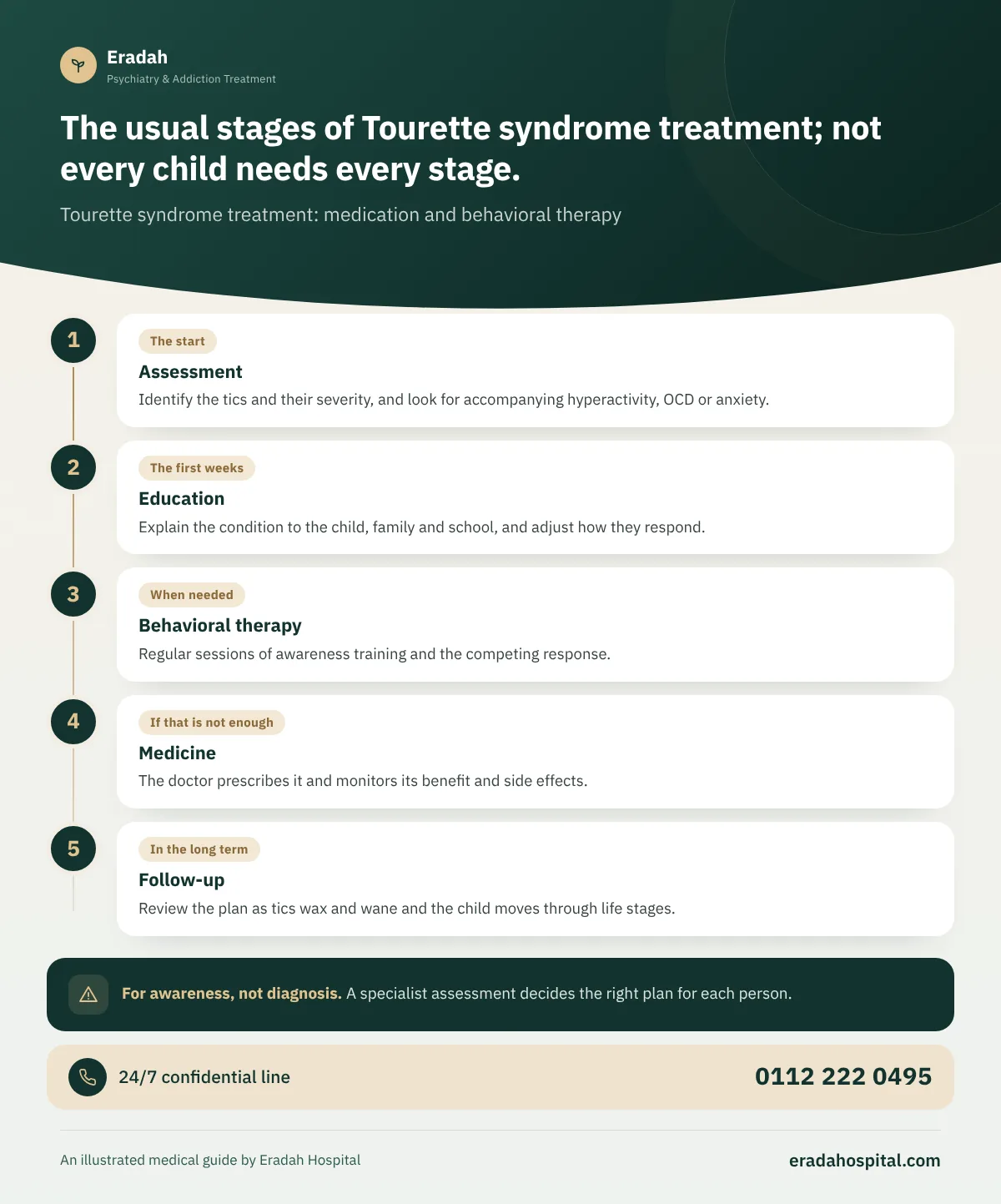
What are the stages of the Tourette syndrome treatment journey?
- The startAssessment
Identify the tics and their severity, and look for accompanying hyperactivity, OCD or anxiety.
- The first weeksEducation
Explain the condition to the child, family and school, and adjust how they respond.
- When neededBehavioral therapy
Regular sessions of awareness training and the competing response.
- If that is not enoughMedicine
The doctor prescribes it and monitors its benefit and side effects.
- In the long termFollow-up
Review the plan as tics wax and wane and the child moves through life stages.
What medications are used to treat Tourette syndrome?
The European guidelines say medication is turned to when behavioral therapy is not effective, available or suitable, either alone or alongside it. These are the main classes:
| Category | Examples | When is it considered? | Possible side effects |
|---|---|---|---|
| Dopamine-blocking drugs (some antipsychotics) | Aripiprazole, risperidone, tiapride | The class with the most evidence; the European guidelines prefer aripiprazole for its milder effects | Weight gain, drowsiness, movement disorders, raised prolactin |
| Alpha-2 receptor agonists | Clonidine, guanfacine | Especially when hyperactivity and attention problems are present | Drowsiness, and effects on pulse and blood pressure |
| Options for resistant cases | Topiramate, botulinum injections into the muscles involved in the tic | When the first options fail | Vary by medication, and the evidence is weaker |
The American Academy of Neurology review documented possible harms of these medications, including weight gain, drug-induced movement disorders, raised prolactin, drowsiness, and effects on heart rate, blood pressure and the ECG. This is why the doctor decides the type and dose and monitors them. Antipsychotics are used here to ease tics, not because the child is “psychotic.”
Why is treating accompanying conditions an essential part?
The MSD Manual stresses that accompanying conditions sometimes interfere with a child’s development and comfort more than the tics themselves, so treating them matters. Attention-deficit hyperactivity disorder may be treated with medications the doctor chooses so they do not worsen tics, and obsessive-compulsive disorder and anxiety are treated with psychotherapy and sometimes medication. The school day often improves when distraction is treated, even if the tics stay the same.
Is deep brain stimulation a treatment for Tourette syndrome?
Deep brain stimulation is a surgery in which electrodes are implanted in specific brain areas. The 2022 European guidelines consider it an experimental treatment used only for carefully selected patients whose condition is severe and has not responded to all other treatments, because the results of controlled trials were less positive than open-label studies and sometimes conflicting.
What is the role of family and school in treatment?
- A steady daily routine with plenty of physical activity, as the NHS advises.
- A calm, regular bedtime, with phones and devices kept away before sleep.
- Reducing stressful situations as far as possible, without depriving the child of their life.
- Telling the school about the diagnosis, and agreeing on a comfortable place in exams and a short break when needed.
- Taking any bullying seriously, as it is one of the biggest sources of anxiety and depression in these children.
Do herbs and supplements help treat tics?
The NHS notes that some people use complementary treatments such as herbs and supplements, but the evidence for their benefit in Tourette syndrome symptoms is limited. If the family wants to try any of them, the doctor must be told first, because some may interact with prescribed medications.
Tourette syndrome treatment at Eradah
At Eradah we see children and adolescents to assess tics and any accompanying hyperactivity, OCD or anxiety, and to train families in how to respond, in coordination with the pediatrician or neurologist. Adults living with persistent tics often need treatment for the anxiety, depression or social phobia that has built up alongside them, and some have turned to alcohol or sedatives to ease tension. At Eradah we offer a confidential psychological assessment and follow-up in the outpatient clinics, and integrated treatment under dual diagnosis when a mental disorder occurs together with substance use.
A harmful tic or severe despair? Ask for help now
- A violent tic of the neck or head causing severe pain, injury or sudden weakness in the arms or legs
- Severe tics appearing suddenly over a day or a few days, especially after an infection or a new medication
- Severe muscle stiffness, fever or confusion after starting a new medication
- Talk of death or self-harm because of bullying, isolation or constant embarrassment
- A teenager or adult turning to alcohol, sedatives or stimulants to calm tics
Stay calm, do not blame the person for their tics or ask them to suppress them, stay beside them and quietly ask how they feel. If a physical injury or sudden symptoms appear after a medication, call the treating doctor or go to the nearest emergency room. If they talk about harming themselves, do not leave them alone; call an ambulance (123) or the mental health support line 16328 (24 hours).
Ambulance 123 Mental health support line 16328