Do you start tasks with enthusiasm and then drop them before the end, and forget appointments despite your sincere intentions? These may be features of attention-deficit/hyperactivity disorder, which continues into adulthood in many people without being noticed.
Start the ADHD test
How is the score calculated?
The answers on this scale are not added up; only the “significant” answers are counted. For questions 1 to 3, an answer counts as significant if it is “Sometimes” or more. For questions 4 to 6, it counts only if it is “Often” or “Very often.” The reason is that the last three questions describe behaviors many people experience, so they become notable only when they happen frequently.
| Number of significant answers | Meaning | Suggested step |
|---|---|---|
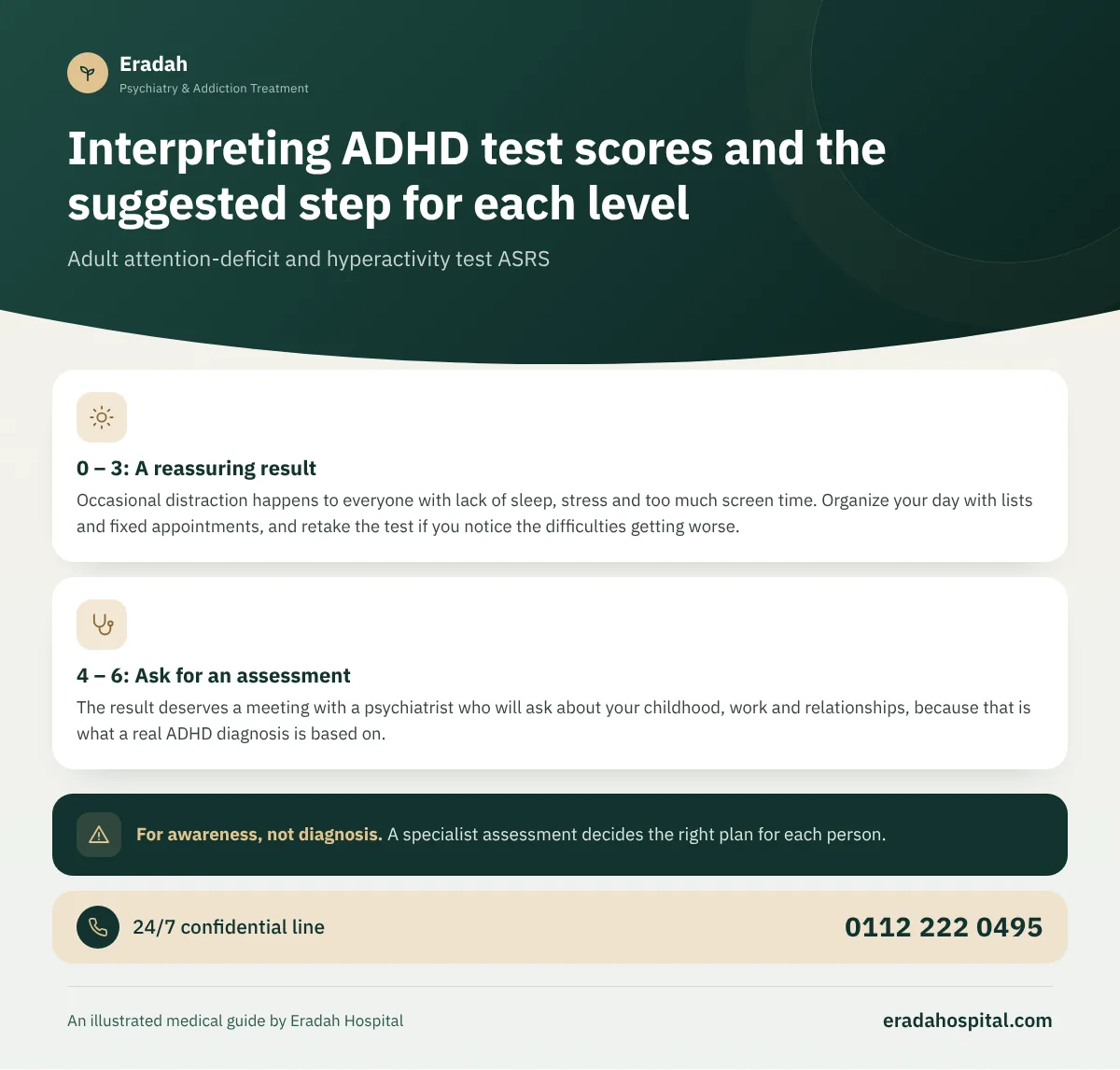
| 0 – 3 | Not consistent with the disorder | No action needed, unless the difficulties disrupt your life |
| 4 – 6 | Consistent with the disorder in adults | Comprehensive evaluation by a psychiatrist |
What to do after your result
Occasional distraction happens to everyone with lack of sleep, stress and too much screen time. Organize your day with lists and fixed appointments, and retake the test if you notice the difficulties getting worse.
The result deserves a meeting with a psychiatrist who will ask about your childhood, work and relationships, because that is what a real ADHD diagnosis is based on.
If the diagnosis is confirmed, there are several options, including medication, behavioral therapy and organizing your surroundings, and the doctor chooses what suits your case and follows your response. You can read more about ADHD treatment before your appointment.
Before the assessment appointment, it helps to gather things that will help the doctor: notes from one of your parents about your childhood, old school reports with teachers' comments, and specific examples of difficulties at work and at home. These details make the assessment more accurate and shorter.
What is the ASRS scale?
ASRS stands for “Adult ADHD Self-Report Scale.” It was developed by the World Health Organization with a research team led by Ronald Kessler, and its validation study was published in 2005. The full scale has 18 questions drawn from the diagnostic manual's criteria, and the first six, which are Part A, proved the best at predicting the disorder, so they came to be used on their own as a quick screening tool. In the original study this short part classified about 98% of participants correctly and outperformed the full version in initial screening.
What does ADHD look like in adults?
The picture of the disorder changes with age; a hyperactive child may become an adult who looks calm on the surface but lives with inner restlessness and distraction that wear them and those around them out. Signs adults commonly notice include:
- Putting off important tasks until the last minute, then finishing them under intense pressure.
- Frequently losing everyday items such as keys, phone and papers.
- Interrupting others while they talk, or rushing into decisions and purchases.
- Difficulty sticking with one job, and changing jobs or projects often.
- A constant feeling that you are achieving less than your real abilities allow.
Many adults do not know that what they live with is a disorder that has a name and treatments, so they blame themselves for years and are accused of laziness or carelessness. Simply understanding the cause eases much of this burden and opens the door to a practical plan that suits the nature of your mind instead of fighting it.
Limits of the test
- It does not diagnose the disorder; diagnosis requires that symptoms began in childhood and affected more than one area of your life.
- Anxiety, depression and chronic lack of sleep can cause distraction that resembles the symptoms of the disorder.
- Some physical problems, such as thyroid disorders, affect concentration and activity.
- Using stimulant or sedative substances, and their withdrawal, temporarily changes attention.
- A low result does not rule out the disorder, especially in people whose picture is mainly quiet inattention without excess movement.
ADHD and addiction
Some adults with untreated ADHD tend to look for something that calms their impulsivity or improves their focus, so they turn to nicotine, hashish or stimulants without medical supervision. Studies indicate that their risk of substance use disorders is higher than in others, and that treating the disorder itself is an important part of prevention. If both problems are present for you, read about the relationship between ADHD and addiction, and how they are treated together under dual diagnosis.
Free confidential consultation
If your result is consistent with the disorder, or if concentration difficulties are getting in the way of your work, studies or relationships, the Eradah team would be glad to listen. Contact us for a free, confidential initial consultation on 01122220495, and we will help you decide the right step for you.