Has anxiety become a daily companion, even over small things? Passing anxiety is a normal part of life, but when it continues and is hard to stop, it may be generalized anxiety disorder. Answer the seven questions to see where you stand.
Start the anxiety test
How is the anxiety test result calculated?
Each answer takes a score: “Not at all” = 0, “Several days” = 1, “More than half the days” = 2, and “Nearly every day” = 3. The scores for the seven questions are added up to give a total between 0 and 21, read according to the cutoffs set by the developers of the scale:
| Level | Anxiety level | Suggested step |
|---|---|---|
| 0 – 4 | Minimal or none | No intervention needed, while watching for any change |
| 5 – 9 | Mild | Self-care and retaking the test after two weeks |
| 10 – 14 | Moderate | Assessment by a mental health specialist |
| 15 – 21 | Severe | See a psychiatrist soon |
What should you do after seeing the result?
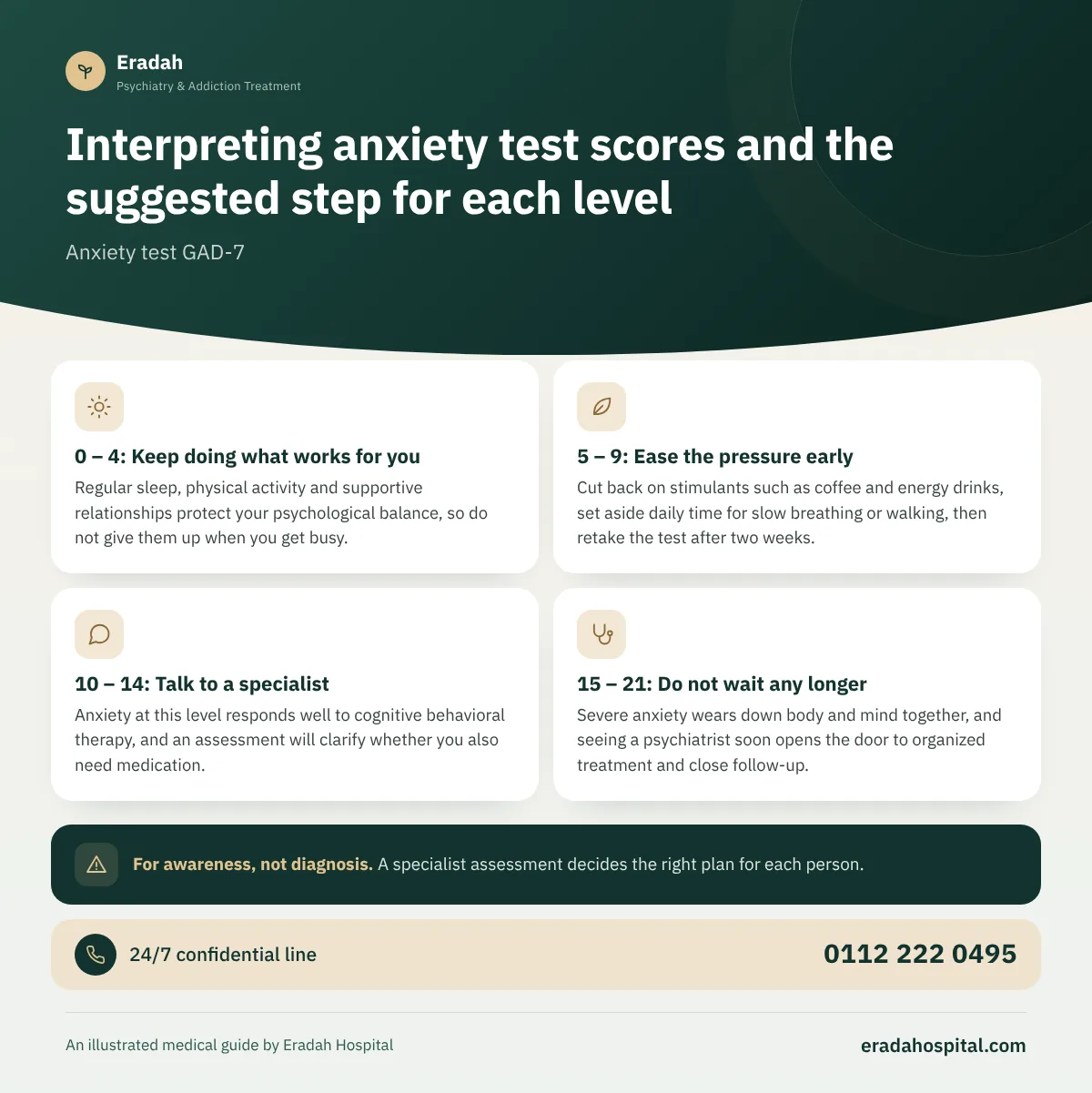
Regular sleep, physical activity and supportive relationships protect your psychological balance, so do not give them up when you get busy.
Cut back on stimulants such as coffee and energy drinks, set aside daily time for slow breathing or walking, then retake the test after two weeks.
Anxiety at this level responds well to cognitive behavioral therapy, and an assessment will clarify whether you also need medication.
Severe anxiety wears down body and mind together, and seeing a psychiatrist soon opens the door to organized treatment and close follow-up.
What is the GAD-7 scale?
GAD-7 stands for “Generalized Anxiety Disorder 7-item scale.” It was published by Robert Spitzer and colleagues in 2006 after a study of thousands of patients in primary care clinics, and they chose its seven items from a larger number because they were the best at telling cases apart. In the original validation study, a score of 10 or above picked up about 89% of generalized anxiety cases, with an ability to rule out people without the condition of about 82%.
Later research showed that the scale also picks up panic disorder, social anxiety and post-traumatic stress disorder to an acceptable degree, so it is used as a first gateway for detecting anxiety disorders in general and for tracking improvement during treatment. Its developers made it available for free use without prior permission.
When is anxiety normal and when does it become a disorder?
Anxiety before an exam or a job interview is a healthy response that helps you prepare, and it goes away when the situation ends. Generalized anxiety disorder, by contrast, is worry lasting six months or more, moving among many subjects such as health, money and family, and hard to stop even when you realize it is exaggerated. It is often accompanied by muscle tension, insomnia, difficulty concentrating and constant fatigue. Review the symptoms of generalized anxiety in detail to compare with what you are going through.
When should you not wait for the test result?
Some signs call for contacting a doctor quickly even if your score is low, because the test does not cover them:
- Sudden episodes of intense palpitations, shortness of breath and fear of dying or losing control.
- Insomnia lasting days that exhausts you and disrupts your work or studies.
- Avoiding leaving the house or going to work because of fear.
- Chest pain or repeated dizziness whose physical cause has not yet been ruled out.
- Thoughts of death or self-harm; if so, contact 16328 or 123 immediately.
And remember that chronic anxiety does not mean a weakness of character. It is a common condition with overlapping psychological, physical and genetic causes, and dealing with it early is much easier than waiting for it to get worse.
Limits of the anxiety test
- It does not diagnose an anxiety disorder; a diagnosis needs an interview with a psychiatrist.
- It does not accurately distinguish between the different types of anxiety disorders.
- Physical conditions such as an overactive thyroid and heart rhythm disorders can produce similar symptoms.
- Too much caffeine, or withdrawal from sedatives and alcohol, can raise the score temporarily.
- Anxiety is often accompanied by depression, which this test does not measure, so you may find it useful to take the depression test as well.
Anxiety and addiction
Some people with anxiety turn to sedatives, hashish or alcohol for quick relief, and many start with pregabalin to calm anxiety and then find themselves needing larger amounts. The relief here is temporary, and when the substance wears off, the anxiety returns stronger, so the cycle starts again. If your score is high and you are using a substance to calm down, treating anxiety and addiction together is the safest path, as the article on anxiety accompanying addiction explains.
Free confidential consultation
If your result raises questions, or you want to understand what you are going through more clearly, the Eradah team welcomes your inquiries in a free, confidential first consultation on 01122220495. One small step today may save you months of suffering.