What is the relationship between generalized anxiety and addiction?
The US National Institute on Drug Abuse (NIDA) explains that the relationship between anxiety disorders and substance use runs in both directions: anxiety raises the risk of turning to substances, and substances can increase anxiety immediately and over the long term.
When a mental disorder and addiction occur together in the same person, it is called dual diagnosis. It is common, it is among the things addiction treatment centers see most, and it requires understanding both conditions together.
In generalized anxiety specifically, the worry is constant throughout the day, so the person looks for “permanent relief,” which makes daily reliance on a sedative substance a close danger.
Why does an anxious person turn to self-medication?
- Because anxiety is exhausting and constant, and the substance gives quick relief that nothing else does.
- Because stigma keeps them from seeing a psychiatrist, while a sedative is “easier” and less embarrassing.
- Because the accompanying insomnia pushes them to look for anything that helps them sleep.
- Because some sedative medications circulate among friends and relatives as an “ordinary tranquilizer.”
- Because they do not know that there are effective treatments that do not cause dependence.
The substance that quiets anxiety tonight borrows relief from tomorrow, then returns it as doubled anxiety.
Which substances are commonly misused with generalized anxiety?
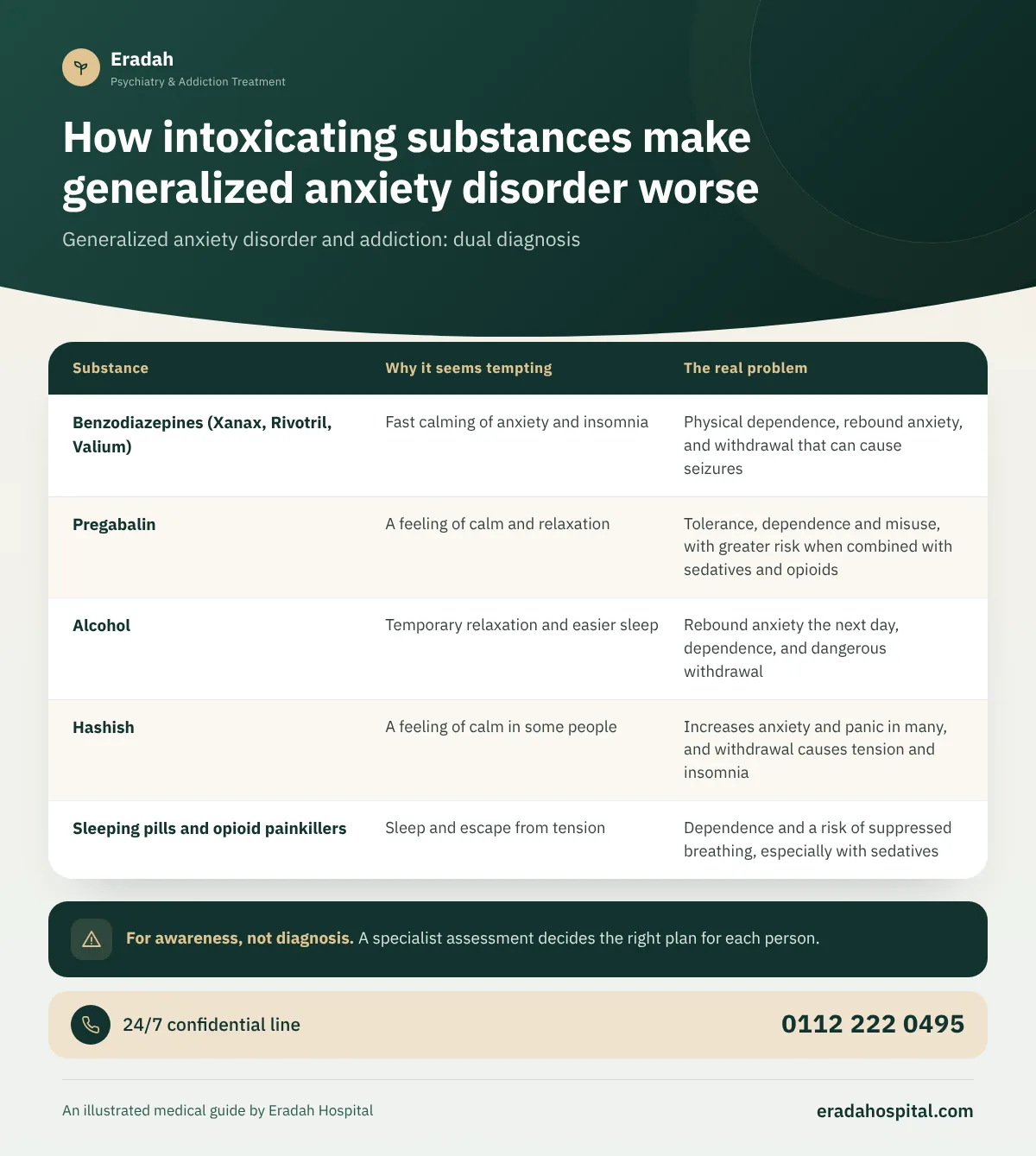
| Substance | Why it seems tempting | The real problem |
|---|---|---|
| Benzodiazepines (Xanax, Rivotril, Valium) | Fast calming of anxiety and insomnia | Physical dependence, rebound anxiety, and withdrawal that can cause seizures |
| Pregabalin | A feeling of calm and relaxation | Tolerance, dependence and misuse, with greater risk when combined with sedatives and opioids |
| Alcohol | Temporary relaxation and easier sleep | Rebound anxiety the next day, dependence, and dangerous withdrawal |
| Hashish | A feeling of calm in some people | Increases anxiety and panic in many, and withdrawal causes tension and insomnia |
| Sleeping pills and opioid painkillers | Sleep and escape from tension | Dependence and a risk of suppressed breathing, especially with sedatives |
Read more on the pages for Xanax, Rivotril, Valium, pregabalin, alcohol and cannabis.
How does an anxiety sedative turn into dependence?
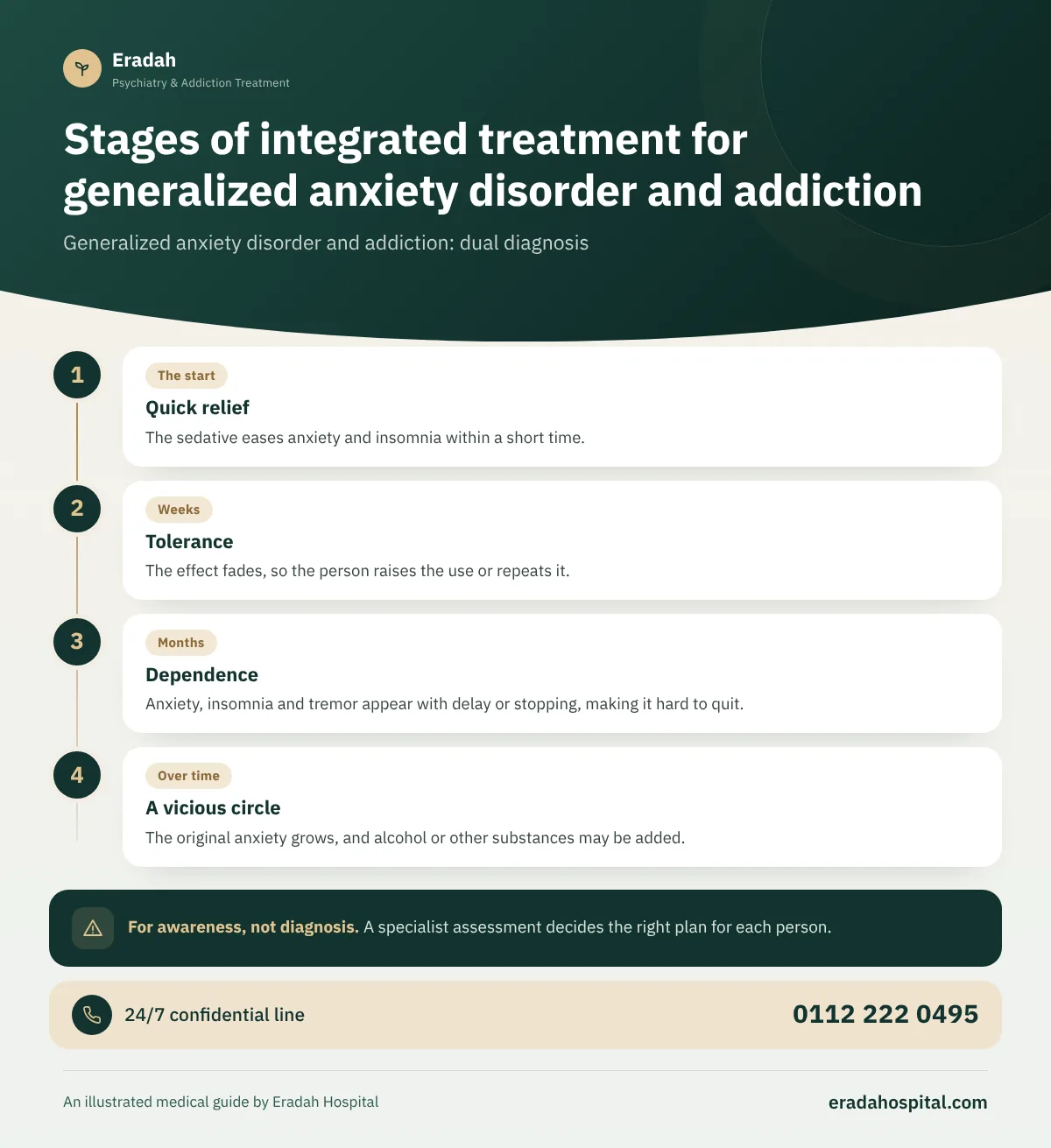
The story often begins with a short prescription or a pill from a relative on a hard day. The person feels relief and goes back to it the next day. With continued use the brain adapts, so a larger amount is needed for the same effect (tolerance), and anxiety returns between doses or when trying to stop, so the person thinks their “anxiety has increased” when it is partly withdrawal.
- The startQuick relief
The sedative eases anxiety and insomnia within a short time.
- WeeksTolerance
The effect fades, so the person raises the use or repeats it.
- MonthsDependence
Anxiety, insomnia and tremor appear with delay or stopping, making it hard to quit.
- Over timeA vicious circle
The original anxiety grows, and alcohol or other substances may be added.
How do substances make generalized anxiety worse?
- Rebound anxiety: When the substance wears off the anxiety returns stronger, especially with alcohol and short-acting sedatives.
- Disturbed sleep: Alcohol and sedatives spoil the quality of deep sleep, so exhaustion and tension increase.
- Blocked learning: The substance prevents the brain from learning that anxiety can be tolerated, so the disorder stays as it is.
- Complicated treatment: Some substances interact with psychiatric medications and reduce the benefit of psychological therapy.
- New problems: Family, legal and financial disputes add real sources of anxiety.
What are the signs that self-soothing has turned into addiction?
- Needing the substance every day to calm down or to sleep.
- Increasing the amount or frequency without consulting a doctor.
- Getting the sedative from more than one source or without a prescription.
- Anxiety, tremor and insomnia when it is later than the usual time.
- Hiding the use from family or the doctor.
- Mixing sedatives with alcohol or other substances.
Having two or more signs deserves a specialist assessment, without blame or shame; dependence on a substance that began as a way to calm anxiety is common and can be treated.
How are generalized anxiety and addiction treated together?
Integrated treatment means one team and one plan, not two separate treatments in two places. Its stages usually include:
- Comprehensive assessment: Distinguishing the original anxiety from anxiety caused by the substance or its withdrawal.
- Safe withdrawal: Gradual reduction of sedatives, alcohol or pregabalin under medical supervision, as an outpatient or in residential care depending on the case.
- Treating anxiety without dependence: Cognitive behavioral therapy, and medications such as antidepressants chosen by the doctor.
- Alternative skills: Coping with anxiety, insomnia and cravings without a substance.
- Relapse prevention: A clear plan for stressful situations, regular follow-up and family support.
Care in choosing medication matters here; the doctor avoids, as far as possible, medications with potential for misuse in someone with a history of dependence.
Are anxious young people more likely to try substances?
A teenager or young adult with ongoing, undiagnosed anxiety may find in cannabis or sedative pills that friends pass around a quick way to “calm down” or to fit in. The younger substance use begins, the greater the risk it becomes dependence, because the brain is still maturing.
So detecting anxiety early in children and treating it safely is also protection against addiction. If a family notices severe anxiety together with sudden changes in friends, sleep or money, it is best to seek a specialist assessment calmly and without accusation.
How can a family help an anxious person who depends on sedatives?
- Talk about the anxiety first, not about “addiction”: “We can see you're worn out and we want real relief for you.”
- Do not try to take the sedative away suddenly or hide it; that may be medically dangerous.
- Encourage a specialist assessment that treats both causes together.
- Do not share your own sedative medications, however good the intention.
- Ask for family guidance, since the family is part of recovery.
Dual diagnosis treatment for anxiety at Eradah
At Eradah we treat anxiety and addiction as one condition: psychological and medical assessment, safe supervised withdrawal from sedatives or alcohol, cognitive behavioral therapy for anxiety, and carefully considered medication follow-up, with a relapse prevention program and family support, in complete confidentiality.
Suicidal thoughts or severe hopelessness along with anxiety? Get help now
- Talking about wanting to die or being a "burden" on those around them
- Severe hopelessness and a feeling that the anxiety will never end and there is no way out
- Suddenly saying goodbye to family or giving away things that are dear to them
- Complete withdrawal from people and work with severe sleeplessness for consecutive days
- Overusing sedatives or alcohol, or mixing them, in search of relief
Stay with the person and do not leave them alone. Listen calmly, without judgment or blame, and ask them directly about their thoughts; asking does not plant the idea, it opens the door to help. Keep medications and dangerous objects out of their reach as far as possible, and call the ambulance (123) or go to the nearest emergency room, or call the mental health support line 16328, available around the clock.
Ambulance 123 Mental health support line 16328