Is pregabalin used for anxiety?
“The doctor said Lyrica would calm my nerves and anxiety, but I'm afraid of getting addicted.” This is a legitimate question many patients ask, because pregabalin's name in Egypt has been linked more to misuse than to anxiety treatment. The truth is that it has a place in treating anxiety, but a specific and conditional one.
Generalized anxiety disorder is a condition in which a person lives with constant, excessive worry that is hard to control for months, with tension, insomnia, fatigue and difficulty concentrating, and it is explained in the guide to generalized anxiety. Pregabalin, which many know as Lyrica, is licensed by the European Medicines Agency to treat this disorder in adults, but it is not licensed for this purpose in the United States.
This page focuses on one question: when is pregabalin for anxiety an appropriate choice, and when is it not? Its other uses are explained in the pregabalin guide.
What does research say about pregabalin for anxiety?
The European Medicines Agency states that its licence for generalized anxiety was based on eight studies involving more than 3,000 patients, in which 52% of those who took it improved by half or more on an anxiety scale, compared with 38% on placebo.
A systematic review published in 2017 pooled eight randomized trials involving 2,299 patients and found that pregabalin was superior to placebo with a small to moderate effect size, without a clear increase in dropping out of treatment because of side effects. A large network meta-analysis published in The Lancet in 2019, covering 89 trials and more than 25,000 patients, placed pregabalin among the more effective drugs with good acceptability, alongside duloxetine, venlafaxine and escitalopram.
Where does pregabalin come in an anxiety treatment plan?
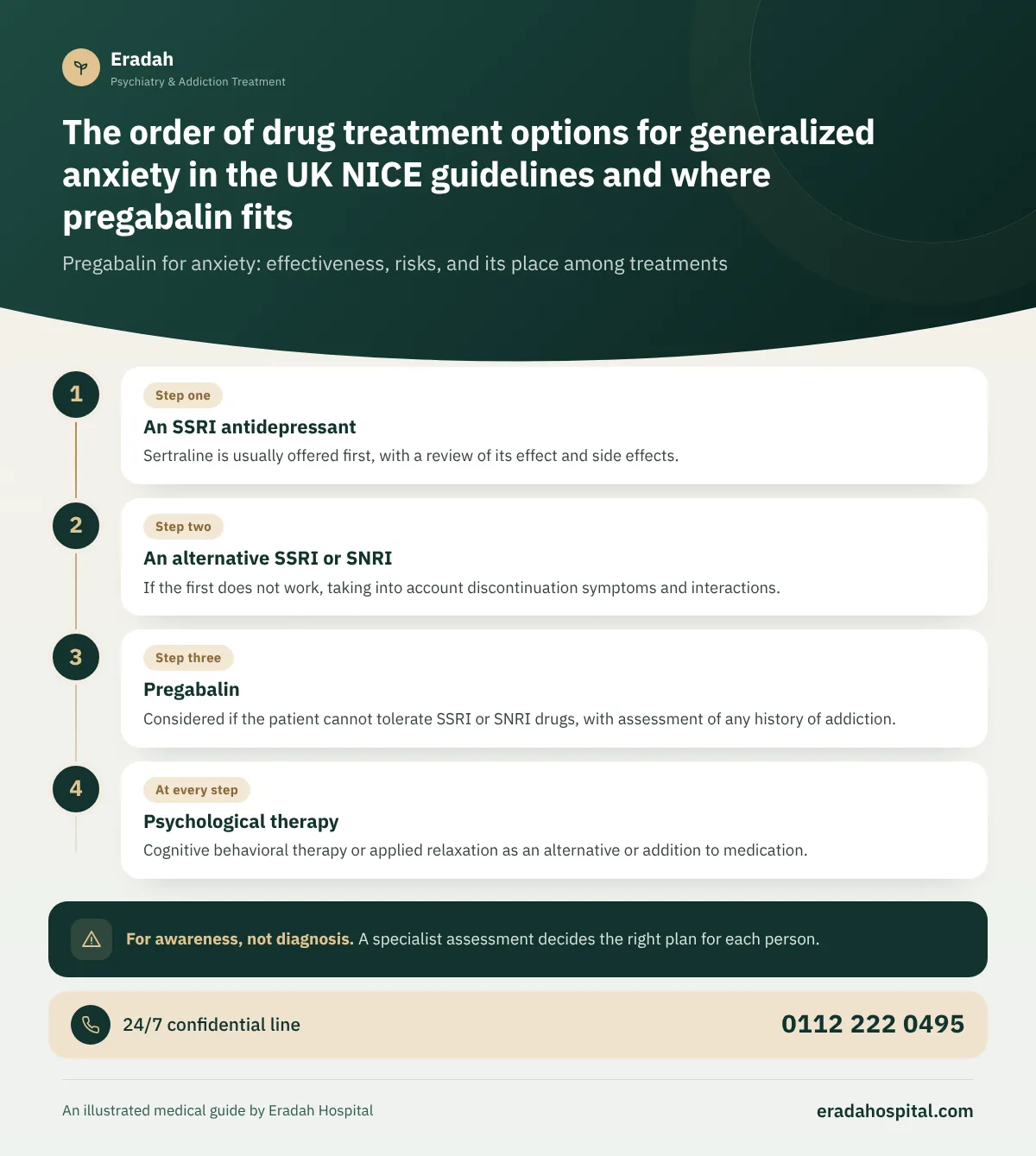
The UK guidelines for generalized anxiety (NICE CG113) recommend stepwise treatment for those who choose medication:
- Step oneAn SSRI antidepressant
Sertraline is usually offered first, with a review of its effect and side effects.
- Step twoAn alternative SSRI or SNRI
If the first does not work, taking into account discontinuation symptoms and interactions.
- Step threePregabalin
Considered if the patient cannot tolerate SSRI or SNRI drugs, with assessment of any history of addiction.
- At every stepPsychological therapy
Cognitive behavioral therapy or applied relaxation as an alternative or addition to medication.
The same guidelines state that benzodiazepines should not be prescribed for generalized anxiety except for a short period in a crisis, and that the patient should be carefully assessed for any history of substance misuse before pregabalin is prescribed, with monitoring for signs of misuse and dependence.
Why isn't pregabalin the first choice for anxiety?
For reasons of long-term safety, not effectiveness alone:
The Lyrica leaflet states that sudden discontinuation may cause symptoms that indicate physical dependence.
It is misused, especially in people with a history of opioids.
Among its most common effects, and they affect work and driving.
Gradual weight gain in some patients.
This does not mean it is a bad drug; it means that the antidepressants chosen first do not carry the same risk of misuse, which is why the guidelines start with them.
Who is pregabalin for anxiety not suitable for?
- Someone with a history of tramadol, heroin or other opioids.
- Someone who takes benzodiazepines or sleeping pills or drinks alcohol regularly, because of the risk of respiratory depression.
- People with impaired breathing or lung disease, except with great caution and monitoring, according to the warning in its official leaflet.
- Someone with anxiety and active drug use that has not yet been treated, where integrated treatment under dual diagnosis is preferable.
The page on anxiety and addiction explains how each feeds the other.
The risk of treating anxiety with pregabalin without a prescription
Many people start with a pill from a friend “to calm down,” then find that the anxiety comes back worse when they are late with it. Sudden discontinuation can cause insomnia, anxiety, sweating and nausea, symptoms that resemble the original anxiety and so look like proof that the drug is needed. This cycle is one of the fastest routes to dependence, and it is explained on the page about the causes of pregabalin addiction.
Pregabalin alternatives for treating anxiety
You have effective options: antidepressants such as sertraline, escitalopram (Cipralex) and duloxetine, and psychological therapy such as cognitive behavioral therapy. The page on pregabalin alternatives sets out alternatives by reason for the prescription. At Eradah, the psychiatrist assesses your condition and sets an integrated plan, and the first consultation is free and confidential.
Danger signs after taking pregabalin: call an ambulance (123) immediately
- Deep drowsiness or difficulty waking.
- Slow or weak breathing, especially with tramadol, sedatives or alcohol.
- Severe confusion, unsteadiness or slurred speech.
- Swelling of the face, lips or tongue, or difficulty breathing.
- Seizures.
Call ambulance (123) immediately. If the person is unconscious but breathing, place them on their side so they do not choke on vomit. Stay with them and do not leave them alone. Do not give them food or drink, and tell the paramedics everything they took or used, and the amount and time if you know them.
Call the ambulance 123