A person who goes through repeated episodes of depression may not notice that they also lived through periods of excess energy, little sleep and impulsiveness. These periods are what this test looks for, because their presence changes the treatment approach entirely.
Start the bipolar test
How is the score calculated?
Each “yes” answer to the first thirteen questions equals one point, so the score ranges from 0 to 13. The screen is positive only when three conditions are met together: 7 or more “yes” answers, several of these symptoms having happened in the same period, and their having caused a moderate or serious problem. The last two questions are not added to the score.
| Result | Explanation | Suggested step |
|---|---|---|
| 0 – 6 “yes” answers | Negative | The scale does not point to bipolar disorder |
| 7 – 13 without one of the two conditions | Does not meet the screening criteria | Discuss the symptoms with a specialist if they are bothersome |
| 7 – 13 with symptoms occurring together and a moderate or serious problem | Positive | Assessment by a psychiatrist soon |
What to do after your result
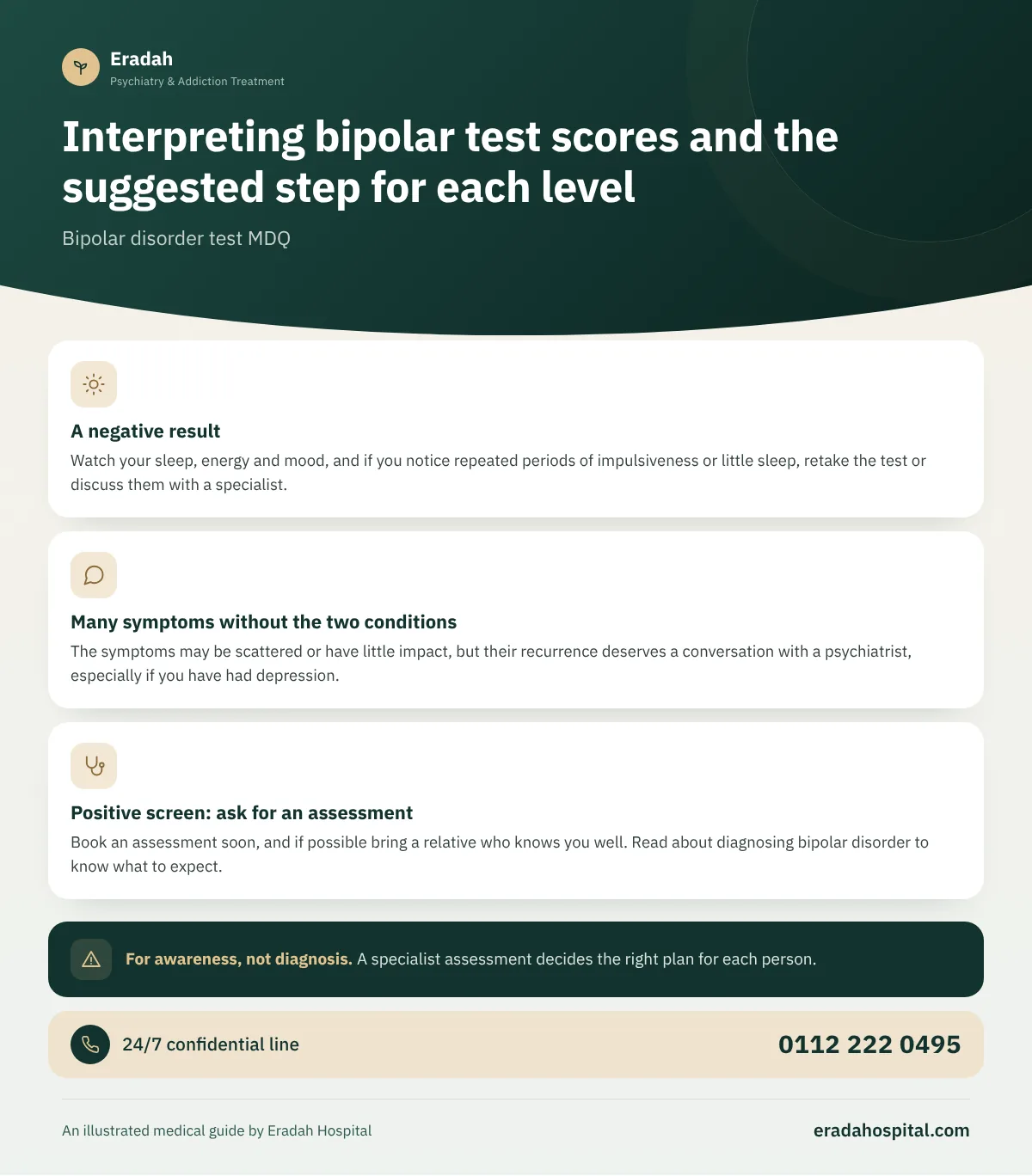
Watch your sleep, energy and mood, and if you notice repeated periods of impulsiveness or little sleep, retake the test or discuss them with a specialist.
The symptoms may be scattered or have little impact, but their recurrence deserves a conversation with a psychiatrist, especially if you have had depression.
Book an assessment soon, and if possible bring a relative who knows you well. Read about diagnosing bipolar disorder to know what to expect.
It is important that your doctor knows your result if you are taking an antidepressant or thinking of starting one, because in some people with bipolar disorder, antidepressants alone can contribute to a switch of mood toward mania. Do not stop or start any medication on your own; only the doctor decides the safe plan.
What is the MDQ scale?
Dr. Robert Hirschfeld and colleagues developed the Mood Disorder Questionnaire, and its validation study was published in 2000. Its thirteen questions are based on the criteria for a manic episode in the diagnostic manual and on clinical experience. Among patients in psychiatric clinics, it picked up about seven in ten people with bipolar disorder and ruled out about nine in ten people without it. In the general population, a later study showed its sensitivity is much lower, as it misses many cases, especially those with hypomania, so a negative result is not enough to reassure someone with a strong suspicion. The scale is widely used today in clinics and in many languages, but it remains a first step that comes before the diagnostic interview and does not replace it.
Mania and hypomania: what is the difference?
A manic episode is a period lasting at least a week in which mood is clearly elevated or irritability clearly increased, with little need for sleep and impulsiveness that can lead to dangerous decisions, and sometimes it needs hospital care. Hypomania is shorter and milder, and the person may see it as an enjoyable period of energy and productivity, while those close to them notice they are not themselves. That is why hypomania is often missing from memory and from the diagnosis, and the person is treated for years as having depression alone.
- If you have repeated episodes of depression interspersed with periods of striking energy, tell your doctor about it openly.
- Having a first-degree relative with bipolar disorder is important information in the assessment.
- Recording sleep and mood daily for a few weeks helps the doctor see the pattern clearly.
- If your family notices a clear change in your sleep, speech or spending, take their observation seriously even if you feel fine.
Limits of the test
- It does not diagnose bipolar disorder, and does not determine its type.
- It depends on remembering periods that may be far in the past, and many people do not see hypomanic episodes as a problem.
- Stimulants, alcohol and some medications can cause symptoms that resemble mania.
- Severe anxiety and borderline personality disorder can raise the score without bipolar disorder being present.
- It misses many cases in the general population, so a negative result does not rule out the disorder.
bipolar and addiction
Bipolar disorder is one of the mental disorders most often paired with addiction: impulsiveness in manic episodes pushes toward experimenting and overindulgence, and the crash of depressive episodes pushes toward looking for numbness. The substances themselves increase mood swings and weaken the response to treatment, and some stimulants can reveal the first manic episode in someone predisposed to it. This is why having both problems requires a single integrated plan, as covered in the article on bipolar disorder and addiction and the dual diagnosis treatment program.
Free confidential consultation
If your screen is positive, or your mood swings are affecting your work and relationships, do not wait for the next episode. Contact the Eradah team for a free, confidential first consultation on 01122220495, and we will help you arrange a suitable assessment.