Who diagnoses bipolar disorder?
Diagnosis is the responsibility of the psychiatrist, and a clinical psychologist may take part using rating scales and structured interviews. The UK’s NICE guidelines recommend that anyone suspected of having the condition be referred to a specialist mental health service for assessment, rather than relying on a quick impression.
Diagnosis sometimes takes time. The doctor may first see the patient during a depressive episode, which does not by itself reveal the bipolar nature, so the doctor relies on the medical history, the family’s observations and follow-up.
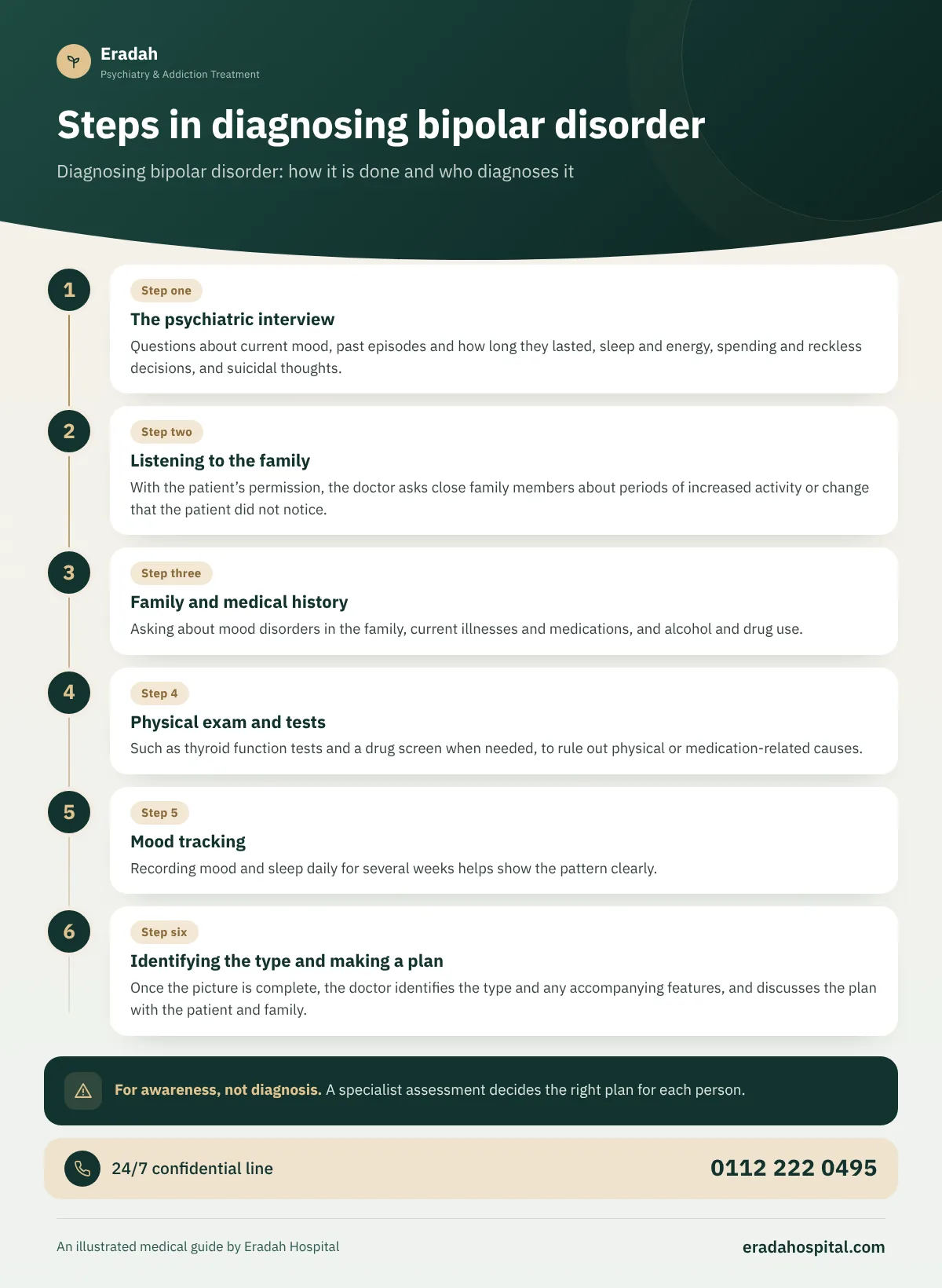
What are the steps in diagnosing bipolar disorder?
- Step oneThe psychiatric interview
Questions about current mood, past episodes and how long they lasted, sleep and energy, spending and reckless decisions, and suicidal thoughts.
- Step twoListening to the family
With the patient’s permission, the doctor asks close family members about periods of increased activity or change that the patient did not notice.
- Step threeFamily and medical history
Asking about mood disorders in the family, current illnesses and medications, and alcohol and drug use.
- Step 4Physical exam and tests
Such as thyroid function tests and a drug screen when needed, to rule out physical or medication-related causes.
- Step 5Mood tracking
Recording mood and sleep daily for several weeks helps show the pattern clearly.
- Step sixIdentifying the type and making a plan
Once the picture is complete, the doctor identifies the type and any accompanying features, and discusses the plan with the patient and family.
What is a mood diary good for?
A mood diary is a simple tool in which a person records each day a rating of their mood on a scale from very low to very high, along with hours of sleep, important events and any substances they used. Over time it reveals patterns: when do episodes begin? What comes before them? Are they linked to a particular season or a specific stress?
- Daily mood level, from low to high.
- Hours of sleep and sleep times.
- Energy level and irritability.
- Major stressful or joyful events.
- Medications and any alcohol or drugs.
The diary is also useful later in follow-up, because it helps spot early warning signs before an episode.
Which rating scales are used in the assessment?
Doctors use validated scales that help with screening or measuring severity, but they do not replace the clinical interview. Among the best known are:
| Measure | Purpose |
|---|---|
| Mood Disorder Questionnaire (MDQ) | A screening tool that asks about past manic or hypomanic periods. |
| Hypomania Checklist (HCL-32) | Helps detect hypomanic periods that the patient may overlook. |
| Young Mania Rating Scale (YMRS) | Measures the severity of current manic symptoms and tracks improvement. |
| Depression scales such as the PHQ-9 | Measure the severity of current depression, and cannot on their own tell depression from bipolar disorder. |
Is there a blood test or scan to diagnose bipolar disorder?
There is currently no test or scan that confirms the diagnosis. But the doctor may order tests and examinations for two reasons: to rule out other causes that can produce similar symptoms, such as thyroid disorders or the effects of drugs or medications, and to assess physical health before starting certain medications, such as kidney and liver function. A brain scan may be requested if symptoms first appear late in life or in an unusual way.
How does the doctor tell it apart from similar conditions?
This is one of the most delicate parts of diagnosis, because more than one condition can involve mood swings, impulsiveness or poor concentration:
| The situation | Similarities | What points toward bipolar disorder |
|---|---|---|
| Depression | Episodes of sadness and loss of pleasure | A manic or hypomanic episode at any point, and a family history of bipolar disorder |
| ADHD (attention-deficit/hyperactivity disorder) | Distractibility, talkativeness and impulsiveness | In bipolar disorder the symptoms come in episodes with a beginning and an end, not continuously since childhood, and are accompanied by a reduced need for sleep |
| Borderline personality | Emotional swings and impulsiveness | In borderline personality, mood shifts happen within hours and are tied to relationships, whereas the episodes here last days and weeks |
| Effect of drugs | Activity, insomnia and agitation resembling mania | Symptoms that persist or recur after a sufficient period without the substance |
| Schizophrenia | Hallucinations and delusions | Psychosis is tied to mood episodes and usually clears between episodes |
| Thyroid disorders | Hyperactivity and anxiety, or sluggishness | Normal thyroid tests and a distinctive history of episodes |
Bipolar disorder can also genuinely coexist with another condition, such as ADHD, anxiety or addiction, in which case each needs its own plan. Details of the overlap with borderline personality and depression are on their own pages.
Why does the right diagnosis matter before antidepressants?
When bipolar disorder is treated as depression only, an antidepressant may be prescribed on its own. The US National Institute of Mental Health (NIMH) notes that antidepressants are not used alone in this disorder because they may trigger a manic episode or rapid cycling in some patients.
To be fair, research on the size of this risk is mixed and seems to vary by the type of drug and the type of disorder, and it does not mean antidepressants are completely “forbidden.” A doctor may use them in certain cases alongside a mood stabilizer or an antimanic medication, with close monitoring. What matters is that every patient with depression is asked about any past manic periods and about family history before a treatment is chosen.
Why is self-diagnosing online risky?
- A person may be wrongly reassured and delay treatment, or worry unnecessarily.
- Online tests cannot tell bipolar disorder from similar conditions, and cannot see the effect of substances and medications.
- The word “bipolar” is used in everyday talk to describe any kind of mood swing, which distorts the picture of the real illness.
- Self-diagnosis may push someone to try medication without a prescription, which is dangerous.
How do you prepare for your assessment appointment?
- Write down the dates of periods when you felt unusually low or high, and how long they lasted.
- Record your sleep and mood for two weeks before the appointment if you can.
- Gather the names of the medications you take or have taken in the past.
- Be honest about alcohol and drugs; the information is confidential and it changes the diagnosis and the plan.
- Bring a close person with you if you wish; their observations are very useful.
After diagnosis, the planning stage begins. Learn about the available options on the page about treatment of bipolar disorder.