How do bipolar disorder symptoms appear?
Bipolar disorder symptoms do not show up all the time. They come in episodes with a beginning and an end, often separated by periods when the person returns to their usual self. Each episode looks quite different, so much so that the family may feel they are dealing with two different people.
Episodes usually last days or weeks, and may be separated by weeks, months or years of stability. In some patients episodes come very close together, which is known as rapid cycling.
What are the symptoms of a manic episode?
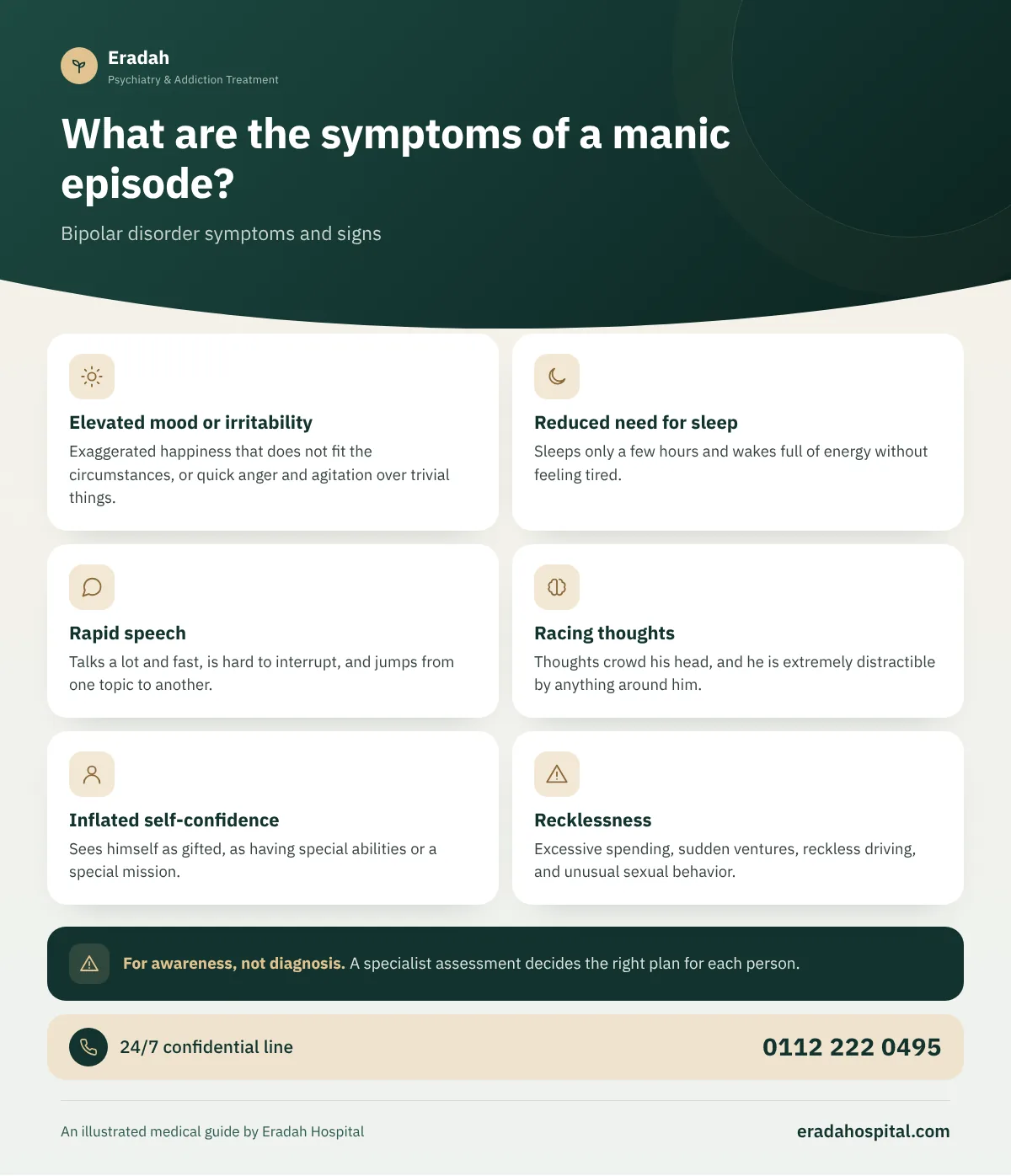
Mania is a period in which mood is abnormally elevated or dominated by irritability, with a clear increase in energy and activity, lasting at least a week for most of the day, or less if hospitalization is needed. It comes with several of these signs:
Exaggerated happiness that does not fit the circumstances, or quick anger and agitation over trivial things.
Sleeps only a few hours and wakes full of energy without feeling tired.
Talks a lot and fast, is hard to interrupt, and jumps from one topic to another.
Thoughts crowd his head, and he is extremely distractible by anything around him.
Sees himself as gifted, as having special abilities or a special mission.
Excessive spending, sudden ventures, reckless driving, and unusual sexual behavior.
In severe mania, psychotic symptoms can appear, such as fixed, unrealistic beliefs (delusions) or hearing voices that are not there. At that point the situation becomes an emergency that needs immediate assessment.
What are the symptoms of hypomania, and why is it hard to notice?
Hypomania has the same signs but in a milder form. It lasts at least four consecutive days, is not accompanied by psychosis, and does not disrupt life to the point of needing hospitalization. That is why it can look, to the person and those around them, like “a period of activity and productivity” rather than an illness.
- Excess enthusiasm and many ideas and projects in a short time.
- Less sleep than usual with high energy.
- Excessive sociability and lots of contact with people.
- Irritability and impatience when interrupted or objected to.
What are the symptoms of a depressive episode in bipolar disorder?
A depressive episode here looks like ordinary depression, lasts at least two weeks, and may be the longest and heaviest part of the illness. It includes:
| Type | Signs |
|---|---|
| Emotional | Sadness, emptiness or hopelessness, loss of pleasure in things he used to love, and feelings of guilt or worthlessness. |
| Mental | Slowed thinking, difficulty concentrating and making decisions, and forgetfulness. |
| Physical | Severe fatigue, sleeping far too much or insomnia, changes in appetite and weight, and slowed movement. |
| Behavioral | Withdrawal from people, neglect of work and personal hygiene, and staying in bed. |
| Dangerous thoughts | Thoughts of death or suicide, which call for seeking help immediately. |
Doctors note that depression in bipolar disorder may sometimes come with excess sleep, increased appetite and a heavy feeling in the body, or with psychotic features, and may begin at a younger age than ordinary depression.
What is a mixed episode?
In a mixed episode, signs of mania and depression occur at the same time: energy, agitation, insomnia and racing thoughts together with sadness, hopelessness and guilt. It is one of the hardest states for the patient, because hopelessness combined with impulsiveness raises the danger to his safety, so it needs urgent assessment, not waiting.
What are the early signs that an episode is starting?
Each person has a “signature” that comes before their episodes, and learning it with the doctor and family is one of the most important ways to protect against them. Among the best known:
| Before mania | Before depression |
|---|---|
| Less sleep without tiredness | More sleep, or early waking with heaviness |
| Faster, louder speech | Talking less and withdrawing |
| Many sudden projects and plans | Putting off tasks and losing enthusiasm |
| Extra spending and unusual generosity | Losing interest in hobbies and people |
| Irritability and impatience | Crying, extra sensitivity and pessimism |
Do the signs differ in teenagers, women and older adults?
Severe irritability, angry outbursts, recklessness and falling school performance may appear more than euphoria, and they overlap with normal adolescent mood swings, so they need a specialist assessment.
More prone to depressive and mixed episodes, and the risk of relapse may rise after childbirth, including postpartum psychosis, which is an emergency.
Mania, recklessness and aggression may predominate, help is often sought late, and the picture is often mixed with alcohol and drug use.
If a first manic episode appears after midlife, the doctor first looks for a physical or medication-related cause.
Does bipolar disorder come with hallucinations and delusions?
They can occur in severe mania or severe depression. In mania, delusions are usually about grandiosity, superhuman abilities or a special mission; in depression, about guilt, illness or punishment. This can lead to confusion with schizophrenia, but the psychotic symptoms here are tied to the episode and usually settle with its treatment.
How do episodes look to the family?
The family is often the first to notice the change, because the patient in mania feels he is at his best. Signs families describe include:
- Staying up until dawn on “great projects,” then heading out in the morning with full energy.
- Many calls and messages to people he has not contacted in years.
- Exaggerated purchases, loans or gifts that do not fit his income.
- A sudden shift from liveliness to staying in his room for weeks with no desire for anything.
When you speak with him, choose a quiet moment, describe what you noticed in “I’m worried about you because I noticed...” language rather than accusing, and suggest seeing the doctor together.
Questions for self-reflection (not a diagnosis)
- Have you had a period lasting days when you felt unusual energy or elation and slept little without feeling tired?
- Did people around you notice that you were talking faster, or that you were not yourself?
- During that period, did you make reckless financial or personal decisions that you later regretted?
- Have you also had periods of sadness and loss of pleasure lasting two weeks or more?
- Has anyone in your family been diagnosed with bipolar disorder?
Acute mania or suicidal thoughts? Get help now
- Talking about wanting to die or being a “burden” on others, or feeling complete despair
- Saying goodbye to family, giving away belongings, or sudden isolation
- No sleep for several days in a row with severe agitation or nonstop racing speech
- Hearing voices that command them to act, or fixed strange beliefs that they are being pursued or have a special mission
- Dangerous reckless behavior that puts them or others at risk of harm, or unusual aggression
Stay with the person and do not leave them alone, and listen calmly, without arguing or blaming. Call the ambulance on 123 or take them to the nearest emergency department, or call the mental health support line 16328, available around the clock, and keep anything they could hurt themselves with out of their reach.
Ambulance 123 Mental health support line 16328