Why do people confuse bipolar disorder with borderline personality?
“My daughter’s mood changes several times a day, one moment happy and the next falling apart, and if anyone upsets her with a word, the world turns upside down. Is that bipolar?” It is a question that comes up often, and the answer may be yes, it may be no, and it may be both.
A review published in the Journal of Nervous and Mental Disease in 2015 explains that borderline personality disorder and bipolar disorder are often confused because of overlapping symptoms, since both involve unstable mood. But it stresses that the pattern of mood change is quite different: in borderline personality there are brief swings in response to relationship stress, while in bipolar disorder there are sustained mood changes.
How long does the swing last? The first and clearest difference
The US National Institute of Mental Health (NIMH) notes that a person with borderline personality may have intense episodes of anger, depression or anxiety lasting from a few hours to days. In bipolar I, by contrast, the NIMH says a manic episode lasts at least 7 days for most of the day, nearly every day, or is severe enough to need hospital care, and depressive episodes usually last at least two weeks.
Between bipolar episodes, a person may return to their normal state for weeks, months or years, as the NHS explains, whereas mood instability in borderline personality is a near-constant part of daily life and relationships.
What sets off the swings?
In borderline personality the driver is usually relationships: a feeling of rejection or abandonment, or a dispute with someone close. The NIMH lists among its symptoms efforts to avoid real or imagined abandonment, intense unstable relationships, high sensitivity to rejection, an unstable self-image, a chronic feeling of emptiness, and intense anger that is hard to control.
Bipolar episodes, on the other hand, may come with no clear external cause, or after triggers such as lack of sleep or severe stress, and they run their own course even if circumstances improve. It is useful to note that the NIMH cautions that impulsive behavior happening only during periods of elevated mood or energy may be a symptom of a mood disorder rather than borderline personality.
What is the difference between bipolar disorder and borderline personality in a table?
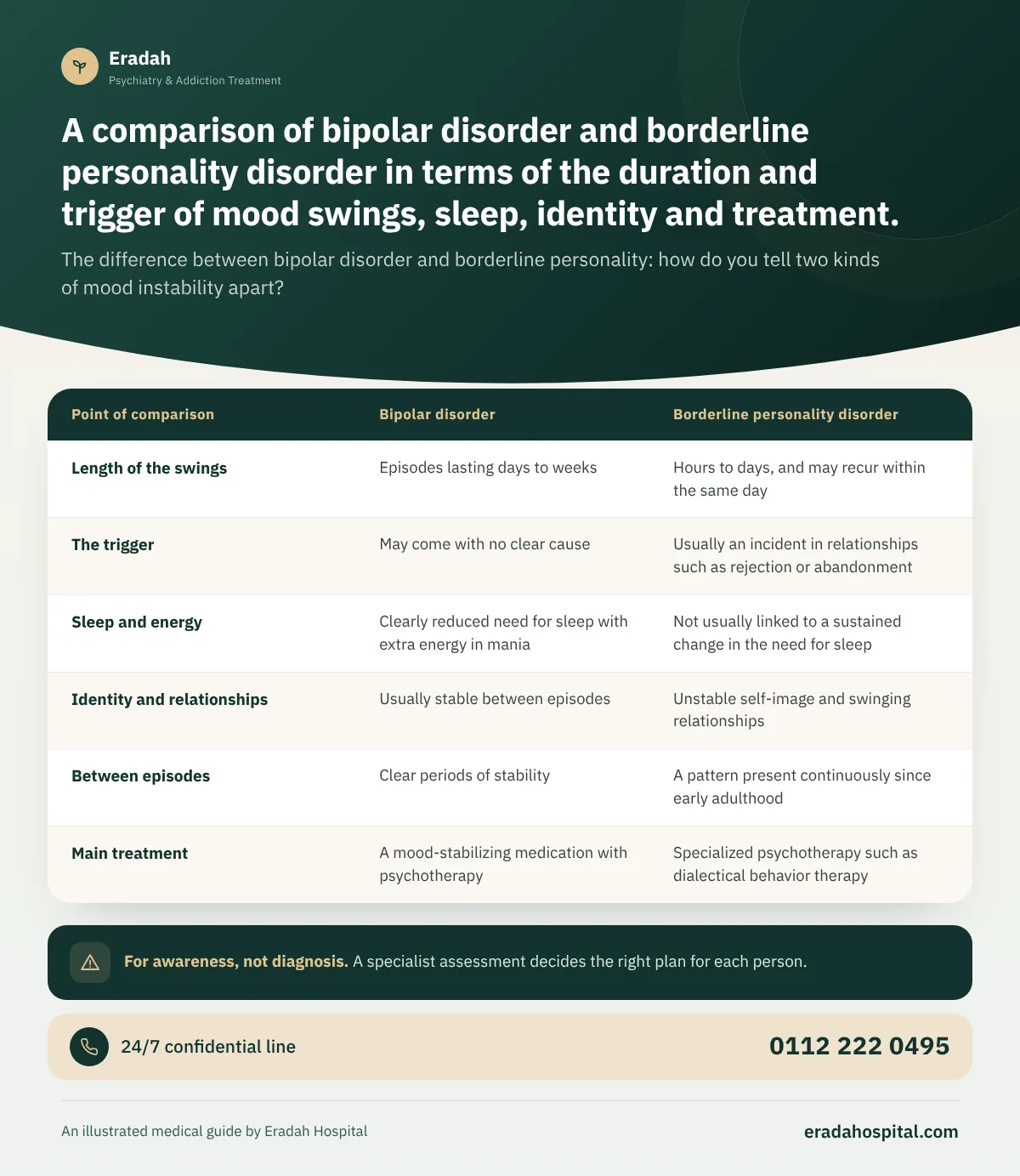
| Point of comparison | Bipolar disorder | Borderline personality disorder |
|---|---|---|
| Length of the swings | Episodes lasting days to weeks | Hours to days, and may recur within the same day |
| The trigger | May come with no clear cause | Usually an incident in relationships such as rejection or abandonment |
| Sleep and energy | Clearly reduced need for sleep with extra energy in mania | Not usually linked to a sustained change in the need for sleep |
| Identity and relationships | Usually stable between episodes | Unstable self-image and swinging relationships |
| Between episodes | Clear periods of stability | A pattern present continuously since early adulthood |
| Main treatment | A mood-stabilizing medication with psychotherapy | Specialized psychotherapy such as dialectical behavior therapy |
Can the two disorders occur together?
Yes, and not rarely. An analysis published in the Journal of Affective Disorders in 2016 pooled the results of 42 studies and found that borderline personality was present in 21.6% of people with bipolar disorder, rising to 37.7% of those with bipolar II, and that bipolar disorder was present in 18.5% of people with borderline personality. That means about 1 person in 5 has both diagnoses.
Even so, the researchers concluded that the differences between the two disorders are clearer and more important than the similarities. When they coexist, the patient needs a plan that treats both: medication for the mood episodes, and psychotherapy for patterns of emotion and relationships. The NIMH notes that borderline personality affects about 1.4% of US adults in a year, while bipolar disorder affects about 4.4% of them over their lifetime.
Why does the right diagnosis matter?
The Journal of Nervous and Mental Disease review stresses that a mistake in telling them apart can deprive the patient of effective treatment: if borderline personality is diagnosed as bipolar disorder, the patient may receive many medications without getting the psychotherapy he actually needs. And if bipolar disorder is diagnosed as a “temperament” or a personal problem, he may miss the medication that prevents dangerous episodes.
- In borderline personality, dialectical behavior therapy is among the leading treatments, and the NIMH lists it among the well-established ones.
- In bipolar disorder, mood stabilizers are the foundation of prevention, together with psychotherapy and regulating sleep, as we explain in treatment of bipolar disorder.
- Do not start or stop any medication without a doctor, since only the doctor decides the type and the dose.
Questions to help you before seeing the doctor
These questions do not diagnose, but they help you describe to the doctor accurately what is happening:
- How long do the swings usually last: hours or continuous days?
- Do they come after an incident with someone close, or with no clear reason?
- Have there been long periods when the need for sleep dropped, with unusual energy and activity?
- Do your self-image and goals change a lot, and do your relationships swing between attachment and aversion?
- Are there long periods of stability between crises?
- Does anyone in the family have bipolar disorder?
It also helps to record mood and sleep daily for several weeks, as we explain in diagnosing bipolar disorder.
Self-harm and suicidal thoughts in both conditions
The NIMH notes that rates of self-harm and of suicidal thoughts and behaviors are much higher in people with borderline personality than in the general population, and that anyone thinking of harming themselves needs immediate help. The risk of suicide in bipolar disorder is also high. So do not treat self-harm as “attention-seeking”; treat it as a sign of pain that deserves support, and learn how to help in the page on self-harm.
At Eradah you can get a free, confidential first consultation for a careful assessment, with a treatment plan in the outpatient clinics, and residential treatment for men during acute episodes or when the condition coexists with addiction.
Self-harm or suicidal thoughts? Get help now
- Talk about death or wanting to disappear after a dispute or rejection
- Cuts or repeated self-harm
- A manic episode with no sleep for days and dangerous recklessness
- Severe hopelessness and isolation with saying goodbye or giving away belongings
- Substance use or heavy drinking along with thoughts about death
Stay with the person and listen calmly without blame or accusing them of seeking attention, and keep medications and sharp objects out of reach. Call the ambulance on 123 or go to the nearest emergency room if the danger is imminent, and contact the mental health support line 16328, available around the clock.
Ambulance 123 Mental health support line 16328