The phone is a normal part of life, but the line between heavy use and loss of control is thin. These statements help you notice the signs of phone addiction in your own day, not in general statistics.
Start the phone addiction test
How is the score calculated?
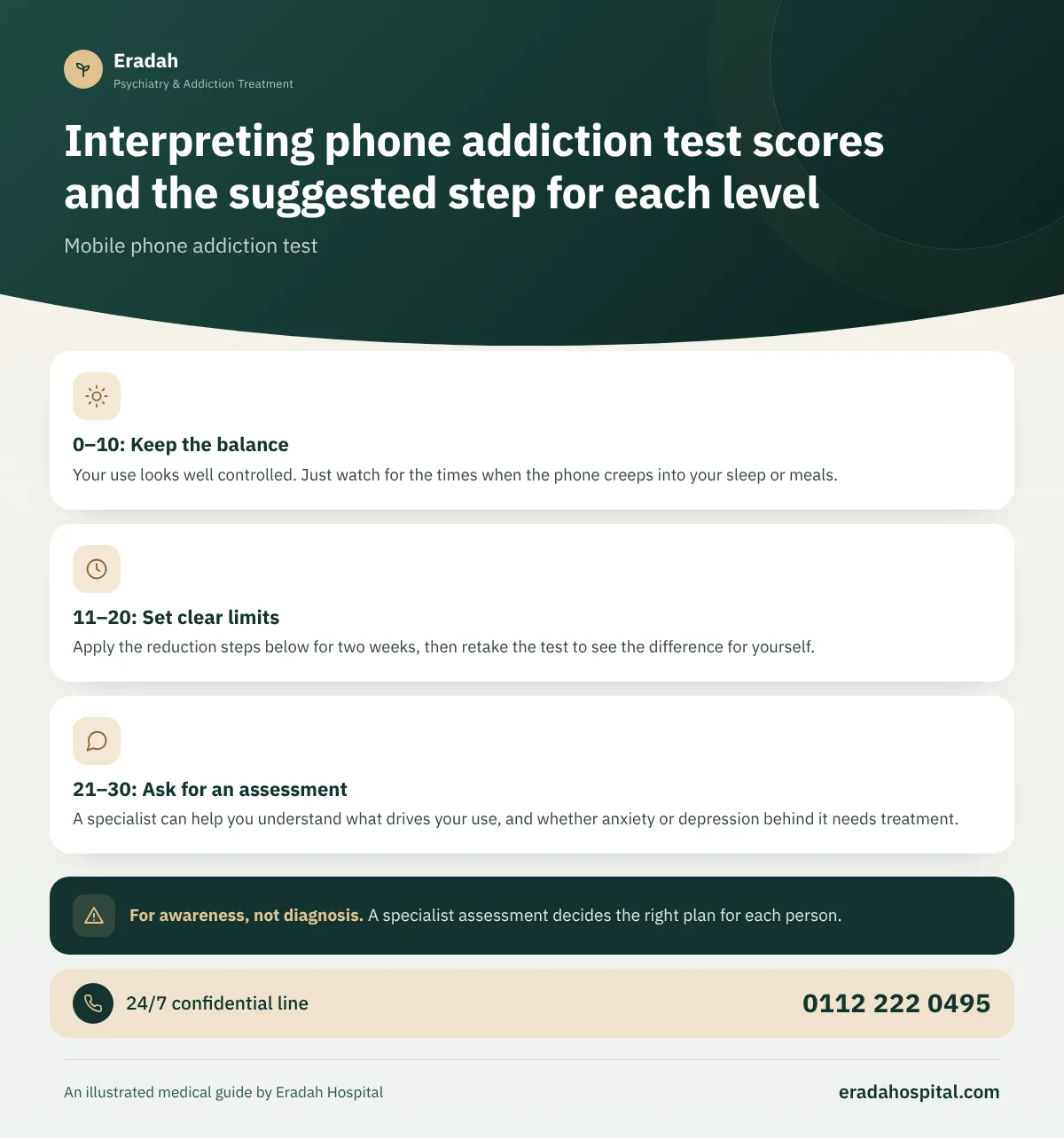
Each statement has a score: “Never” = 0, “Sometimes” = 1, “Often” = 2, and “Almost always” = 3. The scores are added to give a number from 0 to 30. Because this is an unvalidated awareness questionnaire, the ranges are cautious estimates describing how likely an assessment is to help you, not whether an addiction exists:
| Level | Meaning | Suggested step |
|---|---|---|
| 0 – 10 | Low likelihood | Keep up your healthy habits |
| 11 – 20 | Moderate likelihood | A two-week reduction plan, then retake the test |
| 21 – 30 | High likelihood | An assessment by a specialist in treating phone addiction |
What to do after your result
Your use looks well controlled. Just watch for the times when the phone creeps into your sleep or meals.
Apply the reduction steps below for two weeks, then retake the test to see the difference for yourself.
A specialist can help you understand what drives your use, and whether anxiety or depression behind it needs treatment.
Practical steps to reduce phone use
- Turn off unnecessary notifications, leaving only calls and messages from important people.
- Take the phone out of the bedroom, and use a regular alarm clock instead.
- Set phone-free times: meals, the first hour after waking, and time with the family.
- Turn on the usage limit tool in your phone settings for the apps that take most of your time.
- Move tempting apps off the home screen, or try grayscale mode to make them less appealing.
- Plan an enjoyable alternative for moments of free time: a short walk, a book, or a voice call with a friend.
- Cut down gradually instead of stopping suddenly, and reward yourself for every day you stick to it.
Don't expect the urge to pick up the phone to disappear on the first day; the first days are often accompanied by boredom and mild tension, which then fade gradually as your mind gets used to the new rhythm. Keep simple notes on your sleep, concentration and mood over the two weeks, which will help you see improvement when progress feels slow.
Why is it hard to give up the phone?
The difficulty is not weak willpower; infinite scrolling, sudden notifications, like counters and back-to-back short clips are all designed to keep you as long as possible. It gets worse when the phone becomes your only escape from stress or loneliness, so that your mind links it with quick relief. That is why change works when you adjust the environment around you, not when you rely on resistance alone, and when you look for what drives you to the phone in the first place.
Signs that worry parents in their children
- Severe tantrums or crying when the phone is taken or the internet goes down.
- Repeated late nights on the phone and obvious difficulty waking up for school.
- Falling grades and losing interest in sports, friends and old hobbies.
- Hiding how long they use it, or lying about what they do on the phone.
If the user is a child or teenager, shared family rules work better than bans, and it helps when parents see themselves as role models in sticking to them. The Eradah team sees children and teenagers for assessment with the family's involvement.
What is this questionnaire based on?
The DSM-5 diagnostic manual does not recognize phone addiction as a separate diagnosis, but it describes the traits of behavioral addiction, such as mental preoccupation, loss of control, distress on disconnection, and continuing despite harm. We built the statements from these traits in everyday language, so it is a tool for awareness and self-reflection and has not undergone scientific validation studies.
There are published research scales for smartphone use, the best known being the short version of the Smartphone Addiction Scale, developed in South Korea in 2013. Scientific reviews link excessive phone use with higher symptoms of anxiety and depression, without yet settling which comes first, which is why the doctor cares about mood and sleep as much as the number of hours.
Limits of the test
- An unvalidated awareness questionnaire that does not diagnose any disorder.
- Long usage time alone does not mean addiction; what matters is loss of control and harm.
- It does not distinguish between types of use, such as games, social networking sites or pornographic content.
- Anxiety, depression and lack of sleep can raise the score, and may be the underlying problem.
- A low score does not rule out needing help if you are really struggling.
The phone and addiction
Apps are designed to give you small, intermittent rewards, the same pattern that makes the brain's reward system ask for more, as we explain in the article on dopamine and addiction. That is why excessive phone use often overlaps with addiction to social networking sites and gaming, and with anxiety and depression.
If you want to talk to a specialist about your result or your son's phone use, contact us on 01122220495 for a free and completely confidential consultation.