What is internet addiction?
"I open the net to reply to one message, and find it's 3 a.m." Today the internet is an indispensable tool for work, study and communication, which is why it is hard to tell when it turns from a tool we use into a habit that uses us. This guide explains the line between the two.
The term internet addiction appeared in the mid-1990s, and the American psychologist Kimberly Young was among the first to describe it, borrowing the criteria for pathological gambling to describe people who lose control of their time in front of a screen. Researchers then moved to a more precise term, problematic internet use, which a European research network, in a statement published in 2018, defines as an umbrella for repeated behaviors that impair a person's life, with the internet as their channel.
What forms does internet addiction take?
The only form recognized as a stand-alone diagnosis in the International Classification of Diseases.
Compulsive scrolling and constant seeking of interaction and likes.
Available around the clock at the press of a button.
Compulsive buying without a real need.
Compulsive viewing that affects relationships and concentration.
Aimless hopping between videos and articles for hours.
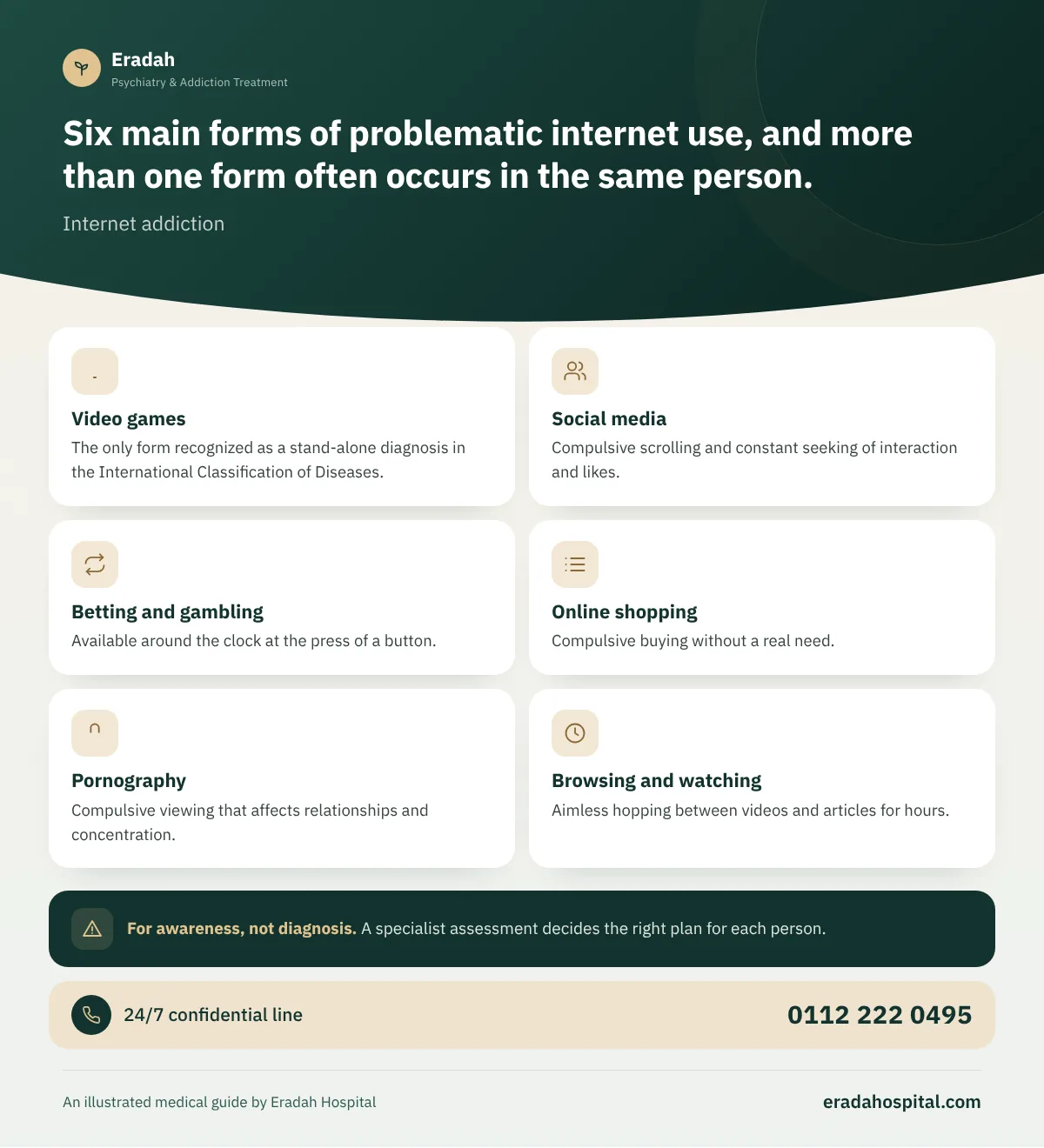
These six forms are roughly those listed in the European statement, and more than one form often occurs in the same person. Each form has its own detailed guide: gaming addiction, social media addiction, gambling and betting addiction, shopping addiction, pornography addiction, and binge-watching addiction.
What is the difference between internet addiction, phone addiction and social media addiction?
| Problem | Focus of attachment | System |
|---|---|---|
| Internet addiction | Any online activity, or several activities together | Any device: computer, phone or game console |
| Smartphone addiction | The device itself, repeated checking and notifications | The phone specifically, even without a particular activity |
| Social media addiction | Interaction, comparison and scrolling | Any device |
| Gaming addiction | The activity of playing | Any device, even offline |
In other words, this guide paints the general picture of your relationship with the network, while the other guides explain each form in detail, along with its treatment.
What are the signs of internet addiction? Kimberly Young's criteria
Young developed a diagnostic questionnaire of eight questions, then expanded it into the 20-question "Internet Addiction Test," the two scales on which the global prevalence analysis relied. Their questions revolve around these signs:
- Constant preoccupation with the internet and thinking about it even when you are away from it.
- Needing more time to feel the same satisfaction.
- Repeated unsuccessful attempts to cut down or stop.
- Irritability, distress or low mood when trying to cut down.
- Staying online longer than you intended.
- Putting a relationship, job or studies at risk because of it.
- Hiding how long you use it or lying about it.
- Using it to escape problems, sadness or anxiety.
Having one or two signs does not mean addiction, but several signs together with clear harm deserve a pause. These questions are a tool for self-reflection; diagnosis is made by a specialist.
Is internet addiction a recognized illness?
Not by that name. The World Health Organization's ICD-11 recognizes "gaming disorder," and usually requires the pattern to last 12 months with clear harm. The American manual DSM-5 placed "internet gaming disorder" in Section III, for conditions that need further research. General "internet addiction" remains a research concept that describes real suffering, and the doctor assesses it according to the predominant form and the harm.
How common is internet addiction?
The difference between the two figures comes from differences in scales and study periods. In both analyses our region came out near the top: the 2022 analysis found higher prevalence in the Eastern Mediterranean region and in low- and middle-income countries, and a higher risk among males, with a rising trend over two decades that worsened considerably during the COVID-19 pandemic. The 2014 analysis noted that prevalence is higher where life satisfaction is lower and environmental quality is poorer, meaning that escaping a difficult reality may be part of the story.
How is internet addiction related to depression, ADHD and alcohol?
An analysis published in 2014 in the journal BMC Psychiatry pooled data from 1,641 people with internet addiction and 11,210 others, and found a clear association between internet addiction and each of the following:
- Alcohol misuse: about 3 times more likely.
- ADHD (attention-deficit/hyperactivity disorder): about 2.8 times more likely.
- Depression: about 2.8 times more likely.
- Anxiety: about 2.7 times more likely.
These are association studies and do not prove which one causes the other, but the practical meaning is clear: a person with depression, ADHD or social anxiety may turn to the screen to escape, and excessive use may in turn worsen these symptoms. That is why a good assessment always looks at what lies behind the screen.
What harm does internet addiction cause?
- Sleep: repeated late nights, insomnia and daytime exhaustion.
- Study and work: procrastination, poor concentration and declining performance.
- Relationships: withdrawal from family and repeated arguments over time.
- Money: losses from betting, buying or in-game spending.
- Body: inactivity, neck and back pain, and eye strain.
Can internet addiction be treated?
Yes. Its main treatment is a model of cognitive behavioral therapy designed specifically for it, together with treatment of co-occurring problems and family involvement. The goal is usually balanced use, not complete abstinence, because the internet is part of work and study. We explain the steps, the treatments and what research says about them in treatment of internet addiction.
When should you seek specialist help?
- Your attempts to cut down have failed repeatedly despite the harm.
- Your studies or work have declined, or a relationship has broken down, because of your use.
- The use comes with persistent sadness, severe anxiety or thoughts of self-harm.
- Debts have built up from betting or online shopping.
- Compulsive use has combined with drinking or substance use.
Internet addiction guide: everything you need to know
We have gathered everything about internet addiction in 1 page, each answering one question in detail. Choose what you are looking for:
Despair, violence or a breakdown because of the internet? Get help now
- Talk of death or self-harm, especially after being cut off from the internet or after blackmail or online bullying
- Violent outbursts of anger in which they hurt themselves or others when the connection is cut
- Staying up for days on end while skipping meals, or severe exhaustion or dizziness
- Large debts or losses from betting or online shopping followed by panic or threats of self-harm
- Complete withdrawal from family, studies or work for weeks, with obvious sadness
Stay calm and do not get into an argument or physical confrontation over the device or the router. Stay close to the person, ask calmly how they feel, and listen without blame. If there is a danger to their life or anyone else's, call an ambulance (123) or go to the nearest emergency room, or call the mental health support line 16328 (24 hours), and do not leave them alone if they talk about harming themselves.
Ambulance 123 Mental health support line 16328