Our admissions team is available now, 24/7
Self-test

Social phobia test10 questions to help you tell shyness from social anxiety

Reviewed by: Dr. Mahmoud El-Sawy Last updated: October 31, 2026 5 min read
Before you begin

This is an awareness questionnaire prepared by the Eradah team based on the medical criteria for social anxiety disorder, and it is not a validated scale. It has 10 questions about your feelings and behavior in social situations over the past six months, and gives you a score from 0 to 30 showing whether what you are going through merits a specialist assessment. Your answers are not saved, and the result is not a diagnosis.

  • The calculation is done on your device, and no one sees your answers.
  • Think about your usual situations, not one difficult occasion.
  • Shyness alone is not a disorder; what matters is how much it affects your life.

Does your face flush before you speak in a meeting, or do you decline an event because you dread people's stares? That may be ordinary shyness, or it may be social anxiety that narrows your life. Answer honestly to learn the difference.

Start the social anxiety test

Over the past six months, how much do the following statements apply to you?

1I feel marked fear or anxiety in situations where others may watch or judge me, such as talking with strangers or eating in front of people.
2I fear that I will act in an embarrassing way, or that signs of anxiety will show, and people will judge me negatively.
3I am afraid of speaking or giving a presentation in front of a group, even a small one.
4I get physical symptoms in social situations, such as blushing, trembling, sweating, or a racing heart.
5I avoid events, gatherings, or phone calls because I fear embarrassment.
6If I have to be in a social situation, I endure it with great distress and wait for it to end.
7I worry for days or weeks before an upcoming social situation.
8After gatherings, I replay what I said and did again and again and criticize myself harshly.
9I realize my fear is greater than the situation deserves, but I cannot control it.
10This fear affects my studies, my work, or my relationships, or deprives me of opportunities I wanted.

How is the score calculated?

“Does not apply” = 0, “Applies a little” = 1, “Applies a lot” = 2, and “Applies completely” = 3. The scores of the ten questions are added to give a number from 0 to 30. These cutoffs are guidelines that we set for awareness purposes, not approved diagnostic thresholds:

How to read the social anxiety questionnaire scores
LevelWhat it meansSuggested step
0 – 7Low likelihoodNo action needed, but keep practicing social situations
8 – 15Moderate likelihoodConsult a mental health specialist if avoidance starts to increase
16 – 30High likelihood that an assessment would help youAssessment by a psychiatrist soon

What to do after your result

0–7: Your confidence is in place

Mild nervousness before new situations is normal, and repeated exposure to social situations reduces it over time.

8–15: Face it gradually

Do not give in to avoidance; start with easier situations and work up gradually, and talk with a specialist if you feel the fear is growing.

16–30: Ask for an assessment

Long-term avoidance entrenches fear, and cognitive behavioral therapy is one of the most effective treatments for social anxiety, and the doctor may add medication when needed.
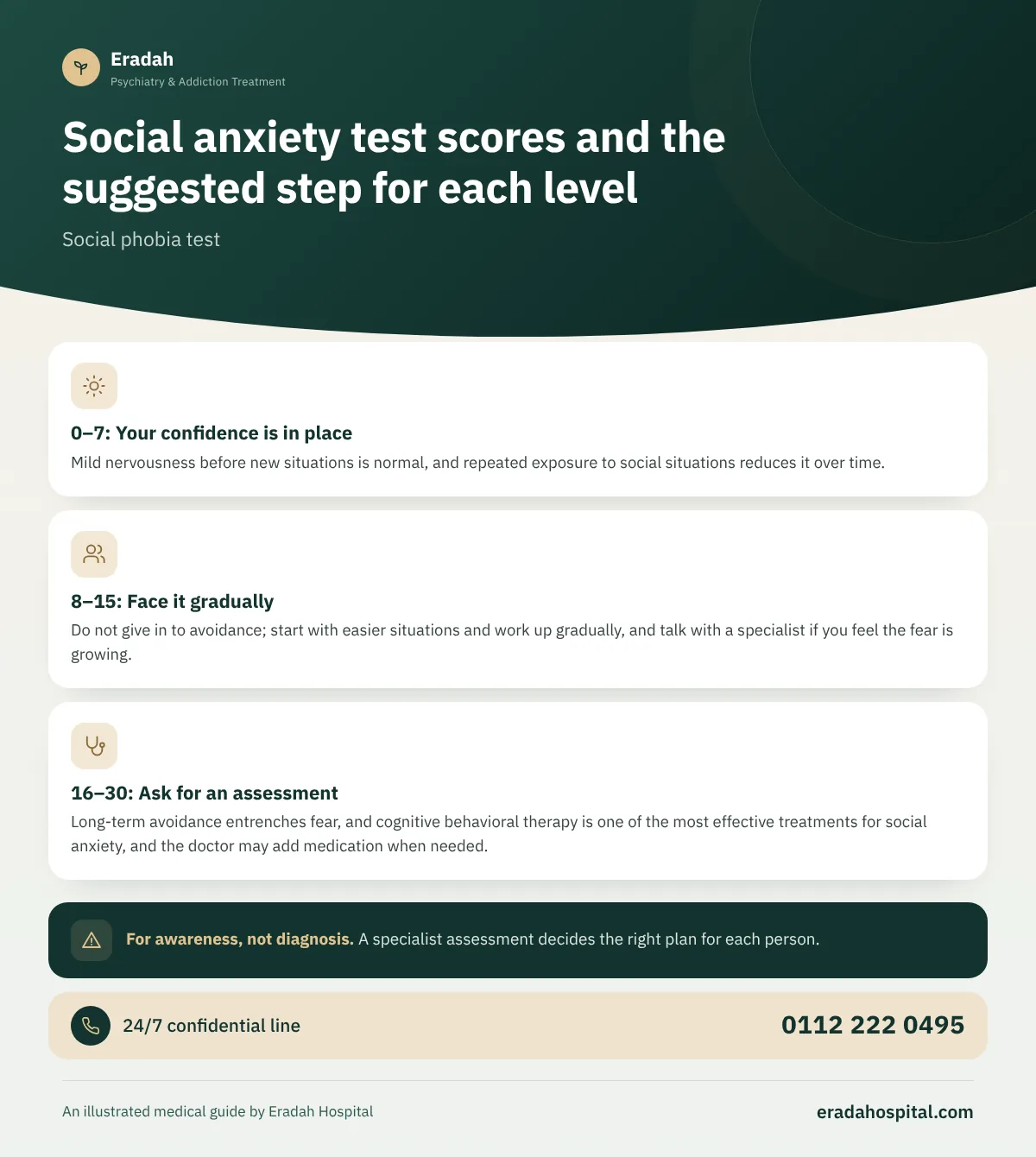
Infographic explaining social anxiety test results: low likelihood, moderate likelihood, high likelihood that an assessment would help you
Social anxiety test scores and the suggested step for each level

Shyness or social anxiety?

Shyness is a common personality trait: the person hesitates at first, then gradually settles in as they get used to the place and the people, and it does not stop them from going to work or attending events. Social anxiety, by contrast, is an intense and persistent fear of negative judgment, usually lasting six months or more, which leads the person to avoid situations they need and causes real suffering or disruption in their life.

The difference between shyness and social anxiety
Point of comparisonShynessSocial phobia
Intensity of fearMild tension that settles with timeIntense fear that may come with obvious physical symptoms
AvoidanceRare; the person attends despite hesitationFrequent; the person makes excuses or withdraws from situations
Thinking before and after the situationLimitedAnxiety for days beforehand and harsh replaying afterward
Impact on lifeSlight or negligibleDisrupts studies, work, or relationships

Social anxiety can also be confused with introversion; an introverted person prefers quiet and is not afraid of people, whereas a person with social anxiety wants to connect but fear holds them back.

Small steps to start today

  1. Write a list of the situations that frighten you, and rank them from easiest to hardest.
  2. Start with the easiest, such as asking a shop assistant a short question, and repeat it until the tension eases.
  3. Notice your thoughts before and after the situation, and ask yourself: did people actually notice what I fear?
  4. Cut back on stimulants before gatherings, and try slow breathing to calm the physical symptoms.
  5. Move on to the next situation on the list when the current one becomes bearable.

These steps help in mild cases, but if the fear stops you from even starting the first step, working with a therapist makes the road shorter and safer.

About this questionnaire

The questions of this awareness questionnaire were drawn from the criteria for social anxiety disorder in the Diagnostic and Statistical Manual of Mental Disorders: fear of being watched and judged, physical symptoms, avoidance, suffering, and impact on life. It has not undergone validation studies and is not used for diagnosis. Doctors rely on the clinical interview, and may use approved scales such as the SPIN to gauge severity.

In the assessment, the doctor asks you about when the fear began, the situations that trigger it, and what you do to avoid them. They rule out other causes that may resemble it, then propose a plan that suits the severity of your symptoms and your life circumstances.

Limits of the test

  • An awareness questionnaire that is not validated and is not enough on its own for diagnosis.
  • It does not distinguish social anxiety from related disorders such as panic disorder or avoidant personality disorder.
  • Having recently been through an embarrassing situation may raise your answers temporarily.
  • If your fear is limited to a single situation such as public speaking, the score may come out lower than the extent of your suffering in it.
  • It is not suitable for children; their social fear is assessed differently, with the parents taking part.

Social anxiety and addiction

Many people with social anxiety discover that alcohol, sedatives, or hashish “loosen the knot” in gatherings, so they come to rely on them before every occasion. This quick fix deprives them of learning to face the fear and opens a door to dependence that is hard to close. If this keeps happening to you, read about social anxiety and addiction and how they are treated together.

Free confidential consultation

Social anxiety makes asking for help itself a hard step, which is why we make the beginning easy: a free, confidential first consultation with the Eradah team on 01122220495, where you can ask whatever you like and are not asked to say anything you do not want to.

Frequently asked questions

Frequently asked questions about the social anxiety test

Didn’t find your answer?

Ask a specialist directly. The reply is confidential and carries no commitment.

Ask on WhatsApp
What is the difference between shyness and social anxiety?

Shyness is hesitation that eases with time and does not stop you from living your life, whereas social anxiety is intense fear of others' judgment that leads you to avoid situations and disrupts your studies, work, or relationships.

Does this test diagnose social anxiety?

No, it is an unvalidated awareness questionnaire that helps you notice symptoms, and a diagnosis requires an interview with a psychiatrist.

When does social anxiety usually begin?

It often begins in late childhood or adolescence, and may continue for years without treatment because the person thinks it is part of their nature.

Can social anxiety be treated?

Yes, many people improve markedly with cognitive behavioral therapy and gradual exposure, and the doctor may add medication depending on the case.

Is social anxiety the same as introversion?

No. An introvert prefers quiet and is comfortable alone, whereas a person with social anxiety wants to connect but fear holds them back.

Is fear of public speaking social anxiety?

It can be a limited form of it if it is severe and disabling, but the usual nervousness before speaking to an audience is common and does not mean a disorder.

Are my answers saved?

No, the calculation is done on your device only, and the answers are not sent to any party.

Medical reviewDr. Mahmoud El-Sawy, Consultant Psychiatrist and Addiction Specialist

This page was written by Eradah’s editorial team and reviewed by a specialist doctor in line with the medical review policy. Last reviewed: October 31, 2026. The content is for awareness and does not replace a doctor’s consultation.

Need a suitable treatment plan?

Your information is confidential and is not shared with anyone

Call WhatsApp Consultation