What is the realistic goal of treating internet addiction?
Unlike drugs or gambling, most people cannot stop using the internet altogether, since it is how they study, work and stay in touch. That is why internet addiction treatment rests on a different idea: abstain from the problem activity, and keep the rest in moderation.
Someone addicted to online betting may need complete abstinence from it while keeping email and work. Someone who spends nights browsing aimlessly may need limits on time and place, not a total ban. Setting this goal together with the therapist is the first step of the plan.
How do you pin down exactly what you are treating?
The phrase “internet addiction” is broad, and the European statement on problematic use describes it as an umbrella for different behaviors. That is why treatment starts with an accurate one-week map:
- What exactly am I doing? Gaming, social media, betting, shopping, or watching?
- When does the long use begin? After an argument, when I’m bored, or before bed?
- What was I feeling just before? Loneliness, anxiety, or study pressure?
- How long did it last compared with what I intended?
- What did I lose because of it today: sleep, a task, or time with family?
Once the main form is clear, the person benefits from the dedicated guide for it, such as gambling addiction treatment or pornography addiction treatment, alongside the general plan here.
How does cognitive behavioral therapy for internet addiction (CBT-IA) work?
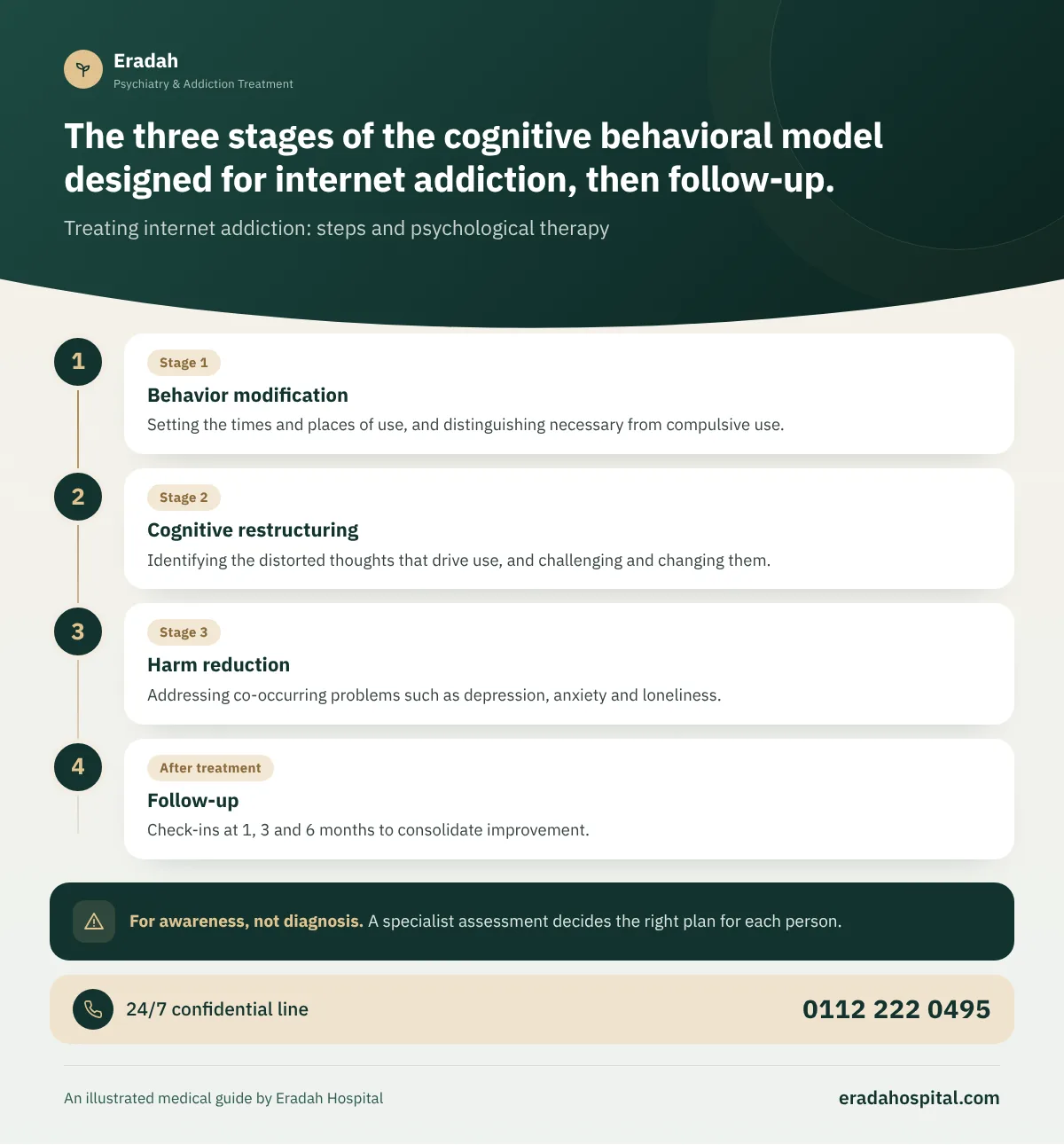
The psychologist Kimberly Young developed a special form of cognitive behavioral therapy, because the necessary everyday use of the internet makes it different from other addictions. The model moves through clear stages:
- Stage 1Behavior modification
Setting the times and places of use, and distinguishing necessary from compulsive use.
- Stage 2Cognitive restructuring
Identifying the distorted thoughts that drive use, and challenging and changing them.
- Stage 3Harm reduction
Addressing co-occurring problems such as depression, anxiety and loneliness.
- After treatmentFollow-up
Check-ins at 1, 3 and 6 months to consolidate improvement.
Examples of the thoughts the therapy works on include: “I’m worthless except online,” “If I log off now I’ll miss something important,” or “One more hour won’t matter.” In Young’s 2013 study of 128 patients who received 12 weekly sessions, more than 95% gained control of their symptoms by the end of treatment, and 78% maintained the improvement after 6 months. But it was a study without a comparison group, so its results are read with caution.
What does research say about the effectiveness of internet addiction treatment?
An analysis published in 2013 in the journal Clinical Psychology Review pooled the results of 16 studies involving 670 participants and found that psychological and drug interventions substantially improved addiction symptoms, time spent online, depression and anxiety from the start of treatment to the end, and the improvement continued at follow-up. The researchers cautioned that the results are preliminary because of the small number of studies and their methodological weaknesses.
In a more recent network analysis published in 2025 that included 90 randomized trials in young people, all 15 non-drug interventions studied were effective at reducing problematic use, with exercise interventions coming first, followed by EEG biofeedback and reality therapy, along with cognitive behavioral therapy, family therapy, mindfulness and group counseling.
What steps can you start with on your own?
- Write a specific goal: “no betting at all” or “no browsing after 11 p.m.,” not “I’ll cut down a bit.”
- Separate the necessary from the compulsive: a device or account for work and study, and strict limits for entertainment.
- Close the riskiest doors: delete the betting app or the site where you lose control, and block it if possible.
- Protect your sleep: no devices in bed, and charge the phone outside the room.
- Fill the gap with movement: daily exercise, one of the most effective interventions in young people in recent research.
- Treat what lies behind the screen: the loneliness, anxiety or sadness you are escaping from.
You will find the details of phone settings and screen time in phone addiction treatment, so we do not repeat them here.
Why should co-occurring depression and ADHD be treated?
Because a 2014 meta-analysis found that internet addiction was linked with depression, ADHD, anxiety and alcohol misuse at roughly 2.7 to 3 times the usual rate. There is no approved medication for internet addiction itself, but a psychiatrist may treat depression, ADHD or anxiety, and control over use often improves when these conditions are treated. Do not start or stop any medication without a doctor.
What is the family’s role in treating internet addiction?
With teenagers especially, family therapy is among the interventions that have shown benefit in research. The aim is to turn the home from a battleground over the “router” into a clear agreement: written rules the son helps set, consistent and predictable consequences, a role model in the parents themselves, and enjoyable shared time without screens. Cutting off the internet suddenly by force often triggers violence or pushes the son to use it in secret.
How do you deal with relapse?
Going back to late nights or long browsing after good weeks does not mean treatment has failed. The riskiest times are long vacations, exam periods or unemployment, and conflict and loneliness. It helps to agree in advance on early warning signs, such as the phone returning to bed or hiding time, and on what you will do straight away if they appear.
Internet addiction treatment at Eradah
At Eradah, treatment begins with an assessment by a psychiatrist to understand the main form of use and what lies behind it, such as depression, anxiety, ADHD or substance use. We then set up a plan that combines cognitive behavioral therapy, family sessions and treatment of co-occurring conditions, mostly in outpatient clinics. When compulsive use comes together with drinking or substance use, we treat both together under dual diagnosis.
Despair, violence or a breakdown because of the internet? Get help now
- Talk of death or self-harm, especially after being cut off from the internet or after blackmail or online bullying
- Violent outbursts of anger in which they hurt themselves or others when the connection is cut
- Staying up for days on end while skipping meals, or severe exhaustion or dizziness
- Large debts or losses from betting or online shopping followed by panic or threats of self-harm
- Complete withdrawal from family, studies or work for weeks, with obvious sadness
Stay calm and do not get into an argument or physical confrontation over the device or the router. Stay close to the person, ask calmly how they feel, and listen without blame. If there is a danger to their life or anyone else's, call an ambulance (123) or go to the nearest emergency room, or call the mental health support line 16328 (24 hours), and do not leave them alone if they talk about harming themselves.
Ambulance 123 Mental health support line 16328