Can you overcome pornography addiction for good?
Yes, many people recover and take back control of their lives. But recovery is usually a gradual journey, not a momentary decision; it begins with understanding your personal pattern and its triggers, then changing your environment, then building new skills for dealing with the feelings the behavior was an escape from.
The goal differs from person to person: many choose to stop completely in line with their values, which is a clear and legitimate goal. The patient sets their goal with the therapist, and what matters is that it is specific and measurable, and that progress is judged by the overall direction, not by a single day.
Practical steps to start today
- Acknowledge the problem to yourself clearly and without self-blame: "I have a pattern I want to change."
- Log your moments of urge for two weeks: the time, the place and the feeling before. You will discover your own pattern.
- Keep devices out of the bedroom at night, and charge your phone outside it.
- Have alternatives ready for moments of weakness: a call to a friend, a walk, a shower, prayer or meditation, a short workout.
- Cut down long stretches alone with devices and use the computer in a shared space.
- Tell one person you trust, since breaking the secrecy takes away half the problem's power.
- Take care of the basics: regular sleep, physical activity and real relationships, which reduce the need to escape.
How do you design your digital environment to stay away from pornography?
Willpower weakens with tiredness and stress, but the environment works all the time. That is why specialists focus on adding distance between the urge and the act, because every extra second gives the mind a chance to think:
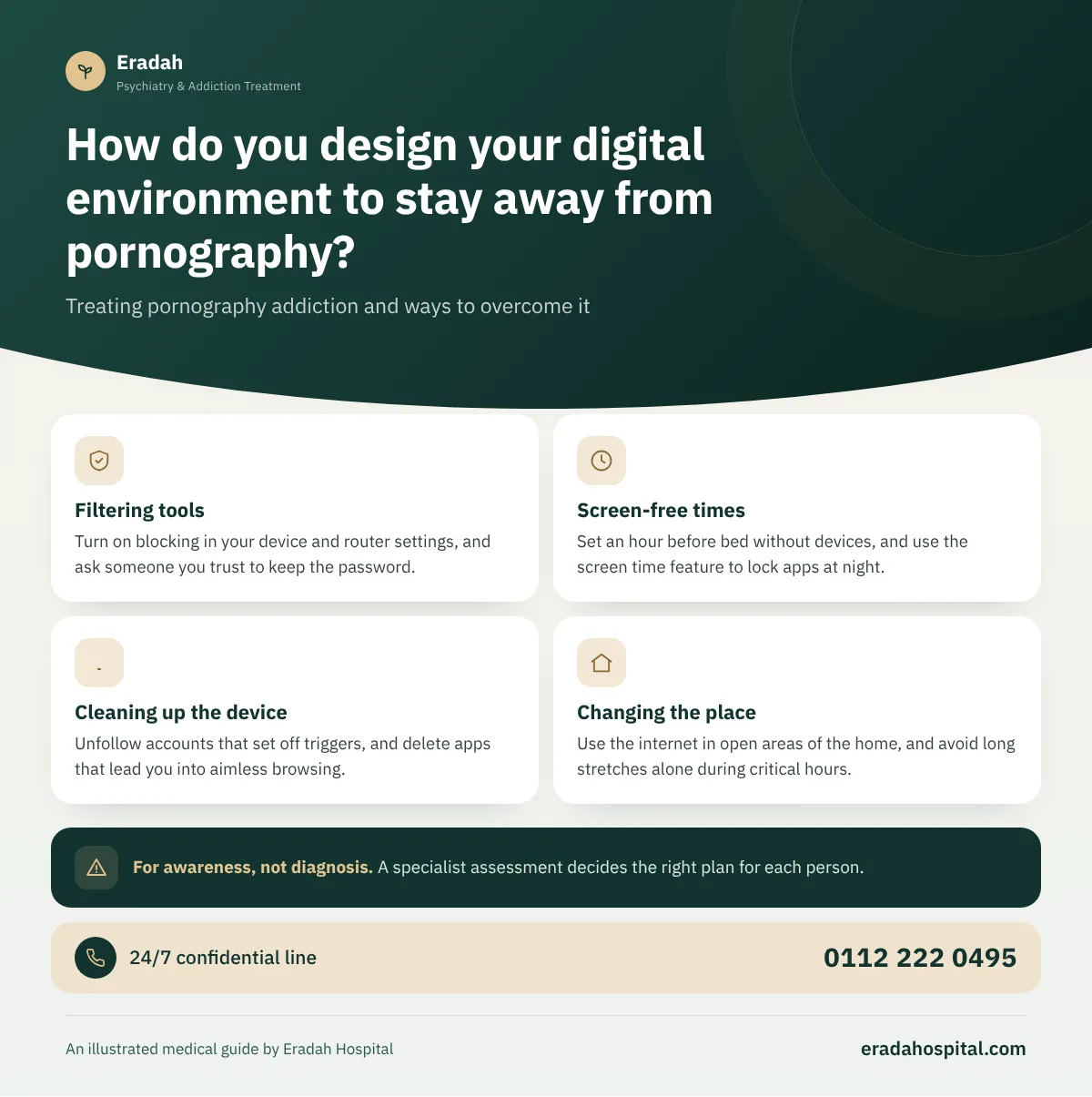
Turn on blocking in your device and router settings, and ask someone you trust to keep the password.
Set an hour before bed without devices, and use the screen time feature to lock apps at night.
Unfollow accounts that set off triggers, and delete apps that lead you into aimless browsing.
Use the internet in open areas of the home, and avoid long stretches alone during critical hours.
These tools are an aid, not a complete treatment; anyone who wants to get around them will find a way. Their value is that they protect you in moments of weakness while inner skills grow.
Cognitive behavioral therapy: how does it help?
Cognitive behavioral therapy is one of the most widely used treatments for this problem. It works on three fronts: understanding the chain of trigger, thought, feeling and behavior; changing the thoughts that pave the way to relapse, such as "Just once won't hurt" or "I'm a failure anyway"; and learning practical skills for facing the urge, solving problems and managing time.
Treatment usually includes homework between sessions, such as a trigger log and a plan for high-risk situations, along with training in communication and conflict-resolution skills, because many relapses begin with an argument or pressure that was never expressed.
Acceptance and commitment therapy and mindfulness
Instead of fighting the urge fiercely, acceptance and commitment therapy teaches a person to notice the urge as a wave that rises and then falls without obeying it, and to act in line with their real values, such as family, faith, health and work. A small randomized trial published in 2016 showed a large drop in use among those who received this therapy compared with a waiting list, which is encouraging although larger studies are needed.
Mindfulness exercises help you notice the moment the urge begins, before it turns into automatic behavior. One of the simplest is to pause for two minutes, breathe slowly and name the feeling that is present: "I'm stressed" or "I'm lonely."
Couples and family therapy
When the marital relationship is affected, it helps to involve the partner in some sessions after an initial stage of individual therapy. Couples therapy aims to help the affected partner express their pain and get support, and to agree on transparency and rebuild trust step by step, without the partner becoming a permanent "monitor" drained by the role.
With teenagers, family therapy is essential: training parents in calm dialogue, setting clear, agreed digital limits, handling slips without exposure, and encouraging alternative activities and real-life friendships.
An accountability partner and support groups
Many people benefit from having an accountability partner: a mature friend or mentor they trust, whom they contact regularly and in moments of weakness. What matters is that the relationship is supportive, not punishing, and that the spouse is not this partner at the start, because that puts a strain on the relationship.
There are also support groups built on sharing experiences, where participants find they are not alone. It is best to choose groups supervised by specialists, and to avoid forums that rely on scare tactics, quick promises or unscientific claims.
Are there medications to treat this problem?
There is no medication approved specifically to treat compulsive pornography use. Some medications, such as selective serotonin reuptake inhibitor antidepressants and naltrexone, have been studied in small studies with limited results. A psychiatrist turns to medication mainly when depression, anxiety or attention-deficit hyperactivity disorder is also present, and decides this after a full assessment. No psychiatric medication should be taken or stopped without medical supervision.
Relapse: how do you deal with it without giving up?
Relapse is common in any behavior change, and it does not mean treatment has failed. The real difference between someone who recovers and someone who gives up is what happens after the slip:
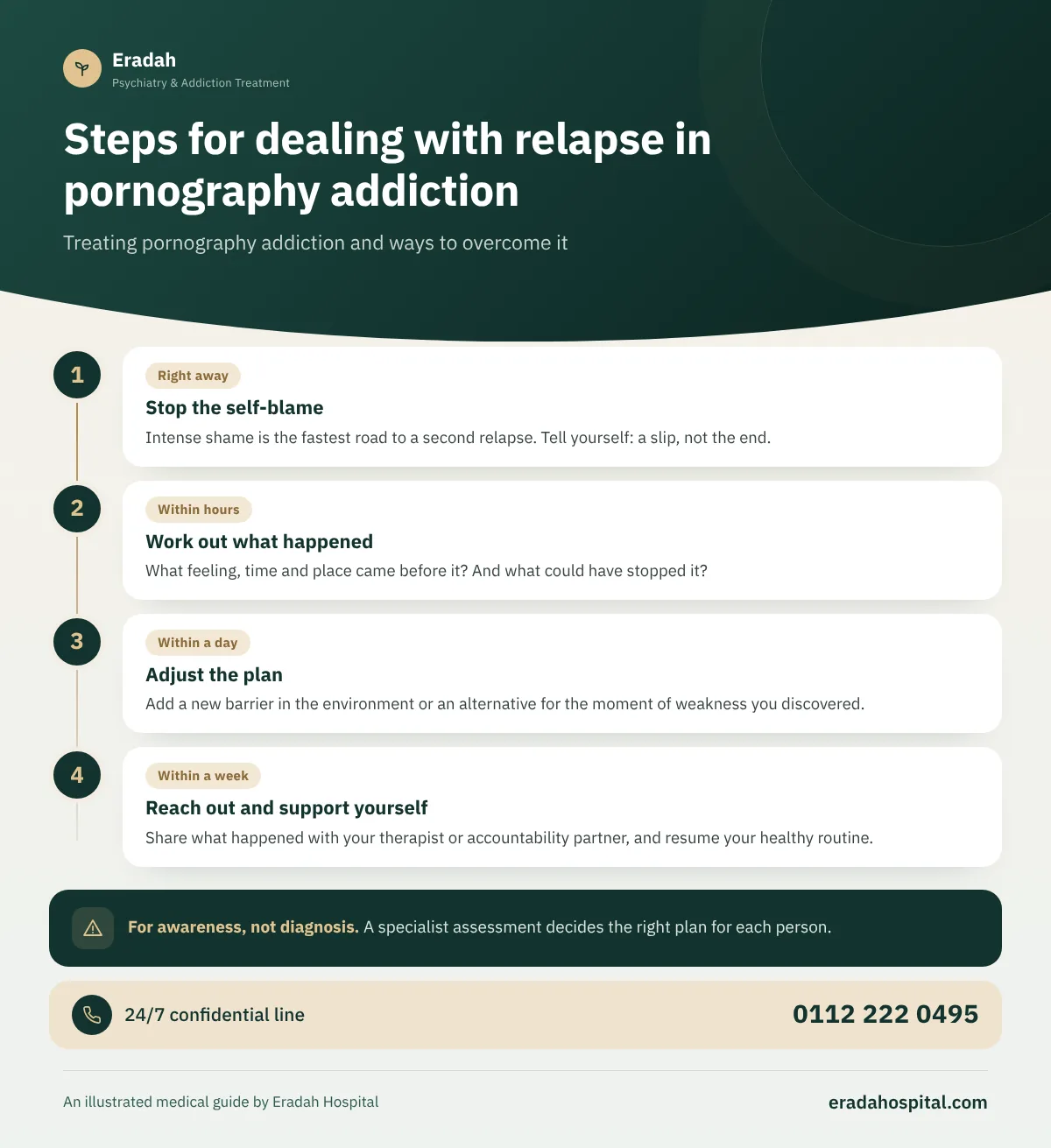
- Right awayStop the self-blame
Intense shame is the fastest road to a second relapse. Tell yourself: a slip, not the end.
- Within hoursWork out what happened
What feeling, time and place came before it? And what could have stopped it?
- Within a dayAdjust the plan
Add a new barrier in the environment or an alternative for the moment of weakness you discovered.
- Within a weekReach out and support yourself
Share what happened with your therapist or accountability partner, and resume your healthy routine.
When do you need a mental health specialist, not just a self-help plan?
- You have tried serious self-help steps for several months without clear improvement.
- The problem is threatening your marriage, work or studies.
- It is accompanied by depression, severe anxiety, or alcohol or drug use.
- You feel intense despair or have thoughts of harming yourself; help is urgent here: call 16328 or 123.
- The person concerned is a teenager, and the situation needs an assessment that takes their age into account and involves their family.
Choosing a Hospital for Pornography Addiction Treatment
Because this type of addiction does not come with dangerous physical withdrawal symptoms, the question is not "Where can I find a bed?" but "Whom can I be open with without being judged?" Many people put off asking for help for years out of fear of scandal, and then end up with someone who offers general preaching or quick promises. This comparison helps you tell a serious place from one that does not suit you:
| What to ask about | A reassuring answer | Warning sign |
|---|---|---|
| How they see the problem | Sees it as a behavioral pattern that can be changed, and looks at what lies behind it, such as loneliness or stress | Only preaches, or adds to your sense of shame |
| Treatment approach | Cognitive behavioral or acceptance and commitment sessions with a clear plan | Offers a long stay or a pill that stops the urge as the only solution |
| Wife and family | Joint sessions when needed and with your consent | Ignores the effect of the problem on the marriage |
| A slip after improvement | Uses it to adjust the plan | Treats it as failure and closes the file |
| Your privacy | Explains who sees your file and why | Asks for your data before listening to you |
At Eradah, psychologists work under the supervision of Dr. Mahmoud El-Sawy, and every patient's data remains completely confidential. When the behavior is intertwined with depression or substance use, they are treated together through a dual diagnosis plan, and a wife can join family program sessions. Call or message us on WhatsApp at 01122220495 at any hour; the first consultation session is free, and your name is not required if you prefer not to give it. If you need a residential stay, it is available for men only, and appointments are arranged through the consultation request form.
Pornography addiction treatment at Eradah
At Eradah Psychiatry & Addiction Treatment Center we approach this problem with complete confidentiality and without judgment. Treatment begins with a comprehensive psychological assessment that determines the nature of the pattern and any co-occurring disorders, followed by an individual plan that combines, as needed, cognitive behavioral therapy, acceptance and commitment therapy, and couples or family sessions, with psychiatric follow-up when depression, anxiety or substance use is present. We respect each patient's values and build their motivation for change on them.