Can compulsive masturbation be overcome?
Yes, many people regain control over this behavior. But change is usually a gradual journey, not a one-moment decision; it starts with understanding your personal pattern and its triggers, then adjusting the environment and routine, then building skills to handle the feelings the behavior used to soothe.
The goal differs from person to person: some choose to stop completely in line with their religious or personal values, which is a clear and legitimate goal, and some want to regain control so the behavior no longer disrupts their life. What matters is that the person sets his own goal, and that progress is measured by the overall direction over weeks, not by a single day.
Practical steps to change the habit, starting today
- Change the way you talk to yourself: "I have a habit I want to change" instead of "I'm a failure."
- Log your urges for two weeks: the time, place and feeling beforehand. You will discover your own pattern.
- Regulate your sleep: a fixed bedtime and wake-up time, and do not lie awake in bed for long.
- Keep your phone out of the bedroom at night, and charge it outside.
- Reduce long, aimless time alone during risky hours, and fill the gap with specific activities.
- Move every day: walking and exercise ease stress and improve sleep and mood.
- Tell one person you trust or a specialist; breaking secrecy weakens the cycle.
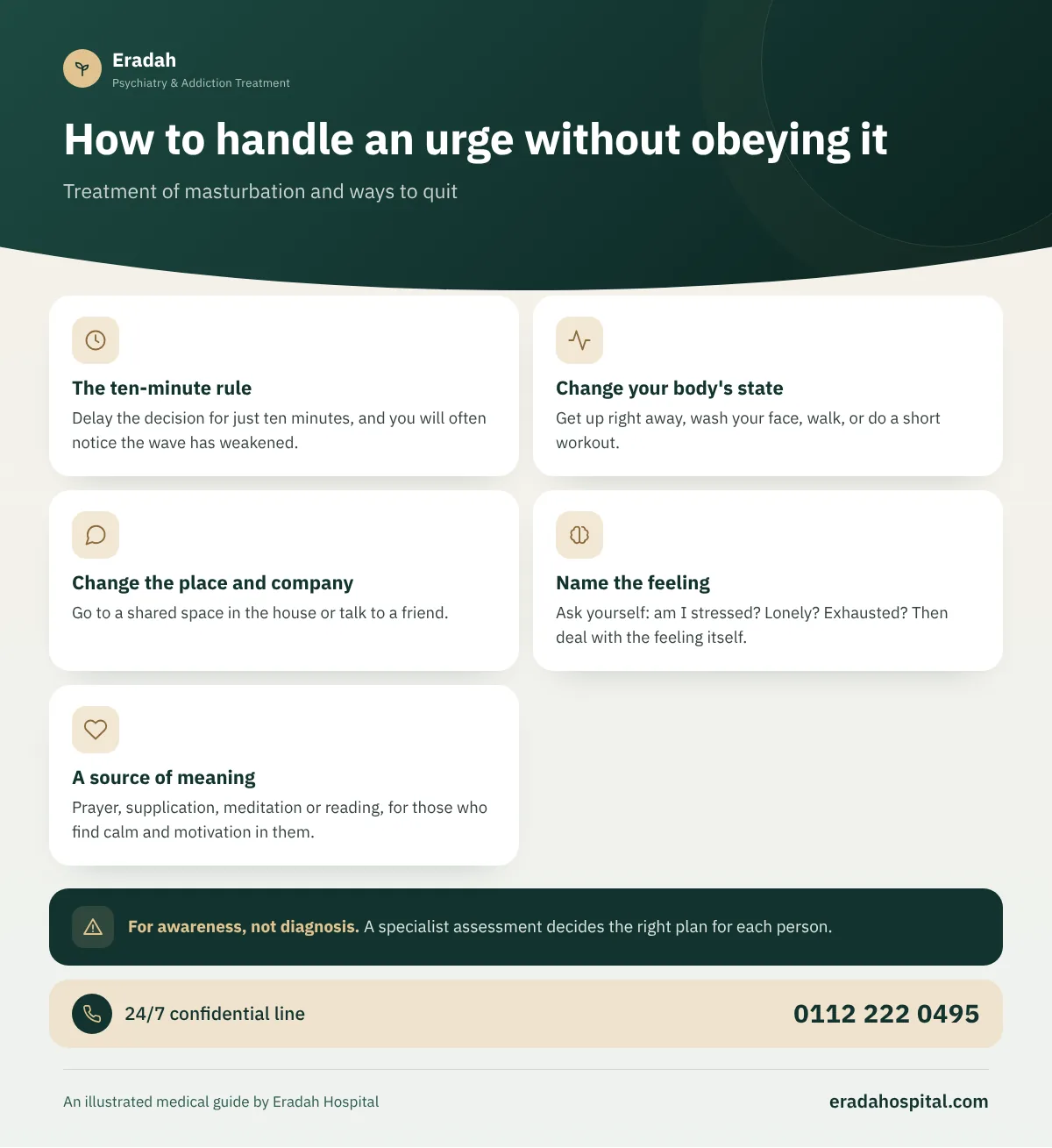
How do you handle an urge without obeying it?
An urge is like a wave: it rises, peaks, then falls within minutes if it is not fed. You don't have to avoid feeling it; what matters is not obeying it automatically:
Delay the decision for just ten minutes, and you will often notice the wave has weakened.
Get up right away, wash your face, walk, or do a short workout.
Go to a shared space in the house or talk to a friend.
Ask yourself: am I stressed? Lonely? Exhausted? Then deal with the feeling itself.
Prayer, supplication, meditation or reading, for those who find calm and motivation in them.
How do you adjust your environment and routine?
Willpower weakens with tiredness and stress, while the environment works all the time. That is why specialists focus on adding distance between the urge and the act: devices outside the bedroom, open doors during risky hours, scheduled activities during free time, and less time in bed without sleeping.
If the behavior is tied to watching pornography, controlling the digital environment is an essential part of the plan; you will find filtering tools, device cleanup and steps for this aspect on the page treatment of pornography addiction.
How does cognitive behavioral therapy help with compulsive behavior?
Cognitive behavioral therapy is one of the most widely used treatments for compulsive behaviors. It works on three fronts: understanding the chain of trigger, then thought, then feeling, then behavior, changing the thoughts that pave the way for repetition, such as "just once won't hurt" or "I've failed anyway, so there's no point," and learning practical skills for facing urges, organizing time and solving problems.
Skills from acceptance and commitment therapy and mindfulness are also used, which teach a person to notice the urge without giving in to it, and to act in line with his real values. Treatment includes homework between sessions, such as a trigger log and a plan for high-risk situations.
Habit-change skills: replace, don't leave a void
Giving up a habit without putting something in its place leaves a gap that the old behavior fills. That is why the therapist helps build alternatives that serve the same function: if the behavior was a way to fall asleep, the alternative is a relaxation routine before bed; if it was for release after pressure, the alternative is exercise or talking to a friend; and if it was to fill empty time, the alternative is scheduled goals and activities.
| Function of the behavior | Suggested alternatives |
|---|---|
| Helping with sleep | A fixed bedtime, screens off before bed, breathing and relaxation exercises |
| Release after pressure | Walking or exercise, writing down feelings, talking to someone close |
| Filling empty time and boredom | A hobby, learning a skill, volunteering, activities with friends |
| Escaping sadness or loneliness | Real social contact, and a psychological assessment if the sadness continues |
Supporting teenagers without scaring or shaming them
With teenagers, the first goal is reassurance and correcting myths, since many live in silent terror of imagined harms. Then comes support for a healthy routine: regular sleep, exercise, devices outside the room at night, and real-life activities and friendships. If a specialist is needed, choose one who speaks to teenagers calmly and involves the parents in guidance without revealing what is private to the sessions.
Are there medications to treat masturbation?
There is no specific medication for this behavior; the foundation is psychotherapy and changing the habit. A psychiatrist turns to medication when there is an accompanying disorder such as depression, anxiety, OCD or ADHD, after a full assessment. No psychiatric medication should be taken or stopped without medical supervision, and you should not rely on "products" sold online with quick promises.
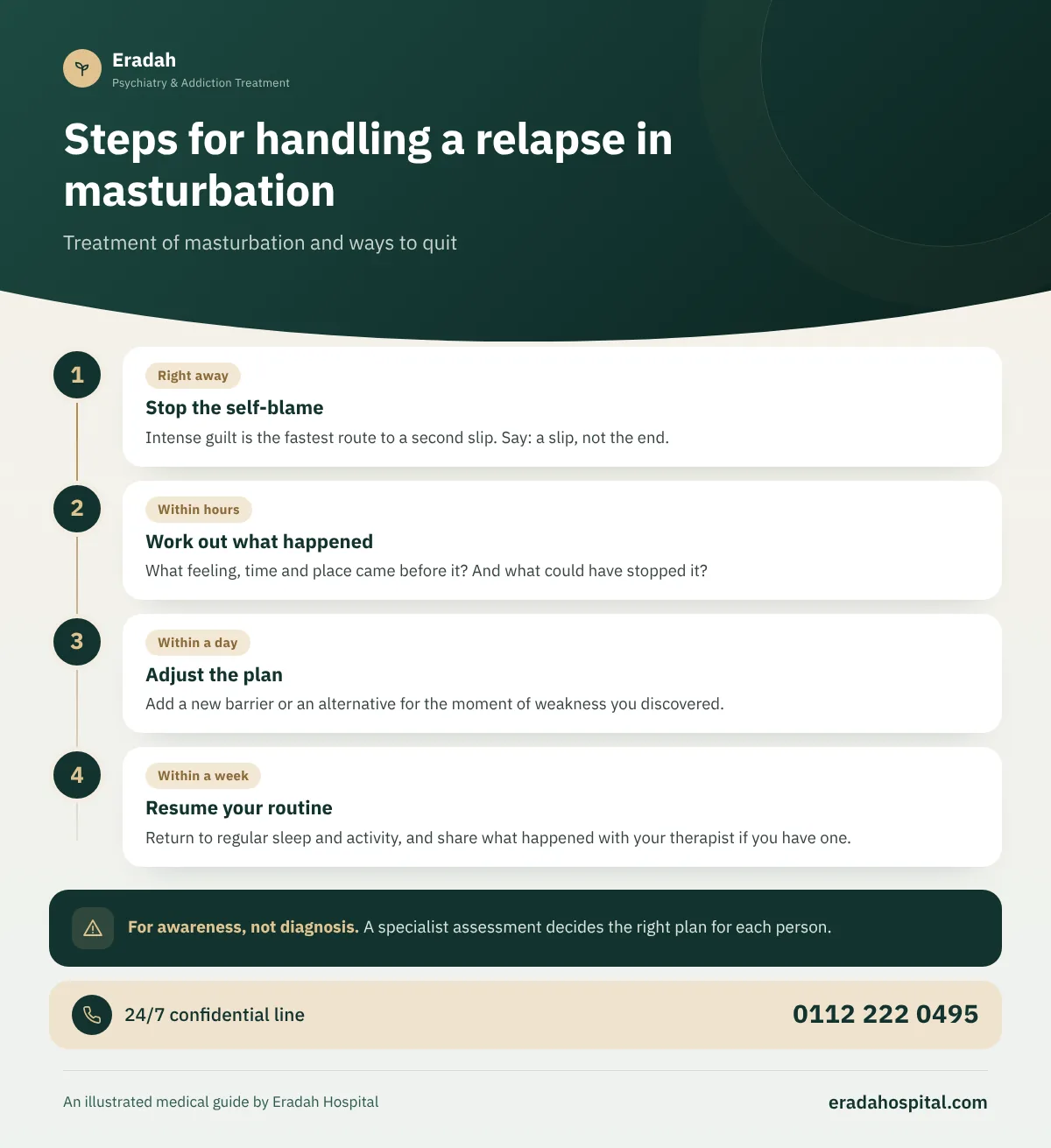
A slip after a period of abstinence: what do you do?
Slips are common in any behavior change, and they do not mean the attempt has failed. The real difference is what happens after the slip:
- Right awayStop the self-blame
Intense guilt is the fastest route to a second slip. Say: a slip, not the end.
- Within hoursWork out what happened
What feeling, time and place came before it? And what could have stopped it?
- Within a dayAdjust the plan
Add a new barrier or an alternative for the moment of weakness you discovered.
- Within a weekResume your routine
Return to regular sleep and activity, and share what happened with your therapist if you have one.
When do you need a psychiatrist, not just a self-help plan?
- You have tried serious self-help steps for several months without clear improvement.
- The behavior disrupts your studies, work or marriage.
- It comes with anxiety, depression, distressing obsessive thoughts or substance use.
- It occurs together with compulsive pornography use that is hard to control.
- You feel overwhelming guilt, despair or thoughts of self-harm. Here help is urgent: 16328 or 123.
A licensed hospital for treating compulsive masturbation
When this behavior becomes compulsive, the biggest obstacle to treatment is embarrassment, not the condition itself; many people put off asking for help for years for fear of the therapist's judgment. So the first thing to judge any provider by is its language: is the matter received as a symptom that can be understood and changed, or as a sin for which the person is put on trial? There is no physical withdrawal or specific medication here, so what is needed is a psychological team skilled in changing habits and looking into what lies behind them.
- An assessment that checks for OCD, anxiety and depression, since some cases are at heart obsessive thoughts about the behavior rather than excess of it.
- A frank question about pornography, because the two occurring together changes the plan and calls for parallel work on it.
- A therapist who respects the patient's religious and family values and builds motivation on them instead of threatening exaggerated harms.
- With young people: calm language, and involving parents in general guidance without revealing the details of sessions.
- A clear plan for slips, so that a single slip does not turn into despair and dropping out of treatment.
For these cases, Eradah offers individual psychological sessions based on cognitive behavioral therapy, with treatment of any accompanying anxiety or depression within the same plan, and it receives teenagers for assessment, treatment and follow-up through the outpatient program. You can compare this with what we offer in treatment of pornography addiction if the two overlap.
Treatment of compulsive masturbation at Eradah
At Eradah Psychiatry & Addiction Treatment Center we approach this subject with full confidentiality, professional language and no judgment. Treatment begins with a psychological assessment that identifies the nature of the pattern and any accompanying anxiety, depression or obsessive-compulsive symptoms, then an individual plan that combines, as needed, cognitive behavioral therapy, habit-change skills and support for the family or partner, respecting each patient's values and building his motivation on what gives him meaning.