Does masturbation have real harms? A balanced view
This is among the most searched questions in Egypt and the Arab world, surrounded by inherited fears that have no scientific basis. The honest medical view is that the behavior in itself does not cause physical illness, while a compulsive pattern can cause real psychological and social harm that deserves attention.
Because fear and misinformation cause great suffering, especially for teenagers, we begin by debunking the best-known myths, then move on to the real harms and when they appear. The aim is to put things in their proper proportion, without downplaying or exaggerating.
Common myths in Egypt: what does science say?
Medical sources, including Cleveland Clinic and Nemours KidsHealth, agree that these fears are not supported by any scientific evidence:
| The myth | What does science say? |
|---|---|
| Causes blindness or weak eyesight | It has no connection to the eyes or vision. Poor eyesight has well-known genetic and health causes. |
| Causes infertility | It does not affect fertility or the ability to have children, in men or women. |
| It causes hair loss or baldness | Hair loss is linked to genetics, hormones, nutrition, stress and some illnesses, not to this behavior. |
| It causes back pain or "erosion of the spinal cord" or discs | It has no connection to the spine or spinal cord. Back pain is most often linked to prolonged sitting and lack of movement. |
| It causes "general weakness" and emaciation | Fatigue is usually the result of staying up late, lack of sleep, anxiety and irregular eating. |
| It causes sexual dysfunction or infertility after marriage | There is no evidence that it causes permanent weakness. Anxiety and stress are common causes of performance problems, and they should be evaluated by a doctor. |
| It causes mental illness or "madness" | It does not cause mental illness, but the guilt and anxiety that accompany a compulsive pattern may affect mood. |
| It causes acne | Acne is linked to puberty hormones and skin type, and it appears at the same age when the behavior begins, so some people assume the two are connected. |
The fear itself may be the greatest harm
Young people come to psychiatric clinics living in constant worry that they have "ruined" their bodies, interpreting every headache, bout of hair loss or episode of fatigue as a result of this behavior. This anxiety can turn into obsessive thoughts that consume the day, into unnecessary repeated medical tests, or into isolation and shame about marriage.
Accurate information is itself a treatment here. But if the distressing thoughts continue despite reassurance and keep recurring in a way that is hard to stop, they may be part of obsessive-compulsive disorder (OCD) or health anxiety, and deserve a psychological assessment.
Psychological harms of the compulsive pattern
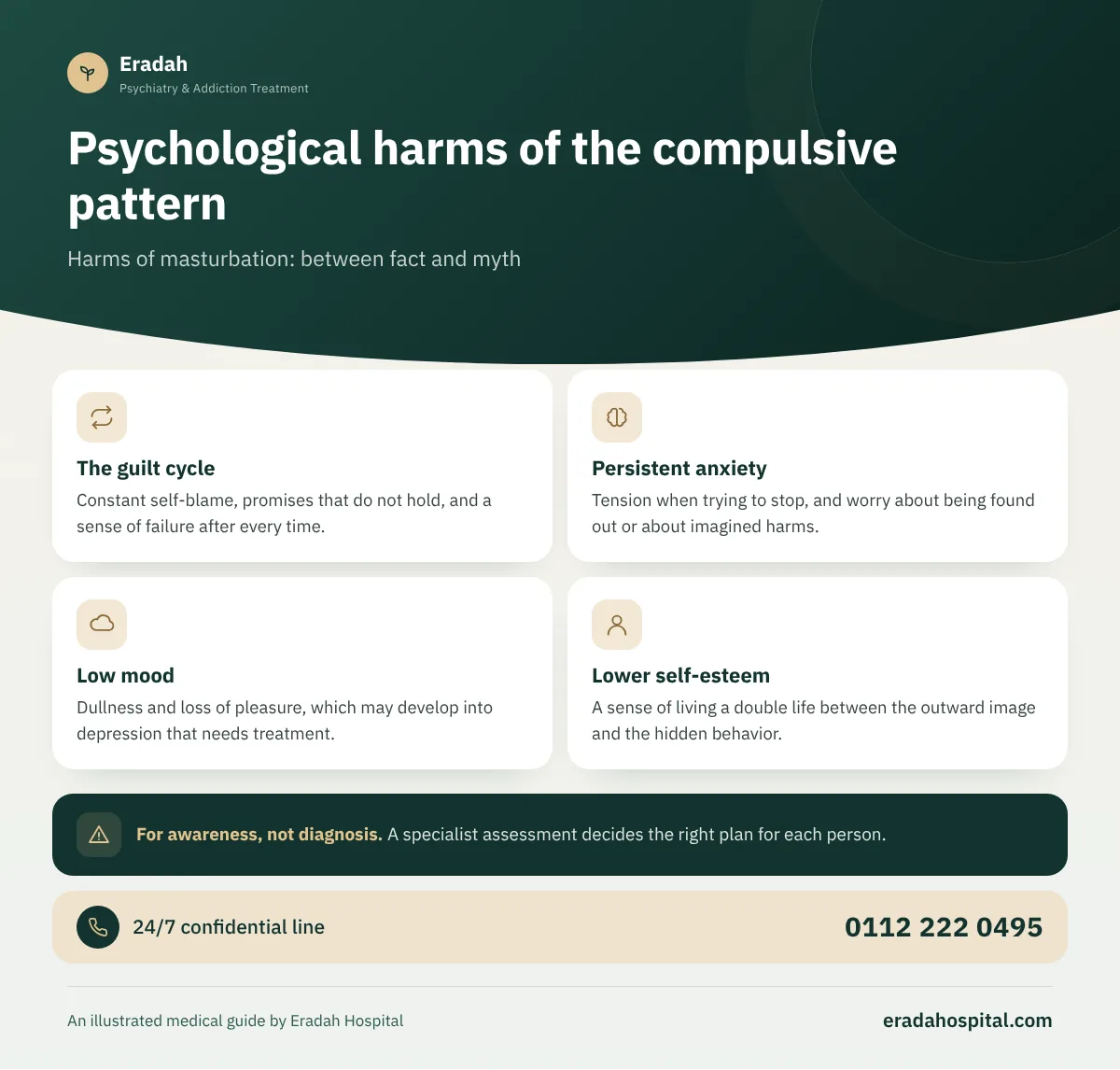
When a person loses control over the behavior, real psychological harms appear, and the relationship runs in both directions: distress drives the behavior, and the behavior and the guilt that follows deepen the distress.
Constant self-blame, promises that do not hold, and a sense of failure after every time.
Tension when trying to stop, and worry about being found out or about imagined harms.
Dullness and loss of pleasure, which may develop into depression that needs treatment.
A sense of living a double life between the outward image and the hidden behavior.
It is only honest to say that many studies in this field are correlational studies that do not prove cause and effect, and that their results are influenced by the participants' value backgrounds. But specialists agree that loss of control, however it is explained, is linked to real distress that usually eases when the person regains control.
Time, sleep, study and work
The time the compulsive pattern consumes has to come from somewhere: from sleep, study or work. Repeated late nights cause daytime exhaustion and poor concentration, and this is often what explains the "general weakness" some people complain of, rather than the behavior itself. With repeated mental preoccupation, the ability to complete long tasks declines.
Relationships and married life
A compulsive pattern may lead to isolation and withdrawal from friends and social activities, and avoidance of emotional closeness. In married life it can cause distance and misunderstanding, especially when combined with compulsive pornography use and the concealment and unrealistic expectations that come with it. Frank conversation and specialized support help both partners.
The real physical effect: limited and temporary
The proven physical harms are limited. With very frequent repetition, minor local skin irritation or friction may occur and usually clears within days; see a doctor if it persists or comes with pain or inflammation. Anything else, such as fatigue and headache, is mostly linked to staying up late, lack of sleep and stress, and improves with a better routine.
The link to compulsive sexual behavior disorder
In severe cases, when the behavior becomes the center of life and continues for months despite attempts to stop and clear consequences, it may fall under compulsive sexual behavior disorder (6C72) in the ICD-11. This disorder is often linked to anxiety, depression and ADHD, and sometimes to alcohol or drug use, and here it needs to be assessed within a dual diagnosis framework.
Overwhelming guilt and the risk of self-harm
Some young people and teenagers go through moments of deep despair because of guilt, after their family discovers the behavior, or after harsh scolding. Overwhelming shame can convince a person that he does not deserve to live, and that idea comes from pain, not from the truth.
If you or someone you know has thoughts of death or self-harm, this deserves help now: talk to someone you trust, and call the mental health support line 16328 or ambulance (123). The problem is treatable, and no one should pay for it with their life.
Can the harms of compulsive masturbation be avoided?
Yes, and most of them are reversible: sleep and concentration improve within weeks of changing the routine, mood improves as the cycle of guilt is broken and any accompanying anxiety or depression is treated, and relationships improve with conversation and support. The key is early intervention and accurate information; you will find the practical steps on the page treatment of masturbation.
Crushing shame or thoughts of self-harm? Get help now
- Talk of wanting to die or that they "don't deserve to live" because of this behavior
- Severe shame and despair after a relapse, with a conviction of being "hopeless" or "corrupt"
- A teenager who is distraught or panicked after their family found out, or after threats or harsh punishment
- Sudden withdrawal from family and friends and stopping eating, sleeping or studying
- Increased use of alcohol, drugs or sedatives to bear the guilt
Stay with the person and listen calmly, and reassure them that what they are going through is common and treatable and that they are not a bad person; blame at this moment increases the risk. Call an ambulance on 123 or take them to the nearest emergency room, or call the mental health support line 16328 (24 hours), and do not leave them alone as long as thoughts of self-harm are present.
Ambulance 123 Mental health support line 16328