For whom are the benefits of quitting masturbation real?
“I want to quit, but everything I read either scares me that I’ll go blind or promises I’ll turn into Superman.” Between scare tactics and exaggeration, many young men get lost. The truth is calmer than both: stopping has clear benefits for people who have lost control of the habit or who live in conflict with their values, but they are not physical miracles.
As we explain in the guide to masturbation, from a medical standpoint it is a common behavior that is not considered a disease in itself, and it does not cause blindness or infertility. Cleveland Clinic even notes that it may be linked to benefits such as stress relief and better sleep. So the right question is not “Is it harmful?” but “Am I in control of it, or is it in control of me?” If it keeps happening against your will, takes your time and sleep, and leaves you with guilt and distress, then the benefits of stopping become real.
Benefits of quitting compulsive masturbation
- Time and sleep: the compulsive habit is often tied to late nights and phone use in the dark, and stopping restores regular sleep.
- Focus and productivity: less mental preoccupation, planning and concealment.
- Mood and self-confidence: the feeling of helplessness and repeated failure eases, replaced by a sense of being able to control yourself.
- Relationships: less isolation, and more presence with family, friends and a partner.
- Reconciling with your values: the inner conflict eases for those who see it as contradicting their faith.
These benefits are really the disappearance of harms caused by the compulsive pattern, which we explain on the page about the harms of masturbation.
What happens when you quit masturbation? Myths and facts
| What people say | What science says | |
|---|---|---|
| Testosterone | Rises sharply on day seven of abstinence | The Chinese study that reported this (2003) was officially retracted in 2021 |
| Strength and energy | Energy and physical strength double | No scientific evidence for this |
| Hair, skin and eyesight | Hair, skin and eyesight improve | No proven link, and the habit does not harm them in the first place |
| Addiction and control | Stopping fixes everything at once | Helps those who have lost control, and usually needs a plan and support |
| Motivation to quit | Anyone who wants to quit is necessarily “addicted” | Motivation is linked more to beliefs than to the severity of the behavior |
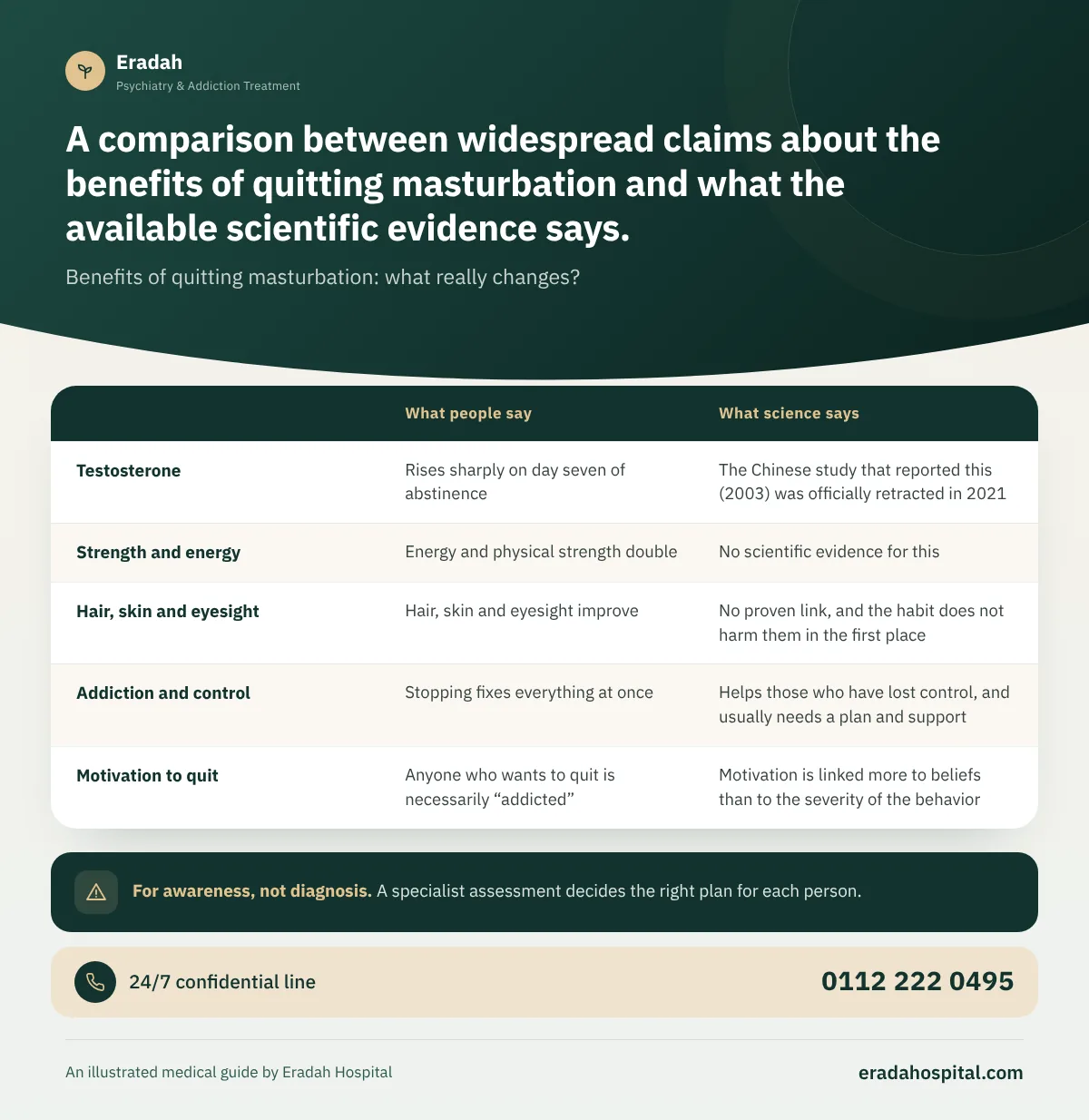
The last point is supported by a study published in Archives of Sexual Behavior in 2020, which found that the motivation to abstain from masturbation was linked mainly to attitudes and beliefs, especially seeing it as unhealthy, and to religiosity, more than to actual behavioral indicators. In other words, many who want to stop do not have an addiction but a conflict between behavior and values, and this deserves to be handled calmly, not with scare tactics.
The truth about testosterone on day seven
A Chinese study published in 2003 on 28 volunteers, which reported that testosterone peaked on the seventh day of abstinence, spread across many websites. This study was officially retracted in 2021 according to its record in PubMed, meaning it is no longer a reliable scientific reference. There is no reliable evidence that abstinence raises testosterone in a sustained or beneficial way. If you have symptoms of low male hormone, the route is a medical examination, not abstinence.
Does stopping masturbation harm the body?
No, stopping is completely safe, and it does not cause dangerous “congestion” or illness. Nocturnal emissions during sleep are normal and happen to many people; they are neither a relapse nor a harm. A large American study published in European Urology in 2016, covering about 32,000 men, found that frequent ejaculation was linked to a relatively lower risk of prostate cancer, especially low-risk types, but this is an association that does not prove cause, and it does not mean that someone who stops for religious or personal reasons is putting themselves at risk.
How do you stop masturbating without self-punishment?
- Identify the times and triggers of the habit: late nights, loneliness, boredom, stress, and the phone in bed.
- Change the environment: take the phone out of the bedroom, and go to sleep when you feel sleepy, not hours later.
- Fill free time with real physical or social activity.
- Deal with the feelings that come before it instead of fighting the act alone.
- If you slip, do not punish yourself; ask what came before the slip, and adjust your plan.
You will find detailed treatment steps in masturbation treatment. If the use is tied to pornography, read about the benefits of quitting pornography, and if it extends to other out-of-control behaviors, read about sex addiction and its treatment.
When guilt itself becomes the problem
Some young men do stop, but are left with constant worry about the “harms” of what they did before, or with repeated thoughts they cannot stop about purity and guilt. This may be a form of obsessive-compulsive disorder (OCD) that needs different treatment. If guilt turns into despair or talk of self-harm, seek help right away through the mental health support line 16328 or ambulance (123).
At Eradah you can book a completely free and confidential first consultation, and we offer outpatient treatment with cognitive behavioral therapy for people who have lost control of the habit or who have co-occurring anxiety or depression.
Severe hopelessness, blackmail or thoughts of self-harm? Get help now
- Talk of death or of life not being worth living after the matter is exposed or after a relapse
- Online blackmail using photos or chats, with a threat of exposure
- Harming or punishing oneself because of guilt and shame
- Risky sexual behavior combined with drug or alcohol use, or exposure to infection
- Violence or threats within the marriage after the problem is discovered
Stay with the person and listen without preaching or belittling, since intense shame increases the risk. Calmly remove medications and dangerous objects. Call an ambulance on 123 or go to the nearest emergency room if the danger is imminent, and contact the mental health support line 16328, available around the clock. In blackmail, do not pay and do not send anything, keep the evidence, and report it to the competent authorities.
Ambulance 123 Mental health support line 16328