Why does it become compulsive for some people and not others?
This behavior appearing with puberty is common and needs no pathological explanation. The real question is: why do some people lose control over it while for others it stays occasional and does not affect their lives? The answer is an interaction between emotions, habit and environment, not "weak willpower."
You can picture it as three overlapping circles: the emotions circle (stress, loneliness, boredom, sadness), the habit circle (repetition tied to specific times and places), and the environment circle (devices available at night, free time, secrecy). The larger the area where they overlap, the more likely the behavior is to become a pattern that is hard to break.
Soothing emotions: the strongest driver
Research on compulsive sexual behavior disorder indicates that the behavior is often a way of regulating difficult emotions rather than a pursuit of pleasure. A person turns to it to calm down, fall asleep or escape a disturbing thought, and gets brief relief that teaches the brain to repeat the same route.
Exams, work pressure or conflicts, so the behavior becomes a quick way to release tension.
Without close, warm relationships, withdrawing into the behavior becomes easier than reaching out to people.
Long hours without goals or activities, especially during vacations or unemployment.
Some people use it to fall asleep, so the bed automatically becomes linked with the urge.
Conditioning: how does an automatic habit form?
The brain learns by association. If distress is repeatedly paired with a behavior that brings quick relief, the distress itself becomes a cue that triggers the urge. Over time, neutral things also become cues: bed late at night, being alone in the bathroom or bedroom, and picking up the phone without any purpose.
That is why many people describe finding themselves in the middle of the behavior before they consciously decided to do it. The behavior has moved from the decision-making region to the habit region, which explains why good intentions alone are not enough, and why change focuses on cues and routines before anything else.
The role of digital content and pornography
One of the strongest factors linked to the compulsive pattern today is easy access to pornography on the phone, anytime and anywhere. Endlessly refreshed content stimulates the reward system, lengthens the time spent, and strengthens the link between the device and the urge.
This does not mean that everyone who masturbates watches such content, but the two often occur together in people who struggle with loss of control. The page on causes of pornography addiction explains the digital design mechanisms in detail, so we do not repeat them here.
Psychological factors that increase vulnerability
Some mental health conditions make a person more prone to compulsive behavior, because they increase the need for soothing or weaken impulse control:
- Anxiety: the behavior gives temporary calm, followed by a bigger wave of anxiety.
- Depression: a search for any sensation that breaks the emptiness and loss of pleasure.
- ADHD: impulsivity, quick boredom and a search for stimulation.
- Obsessive-compulsive disorder (OCD): it may appear as distressing obsessive thoughts about guilt or imagined harm, which needs a different assessment.
- Low self-esteem, social shyness and fear of rejection.
- Difficult experiences or untreated trauma, with the behavior serving as an escape from them.
Factors specific to adolescence
Adolescence is a stage of major hormonal, physical and psychological change. The reward system is very active, while the planning and impulse-control regions do not fully mature until about the mid-twenties. The risk rises when this combines with a lack of family conversation, reliance on misleading sources, and devices left in bedrooms at night without limits.
Ironically, scaring people with myths can worsen the problem rather than prevent it. A teenager who believes he will lose his sight or his ability to have children lives in intense anxiety, and anxiety itself is a strong trigger for the behavior. Calm, accurate information reduces anxiety and helps him gain control.
Do guilt and secrecy increase how often the behavior happens?
Yes, noticeably. Guilt is not merely a consequence; it becomes a driver: the person feels bad, isolates himself, loneliness and stress grow, and he returns to the behavior seeking relief. Research on "moral incongruence" also shows that people who see their behavior as strongly at odds with their values can suffer great distress even with infrequent use. That distress is real and needs understanding, not more blame.
Everyday triggers of the compulsive pattern
The cause makes a person more vulnerable in the long run, while the trigger is the moment that ignites the urge. Knowing your personal triggers is the first practical step toward change:
| Type of trigger | Examples |
|---|---|
| Feelings | Stress, boredom, loneliness, sadness, anger, frustration after a failure |
| Times | Late hours of the night, holiday mornings, long stretches of free time |
| Places | Bed, being alone in a room, traveling or living alone |
| Physical states | Exhaustion and lack of sleep, insomnia, using substances that weaken self-control |
| Digital | Aimless browsing at night, suggestive content on public platforms |
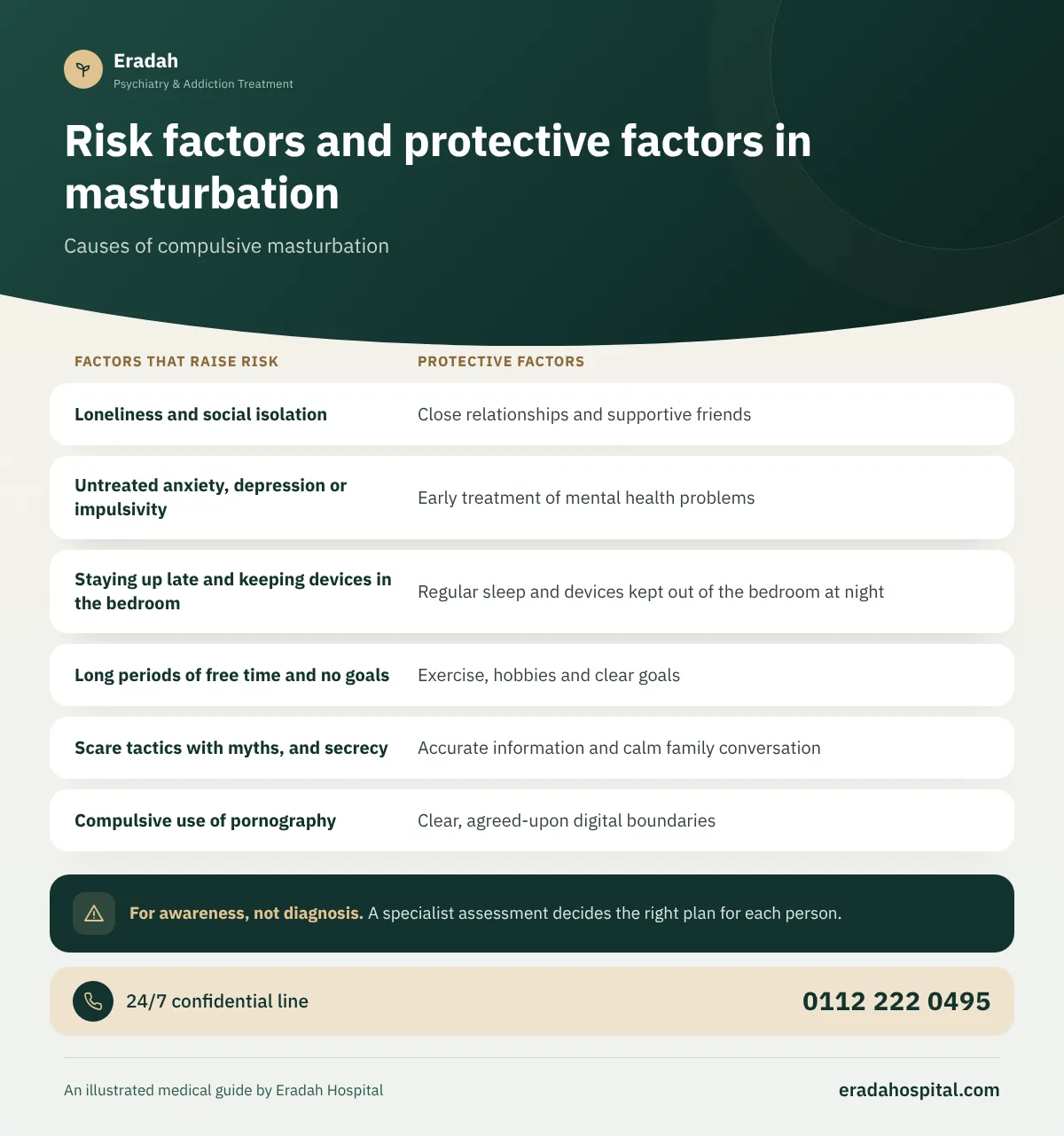
Risk and protective factors for the compulsive pattern
| Factors that raise risk | Protective factors |
|---|---|
| Loneliness and social isolation | Close relationships and supportive friends |
| Untreated anxiety, depression or impulsivity | Early treatment of mental health problems |
| Staying up late and keeping devices in the bedroom | Regular sleep and devices kept out of the bedroom at night |
| Long periods of free time and no goals | Exercise, hobbies and clear goals |
| Scare tactics with myths, and secrecy | Accurate information and calm family conversation |
| Compulsive use of pornography | Clear, agreed-upon digital boundaries |
Understanding the causes is half the way; the other half is practical steps, which you will find on the page how to stop masturbation.