What are the main signs of pornography addiction?
This problem does not show up on a blood test or an X-ray, but in a behavioral pattern that repeats and widens over time. The person often notices many of the signs before anyone else, while the family may pick up on its indirect effects without knowing the cause.
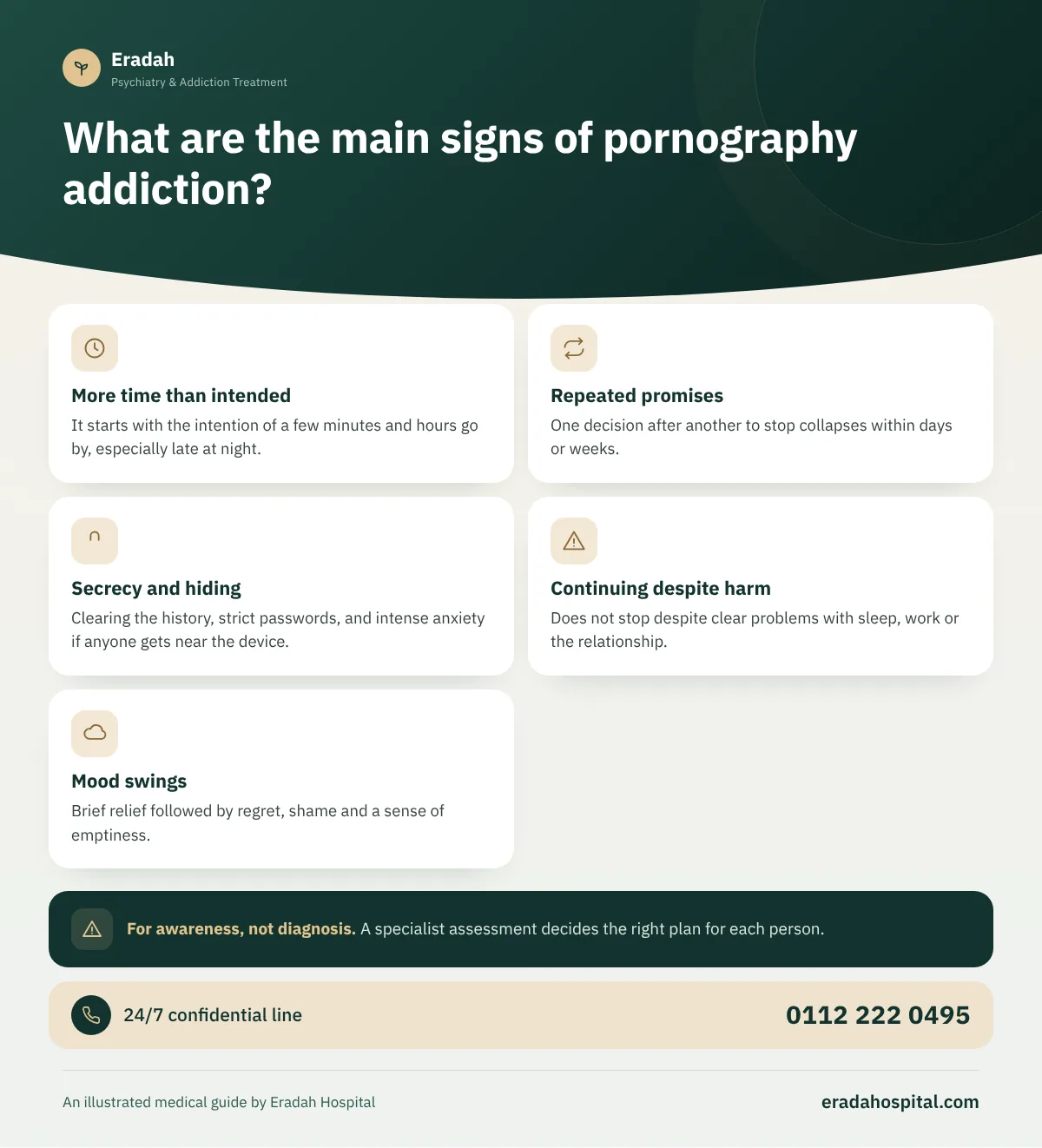
It starts with the intention of a few minutes and hours go by, especially late at night.
One decision after another to stop collapses within days or weeks.
Clearing the history, strict passwords, and intense anxiety if anyone gets near the device.
Does not stop despite clear problems with sleep, work or the relationship.
Brief relief followed by regret, shame and a sense of emptiness.
Behavioral signs
- Spending long periods alone with the phone or computer, and clear irritation when interrupted.
- Frequent late nights for no obvious reason, and waking up late or tired.
- Putting off tasks and duties, or rushing them because of preoccupation.
- Pulling away from social activities, sports and hobbies that were once enjoyed.
- Repeatedly seeking more intense or novel content to get the same effect, which some people describe themselves.
- Use in inappropriate places or times, such as at work or when family is around, with clear risk of being found out.
Psychological and emotional signs
Many people who struggle with compulsive use live with an exhausting inner conflict, which shows in feelings that are hard to hide for long:
- Intense regret and shame after each time, and harsh self-talk such as "I'm a failure" or "I don't deserve anything."
- Tension and irritability when unable to be alone with the device, or when trying to stop.
- A sense of emptiness and boredom, and little enjoyment in everyday things.
- Constant worry about being found out, and extreme sensitivity to any question about the phone.
- Declining self-esteem and a sense of living a double life between the public image and hidden behavior.
Indirect signs in sleep, energy and daily life
There is no physical sign specific to this problem, but its effects show up in the body indirectly: repeated daytime exhaustion from lack of sleep, poor concentration, eye strain and headaches from long screen time, and neglect of regular eating, exercise or self-care. Many problems share these signs, so they are not enough on their own to judge.
How does a specialist assess the case? ICD-11 features in brief
A psychiatrist does not rely on a single sign, but looks for a pattern that matches what the international classification ICD-11 describes for compulsive sexual behavior disorder, which includes:
| Feature | What it looks like in practice |
|---|---|
| Centrality of the behavior | It becomes the center of the day, crowding out health, self-care, interests and responsibilities |
| Failed cutting down | Many unsuccessful attempts to stop or cut down |
| Continuing despite consequences | It continues despite conflicts, losses or clear harm |
| Little satisfaction | It continues even when the person feels the behavior no longer gives real relief |
| Duration and impact | A pattern that lasts a long time, six months or more as an example, and causes marked distress or impairment |
The specialist also rules out other causes that might explain the behavior, such as a manic episode in bipolar disorder or the effect of certain substances or medications, and checks whether the distress comes from real loss of control or only from a conflict of values.
Signs in teenagers
Signs are hard to tell apart in teenagers, because many normal adolescent behaviors resemble them: wanting privacy, staying up late, and mood swings. But what stands out is a clear change from their usual self together with several signs:
- Strong insistence on closing the door with the device for hours, especially after the family has gone to sleep.
- A sudden drop in grades, morning drowsiness and being late for school.
- Sharp irritability or crying when the phone is taken or the internet is restricted.
- Withdrawal from family and friends and saying little about their day.
- Using words or ideas about relationships that do not suit their age, or sudden excessive anxiety about messages they receive.
Paying attention to the last sign is important, because sudden anxiety about messages may point to online threats or blackmail that need parents to step in immediately, not to punish.
Signs in adults and married people
In adults the signs may show up more in work and the marital relationship: reduced productivity or use at the workplace despite the danger, cooler emotional communication with the partner, avoiding conversation, constant preoccupation with the phone at home, and inconsistencies in explaining lost time. A wife often notices a change in closeness and attention before she knows the reason.
Is guilt alone a sign of the problem?
Not necessarily. Some people describe themselves as addicted because the behavior sharply conflicts with their values, even if it is infrequent and does not disrupt their life. Here the core of the suffering is a conflict between values and behavior, not loss of control. Both deserve support, but telling them apart changes how help is given, which is why a specialist asks about control and impact, not about the feeling alone.
Self-assessment questions (not a diagnosis)
Answer honestly, just between you and yourself, these questions about the past six months:
- Have you tried more than once to stop or cut down without success?
- Do you spend much more time than you intend each time?
- Do you turn to it whenever you feel stressed, lonely, bored or sad?
- Has it clearly affected your sleep, study or work?
- Has it caused conflicts or lost trust in your marital or family relationships?
- Do you hide how much you use from others, or lie about it?
- Do you continue even though it no longer gives you the relief it once did?
How can the family or a wife notice the problem?
Families often do not discover the problem all at once, but notice a buildup of changes: late nights, isolation, irritability and a decline in study or work, and then perhaps direct evidence on a shared device. The essential advice is that noticing should not turn into constant spying or humiliating searches, because that destroys trust and leads to even more hiding.
How do you start the conversation with your son or partner?
Speak in a private, calm place, away from the moment of anger or of discovery.
Describe the behavior and its effect: "I noticed you're staying up late a lot and that you're tired," instead of accusations and labels.
Make clear that you love them and want to help, and that the problem is common and can be solved.
Such as an appointment with a specialist or an agreement on device controls, instead of a long list of orders.
If you are met with denial or anger the first time, that is to be expected; leave the door open and come back to the conversation later. To understand why this problem arises in the first place, read the causes page.
Severe hopelessness or thoughts of self-harm? Get help now
- Talk of wanting to die, of being a "burden" on the family, or of not deserving to live
- Crushing shame and total hopelessness after a relapse or after the family or wife finds out
- Sudden withdrawal from everyone, or saying goodbye to people and putting affairs in order in a way that is hard to explain
- A teenager facing online threats or blackmail who seems terrified or broken down
- Increased use of alcohol or drugs, or violent agitation that threatens their safety or the safety of those around them
Do not leave the person alone, and speak to them calmly, without blame or shaming; the feeling of disgrace at this moment may be more dangerous than the problem itself. Call an ambulance on 123 or take them to the nearest emergency room, or call the mental health support line 16328 (24 hours). In cases of online blackmail: reassure the teenager that they are not at fault, keep the evidence, do not comply with any demand, and report it to the competent authorities.
Ambulance 123 Mental health support line 16328