Does pornography addiction have real harms? A balanced view
Frightening claims about the harms of this behavior circulate online, some proven and many exaggerated. The honest scientific view is that compulsive use does cause real harm, but it comes mainly from loss of control, secrecy, wasted time and the effect of all that on the person and their relationships.
We lay out these harms to explain why the problem deserves treatment, and to encourage people who are struggling to seek help before losses pile up, not to scare them. Exaggerated scare tactics increase shame, and shame, as we have seen, feeds the problem.
Psychological harms: anxiety, mood and self-esteem
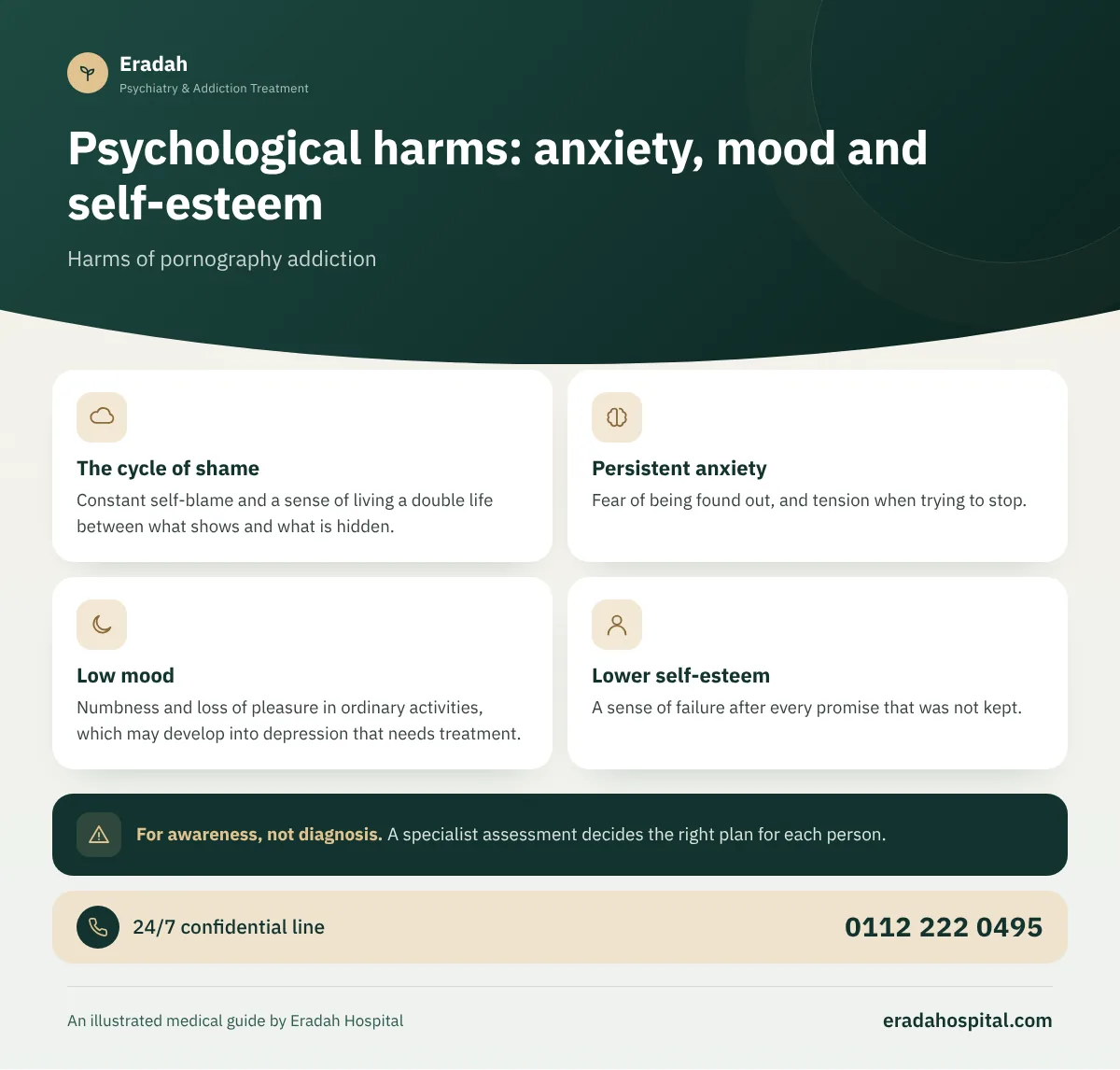
Compulsive use is linked to higher levels of anxiety, low mood and loneliness. The relationship runs in both directions: psychological distress drives the behavior, and the behavior, with the shame and isolation that follow, deepens the distress.
Constant self-blame and a sense of living a double life between what shows and what is hidden.
Fear of being found out, and tension when trying to stop.
Numbness and loss of pleasure in ordinary activities, which may develop into depression that needs treatment.
A sense of failure after every promise that was not kept.
In honesty, many studies in this field are correlational and cannot prove cause and effect, and their results are influenced by the way things are measured and by participants' cultural and value backgrounds. But specialists agree that loss of control, however it is explained, is linked to real psychological distress that deserves assessment and treatment, and that the distress usually eases when a person regains control over their time and behavior.
Its effect on focus, study and work
The time the behavior consumes comes from somewhere: from study hours, work or sleep. With repeated mental preoccupation and intermittent urges, focus weakens and the ability to complete long tasks declines. The most serious aspect is use in the workplace or on work devices, which can lead to losing a job and legal problems related to the employer's policies.
Sleep, energy and the body
Repeated late nights in front of a screen delay sleep and shorten it, and the light from devices delays release of the sleep hormone. The result over time is daytime fatigue, headaches, weakened immunity and changes in appetite. Long sitting and isolation also reduce physical activity, and self-care and general health decline.
Marital relationship and trust
One of the most painful harms is what happens to the marital relationship. A partner who discovers the problem often goes through shock, a sense of betrayal, comparison and lowered self-confidence, and may suffer anxiety, sleeplessness and sadness. Many wives feel they are "the reason," and that is not true.
- Less emotional closeness and real communication between spouses.
- Unrealistic expectations about the relationship and the body, fed by staged content that does not reflect real life.
- Repeated lying and concealment, which sometimes shakes trust more than the behavior itself.
- Conflicts that may end in separation if the problem is left unaddressed and untreated.
The reassuring news is that many couples rebuild trust gradually when the person concerned acknowledges the problem and commits to a clear treatment plan, with specialist support for both partners.
The family and children
The effects reach the whole family: tension in the general atmosphere, one parent preoccupied and less present for the children, and conflicts that children may sense without understanding why. And when this content is on shared devices at home, children may come across it by accident, a risk that is easily avoided by separating devices and turning on controls.
On teenagers and their psychological and social development
A teenager is at a stage when they are forming ideas about themselves, relationships and respect. Child protection organizations note that repeated exposure to this content may give them unrealistic ideas about relationships, body image, consent and boundaries, and increase anxiety and comparison.
- Falling grades because of late nights and distraction.
- Withdrawal from real-life activities and friendships.
- Shame and secrecy that stop them from asking their parents for help.
- The risk of being approached by strangers or asked for personal pictures, followed by threats and blackmail.
Digital and financial risks
| The risk | How it happens |
|---|---|
| Online blackmail | Luring a victim into sharing pictures or information, then threatening to publish them in exchange for money or other demands |
| Malware | Misleading links and ads that steal data or passwords or take control of the device |
| Privacy violations | Leaked personal data or conversations that others exploit |
| Financial losses | Subscriptions and repeated spending that, in some cases, the person hides from their family |
| Professional problems | Use on work devices, in violation of their policies |
The link to substance use and other addictions
Compulsive use may occur together with alcohol or stimulant use in some people, since these substances weaken self-control and prolong the behavior, and a person may use the substance and the behavior together to escape the same feelings. When they occur together the risk is greater, and the situation needs assessment within a dual diagnosis framework.
Despair and the risk of self-harm
Some people who struggle with this problem go through moments of intense despair, especially after a relapse, after the family finds out, or after being blackmailed. Overwhelming shame can convince a person that they do not deserve to live, and that thought comes from pain, not from truth.
If you, or someone you know, have thoughts of death or self-harm, this deserves help now: talk to someone you trust, and call the mental health support line 16328 or an ambulance (123). The problem is treatable, and the family can get through the shock with the right support.
Can the harms of pornography be avoided?
Yes, and most of them are reversible. Focus and sleep improve within weeks of changing routine, mood improves as the cycle of shame is broken and any co-occurring depression or anxiety is treated, and marital trust can be rebuilt through honesty, commitment and specialist support. The key is early intervention before losses pile up; you will find the practical steps on the how to overcome it page.
Severe hopelessness or thoughts of self-harm? Get help now
- Talk of wanting to die, of being a "burden" on the family, or of not deserving to live
- Crushing shame and total hopelessness after a relapse or after the family or wife finds out
- Sudden withdrawal from everyone, or saying goodbye to people and putting affairs in order in a way that is hard to explain
- A teenager facing online threats or blackmail who seems terrified or broken down
- Increased use of alcohol or drugs, or violent agitation that threatens their safety or the safety of those around them
Do not leave the person alone, and speak to them calmly, without blame or shaming; the feeling of disgrace at this moment may be more dangerous than the problem itself. Call an ambulance on 123 or take them to the nearest emergency room, or call the mental health support line 16328 (24 hours). In cases of online blackmail: reassure the teenager that they are not at fault, keep the evidence, do not comply with any demand, and report it to the competent authorities.
Ambulance 123 Mental health support line 16328