Why do some people fall into compulsive use and others do not?
Many people watch this content without losing control, while others fall into a compulsive pattern that is hard to break. The difference is not down to "strength of character" alone, but to an interaction between the nature of digital content, the person's psychological state and their surroundings.
You can picture it as three circles: the medium (content that is always available, anonymous and ever-new), the person (their feelings, needs and vulnerability), and the environment (family, relationships and free time). The larger the overlap between them, the more likely curiosity is to turn into a habit and then into compulsive behavior.
How does digital platform design contribute to the problem?
Since the early days of the internet, researchers have described what are known as the "three engines": access, low or no cost, and anonymity. With smartphones, access is possible anywhere and at any moment, with no barrier that gives a person a chance to think before acting.
The device is in the pocket all day, so there is no time gap between desire and action.
New content and a stream of suggestions stir curiosity and stretch the session far longer than intended.
The feeling that no one knows removes the social checks that normally guard against impulsive behavior.
Not knowing what will appear next keeps attention hooked, the same mechanism that games of chance use.
Conditioned learning: how does a first time become a habit?
The brain learns by association. If distress or boredom is repeatedly paired with a behavior that gives quick relief, the distress itself becomes a cue that triggers the urge automatically. Over time, neutral things also gain the power of a cue: the bed late at night, being alone in a room, even holding a phone with no purpose.
That is why many people say they find themselves "in the middle of it" before they consciously decide. The behavior has moved from the zone of decision to the zone of automatic habit, which explains why good intentions alone are not enough and why treatment focuses on changing cues and the environment.
Psychological factors: escaping feelings, not only seeking pleasure
Research suggests that compulsive use is often a way of regulating difficult emotions. Among the psychological factors most closely linked to it:
- Loneliness and isolation: the absence of warm, close relationships makes the digital substitute easier and less risky.
- Anxiety and stress: the behavior gives temporary calm that is followed by a bigger wave of anxiety.
- Depression and loss of pleasure: a search for any sensation that breaks the emptiness.
- ADHD: impulsivity, quick boredom and a search for stimulation.
- Low self-esteem and difficulty with social skills or fear of rejection.
- Difficult childhood experiences or untreated trauma, from which the person finds an escape in the behavior.
Early exposure in childhood and adolescence
Some children reach this content at a young age, by accident or through peers, before they are able to understand it or place it in context. The teenage brain is naturally sensitive to reward and novelty, while the areas for planning and impulse control are not fully developed until about the mid-twenties. That is why habits formed at this stage are stronger and harder to change later.
The risk rises when a child is left alone with a connected device without controls, or when talking about the body and relationships is completely forbidden at home, so the child looks for answers in misleading sources and then hides what they saw for fear of punishment.
Family, environment and relationships
The environment has an influential role: long stretches of free time with no activities or goals, unemployment, living abroad or traveling for work away from family, chronic marital conflict, and weak emotional communication between spouses. A family that responds to every mistake with exposure and harsh punishment also teaches its children to hide rather than ask for help.
We do not mean that the family is the "cause" of the problem, but the way it responds can raise or lower the risk. Improving dialogue and family warmth is one of the strongest protective factors.
Everyday triggers: what is the difference between a cause and a trigger?
A cause is what makes a person more vulnerable to the problem in the long term, while a trigger is the moment that ignites the urge. A helpful way to remember common triggers is the shorthand "hungry, angry, lonely, tired," along with:
| Type of trigger | Examples |
|---|---|
| Feelings | Stress after a workday, sadness, boredom, frustration, a conflict with a partner |
| Times | Late hours of the night, weekends, long stretches of free time |
| Places | The bedroom, being alone at home, travel and staying alone |
| Physical states | Exhaustion and lack of sleep, alcohol or drug use that weakens self-control |
| Digital | Aimless browsing, misleading ads and links, suggestive content on public platforms |
Do shame and secrecy make the problem worse?
Yes, markedly. Shame is not merely a result of the behavior; it becomes an engine for it: the person feels bad, so they isolate, so loneliness and stress rise, so they return to the behavior seeking relief. Research on "value conflict" also shows that people who see their behavior as strongly at odds with their values may suffer major distress even with less use, and this is real distress that needs understanding, not more blame.
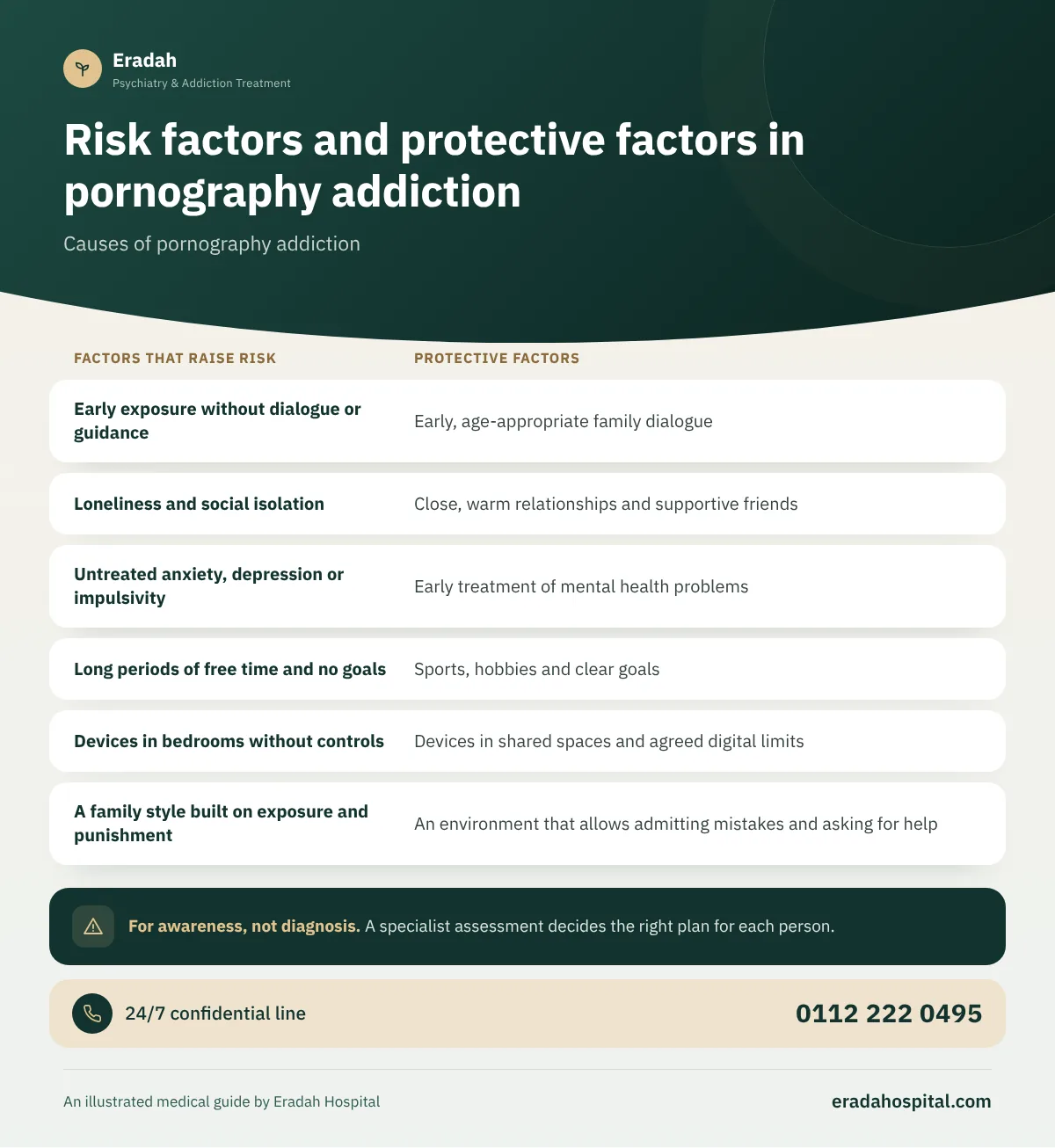
Risk and protective factors in pornography use
| Factors that raise risk | Protective factors |
|---|---|
| Early exposure without dialogue or guidance | Early, age-appropriate family dialogue |
| Loneliness and social isolation | Close, warm relationships and supportive friends |
| Untreated anxiety, depression or impulsivity | Early treatment of mental health problems |
| Long periods of free time and no goals | Sports, hobbies and clear goals |
| Devices in bedrooms without controls | Devices in shared spaces and agreed digital limits |
| A family style built on exposure and punishment | An environment that allows admitting mistakes and asking for help |
Myths about the causes of the problem
- "The cause is poor parenting": it can happen in very careful families; the digital medium is stronger than any single form of oversight.
- "The cause is weak willpower": willpower is affected by tiredness, stress and learned habit, and it is not fixed.
- "Anyone who falls into it has deviant tendencies": most are ordinary people who found in the behavior an easy escape from their pressures.
- "The only cause is dopamine": chemistry is part of the picture, but feelings, environment and habits are no less important.
Understanding the causes is half the way; the other half is practical steps, which you will find on the how to overcome it page.