What is tombak?
“I don’t smoke, it’s just a pinch.” That is how many tombak users see their habit, as if the absence of smoke meant the absence of harm. But research says the opposite: this tobacco, held in the mouth, is among the tobacco products most linked to oral cancer in the world.
Tombak is a Sudanese tobacco product that has been used for about 400 years. It is made from Nicotiana rustica tobacco, which is stronger than ordinary cigarette tobacco, after it is fermented, ground, and mixed with an alkaline substance. The user places an amount of it, which Sudanese people call a “saffa,” between the lip or cheek and the gum, where it stays for hours.
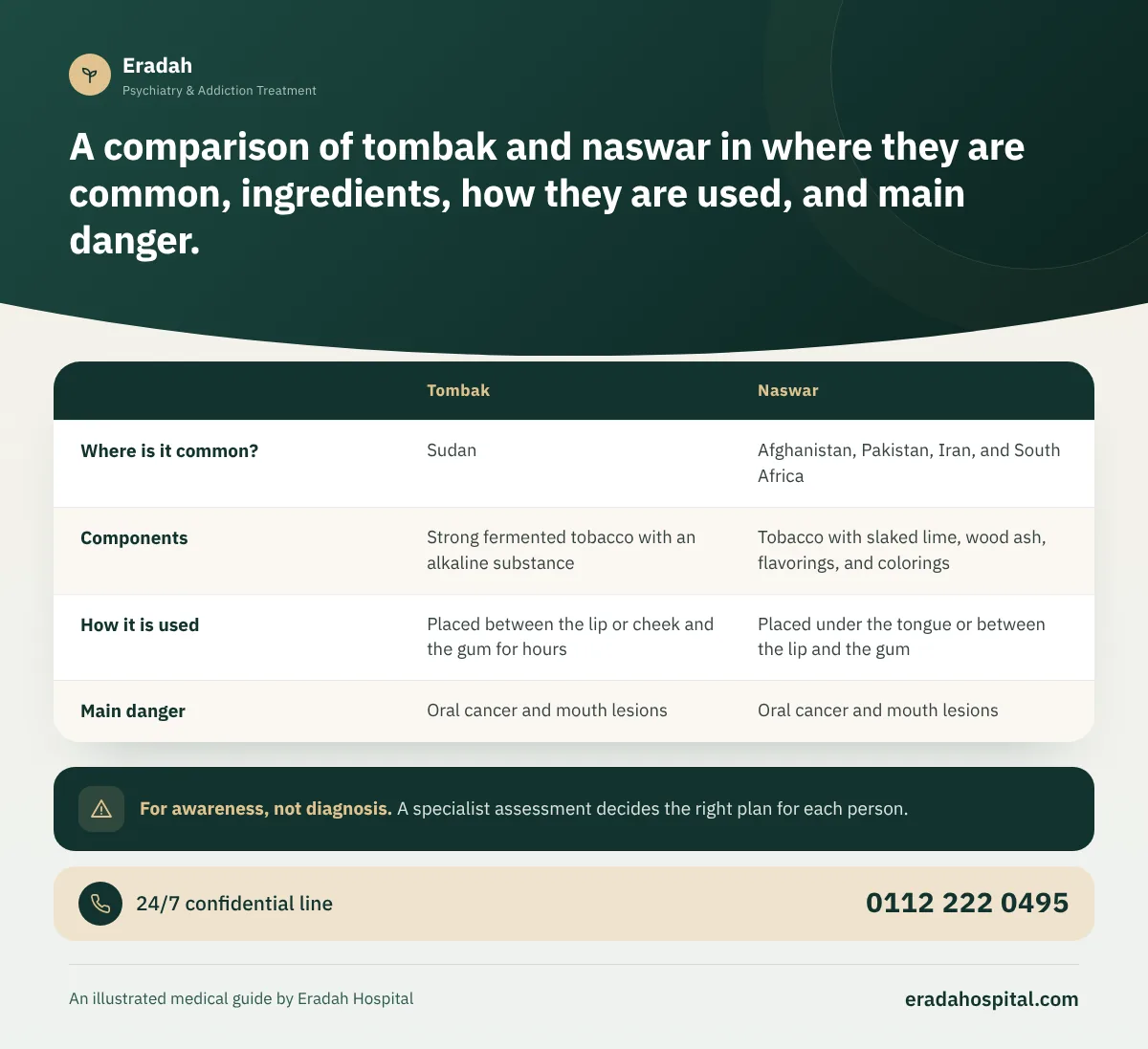
What is the difference between tombak and naswar?
| Tombak | Naswar | |
|---|---|---|
| Where is it common? | Sudan | Afghanistan, Pakistan, Iran, and South Africa |
| Components | Strong fermented tobacco with an alkaline substance | Tobacco with slaked lime, wood ash, flavorings, and colorings |
| How it is used | Placed between the lip or cheek and the gum for hours | Placed under the tongue or between the lip and the gum |
| Main danger | Oral cancer and mouth lesions | Oral cancer and mouth lesions |
A comprehensive review of smokeless tobacco products published in 2026 notes that, in one of the studies it reviewed, naswar users had an oral cancer risk more than 20 times higher than non-users. Both products are often made by traditional methods with no control over the level of harmful substances.
Why does tombak become addictive so quickly?
The alkaline substance makes the mixture basic, so nicotine is released and absorbed easily through the lining of the mouth. According to a comparative study published in 1998 in the journal Oral Oncology, the nicotine content of tombak ranged from 8 to 102 mg per gram of dry tobacco, compared with 5 to 11 mg in Swedish snus. Because the wad stays in the mouth for hours and is repeated throughout the day, the brain is exposed to nicotine almost continuously, so dependence forms quickly, and stopping brings irritability, strong cravings, and difficulty concentrating. The guide on the causes of nicotine addiction explains why quitting is hard.
Harms of tombak to the mouth
The US National Cancer Institute explains that smokeless tobacco contains at least 28 carcinogens, the most dangerous being tobacco-specific nitrosamines that form during fermentation and aging, and that their level is directly linked to cancer risk. In the same Oral Oncology study, levels of these substances in tombak were tens to hundreds of times higher than in Swedish snus, and the risk of oral cancer among tombak users was estimated at between 7 and 73 times. A review of reviews published in 2022 found that the odds of oral cancer with tombak were about 4.7 times higher.
Usually where the tombak is placed, and it may extend to the esophagus.
Precancerous lesions that appear where the “saffa” is held.
Receding and inflamed gums and tooth damage.
The US National Cancer Institute also mentions the esophagus and pancreas.
Harms of tombak to the heart and body
The National Cancer Institute notes that smokeless tobacco may also cause heart disease. A 2026 review summarizes that smokeless tobacco products are linked to high blood pressure, cardiovascular disease, and increased clotting tendency, as well as fertility problems and harm to the fetus if used by a pregnant woman. Nicotine raises the heart rate and narrows blood vessels whether it enters the body through smoke or through the mouth, which is why many of its harms resemble the harms of smoking.
How do you quit tombak and naswar?
A Cochrane review published in 2025 pooled the results of 43 trials involving more than 20,000 smokeless tobacco users and found that: behavioral counseling raised the chances of quitting by about 76% compared with minimal support, brief advice from a doctor by about 24%, and the drug varenicline by about 35% compared with placebo, while the benefit of nicotine replacement was less certain, and bupropion showed no benefit. Only the doctor decides the right medication and dose, so do not start or stop any medication without a doctor.
- Set a quit day, and get rid of your supply and equipment before it.
- Know your usual situations: after meals, with tea, at work, with certain friends.
- Prepare a mouth substitute such as sugar-free gum or seeds.
- Ask for counseling from a doctor or a quit clinic, and ask about helpful medications.
- Have your mouth checked by a dentist, and ask for an examination of any patch or sore.
You can find a detailed quit plan in the guide to treating nicotine addiction. If tombak is part of a wider pattern that includes khat or other substances, or comes with anxiety or depression, an assessment in outpatient clinics may help.
When should you see the doctor?
- A white or red patch in the mouth that does not go away.
- A sore that does not heal, bleeding, or a lump in the mouth or neck.
- Difficulty or pain swallowing, or a change in voice.
- Chest pain or shortness of breath: call the ambulance (123) immediately.
Chest pain or signs of a stroke or heart attack? Call an ambulance on 123 immediately
- Pain, pressure or heaviness in the middle of the chest that may spread to the arm, jaw or back, with cold sweat or shortness of breath
- Sudden drooping of the face, or weakness or numbness in an arm or leg, especially on one side of the body
- Sudden difficulty speaking or understanding, or blurred vision, sudden loss of vision or loss of balance
- Severe shortness of breath or blue lips in a smoker with chronic chest disease
- A child who swallowed e-cigarette liquid or a nicotine pack, then developed vomiting, dizziness or unusual drowsiness
Call an ambulance on 123 immediately and do not wait for the symptoms to pass; have the person sit or lie in a comfortable position, and do not give them food or drink. Note the time the symptoms began, because it matters greatly to doctors in treating strokes and heart attacks. If a child has swallowed nicotine liquid, take them to the nearest emergency room with the container, and do not try to make them vomit.
Ambulance 123 Mental health support line 16328