Why do people start smoking in the first place?
Few people start smoking because they like the taste of smoke. The start is mostly social and psychological: curiosity, wanting to look grown up, going along with friends, or an attempt to cope with exam or work stress.
Most adult smokers started before the age of 20. At this stage the brain is more sensitive to reward and less able to curb impulses, so dependence forms faster and is harder to break later. That is why public health workers focus on preventing young people from starting.
In Egypt, café culture plays a special role. Shisha and cigarettes are present at gatherings, evenings out, and while watching matches, and it is hard for a young man to be the only one in the group who does not smoke.
How does nicotine create addiction in the brain?
Inhaled nicotine reaches the brain within seconds and binds to nicotinic acetylcholine receptors, triggering the release of dopamine in the reward circuit, along with other neurotransmitters such as norepinephrine. The result is a quick feeling of relief and alertness.
This speed is the secret of its addictive power: the faster a substance reaches the brain and the shorter its effect, the stronger the link between the act and the reward, and the more often the craving returns. With repetition, the brain increases the number of receptors and adapts, so having nicotine becomes the “normal state” and its absence a source of discomfort.
Why is smoking tied to coffee and the end of a meal?
Nicotine does not work alone. When smoking is repeated in particular situations, the brain learns to link those situations with reward, and the situations themselves become triggers that set off the craving automatically:
| The trigger | Why it triggers the craving |
|---|---|
| A cup of coffee or tea | A daily association repeated for years, until the cup without a cigarette feels “incomplete” |
| After eating | A fixed ritual repeated several times a day, accompanied by a feeling of relaxation |
| Stress and arguments | The cigarette has become the only “break” or escape the person knows |
| Sitting at the café with friends | Shisha is part of the same social ritual |
| Driving and waiting | Filling empty time, keeping the hands busy, and boredom |
| Alcohol or hashish | Each increases the desire for the other and weakens the ability to resist |
That is why many people who quit say the hardest part was not the nicotine itself but the “coffee cigarette” and the “after-lunch cigarette.” Successful quit plans deal with these associations as much as with the nicotine.
What is the role of anxiety, depression, and other disorders?
Smoking is far more common among people with mental health conditions. Some use cigarettes as a quick way to ease distress, which doctors call “self-medication.” The main associated conditions include:
The person finds in the cigarette a temporary boost of energy and pleasure, which makes it hard to give up. See depression.
A person with anxiety feels the cigarette calms them, while repeated withdrawal adds to their tension. See generalized anxiety.
Nicotine temporarily improves concentration, which is why people with this disorder smoke more and start earlier. See ADHD.
Smoking rates among people with these conditions are very high, and they need special support when quitting.
Smoking often goes along with hashish, alcohol, and drug use, and each feeds the other.
Importantly, treating the co-occurring mental disorder makes quitting much easier, and quitting itself is linked to improved mood and anxiety in the medium term for many people.
Does genetics make some people more prone to nicotine addiction?
Yes, studies indicate that genetic factors influence the likelihood of continuing to smoke after the first try, how quickly the body breaks down nicotine, and how severe withdrawal symptoms are. Someone whose body clears nicotine quickly may need more cigarettes and feel stronger cravings.
But genetics is a predisposition, not destiny. Environment, experiences, and support count for a great deal, and a person with a family history of smoking can quit successfully, although they may benefit more from medication and regular follow-up.
How do family, friends, and marketing affect smoking?
- Parents who smoke: A child who sees their parents smoke learns that cigarettes are a normal part of life, and gets easier access to them.
- Friends: The strongest factor in starting to smoke in adolescence, especially in a group where most people smoke.
- Flavors: Fruit and candy flavors in vapes and shisha tobacco (maassel) mask the harshness of the smoke and attract young people, and data from the US Centers for Disease Control and Prevention show that most teenage vape users choose flavored products.
- Design and marketing: Small, colorful devices that are easy to hide, and social media images linking smoking with style and freedom.
- Easy access: Selling single cigarettes and the spread of kiosks make starting easy and cheap for young people.
The World Health Organization warns that in countries with available data, children use e-cigarettes at about nine times the rate of adults on average, and that vaping is pushing a new generation toward nicotine dependence at an early age.
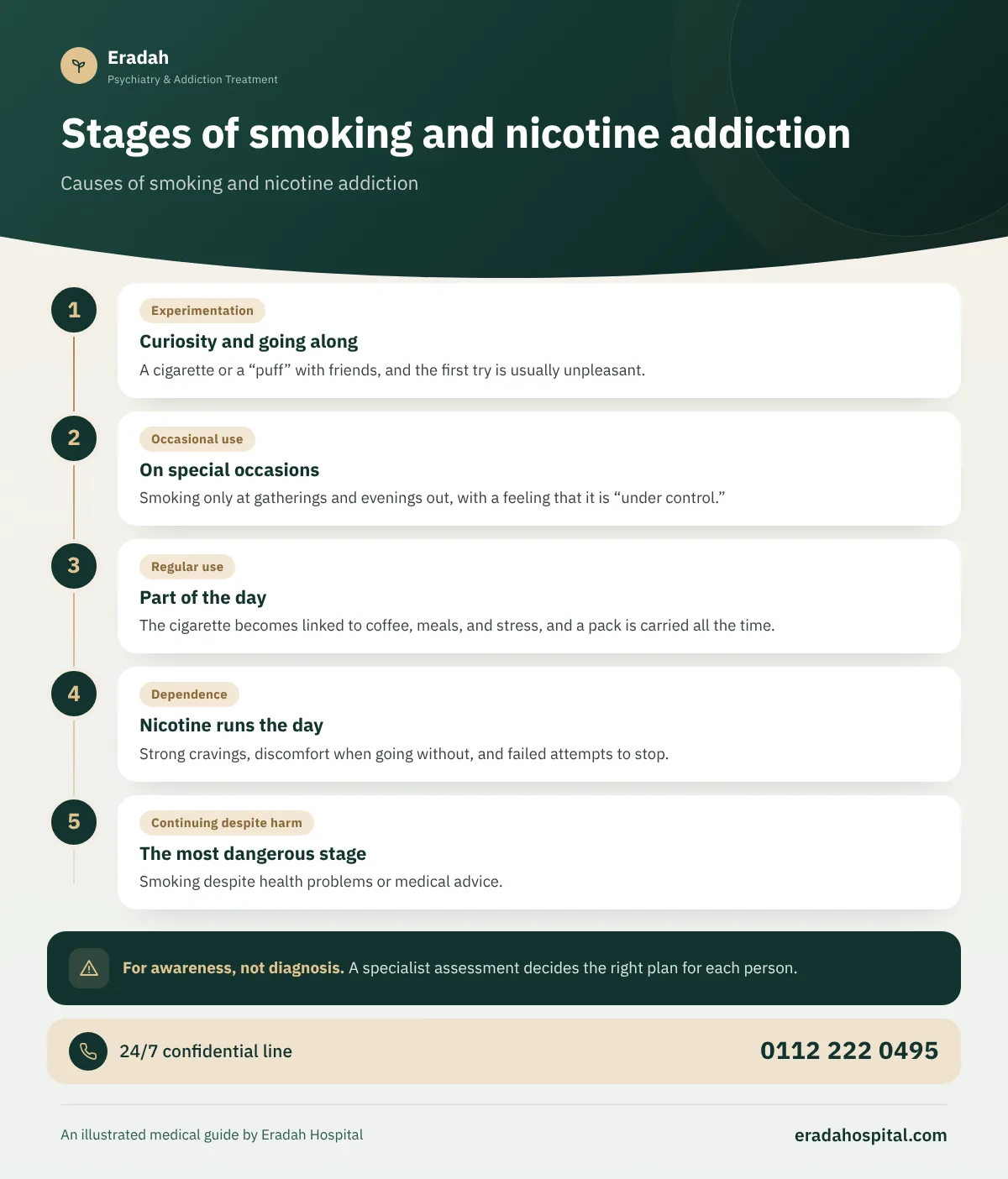
How does smoking progress from experimenting to dependence?
- ExperimentationCuriosity and going along
A cigarette or a “puff” with friends, and the first try is usually unpleasant.
- Occasional useOn special occasions
Smoking only at gatherings and evenings out, with a feeling that it is “under control.”
- Regular usePart of the day
The cigarette becomes linked to coffee, meals, and stress, and a pack is carried all the time.
- DependenceNicotine runs the day
Strong cravings, discomfort when going without, and failed attempts to stop.
- Continuing despite harmThe most dangerous stage
Smoking despite health problems or medical advice.
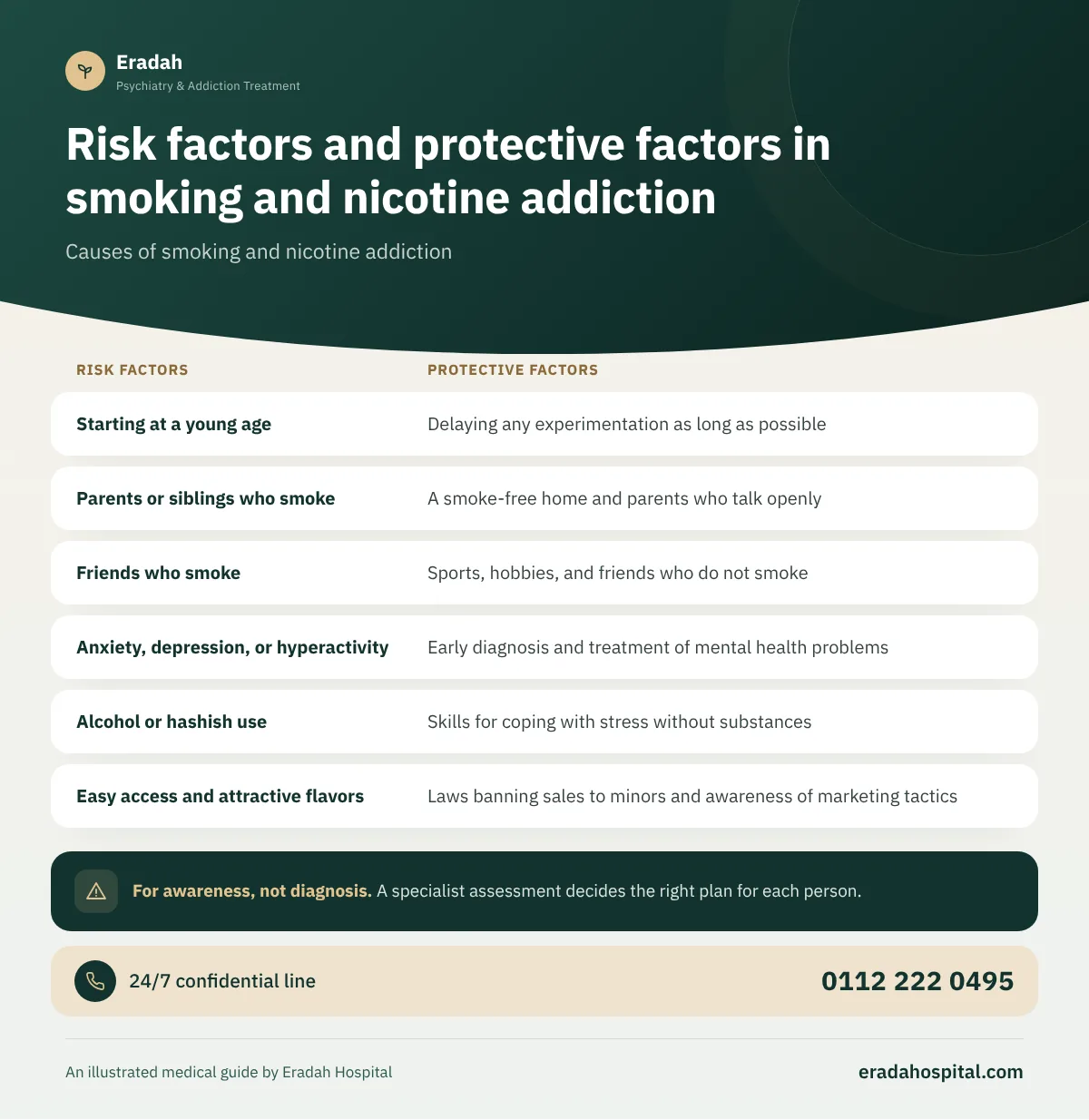
What are the risk and protective factors for smoking?
| Risk factors | Protective factors |
|---|---|
| Starting at a young age | Delaying any experimentation as long as possible |
| Parents or siblings who smoke | A smoke-free home and parents who talk openly |
| Friends who smoke | Sports, hobbies, and friends who do not smoke |
| Anxiety, depression, or hyperactivity | Early diagnosis and treatment of mental health problems |
| Alcohol or hashish use | Skills for coping with stress without substances |
| Easy access and attractive flavors | Laws banning sales to minors and awareness of marketing tactics |
Common myths about the causes of smoking
- “Smokers have weak willpower”: Dependence is a change in the brain, and some of the strongest-willed people are those who need several attempts.
- “Smoking keeps your weight down”: You may gain a little weight after quitting, but it is nothing compared with the harms of smoking, and it can be managed with healthy eating and exercise.
- “I smoke to concentrate”: The temporary improvement in concentration is mostly just the end of the poor concentration caused by withdrawal itself.