Why is smoking one of the most serious health risk factors?
Smoking is the leading cause of preventable death in the world. Tobacco smoke contains thousands of chemicals, dozens of them known carcinogens, along with carbon monoxide, which takes the place of oxygen in the blood, and tar, which settles in the lungs.
The problem is that most of the harm builds up silently over years, so a young smoker feels “fine” until the problem appears in their forties or fifties as angina, a heart attack, a tumor, or permanent shortness of breath.
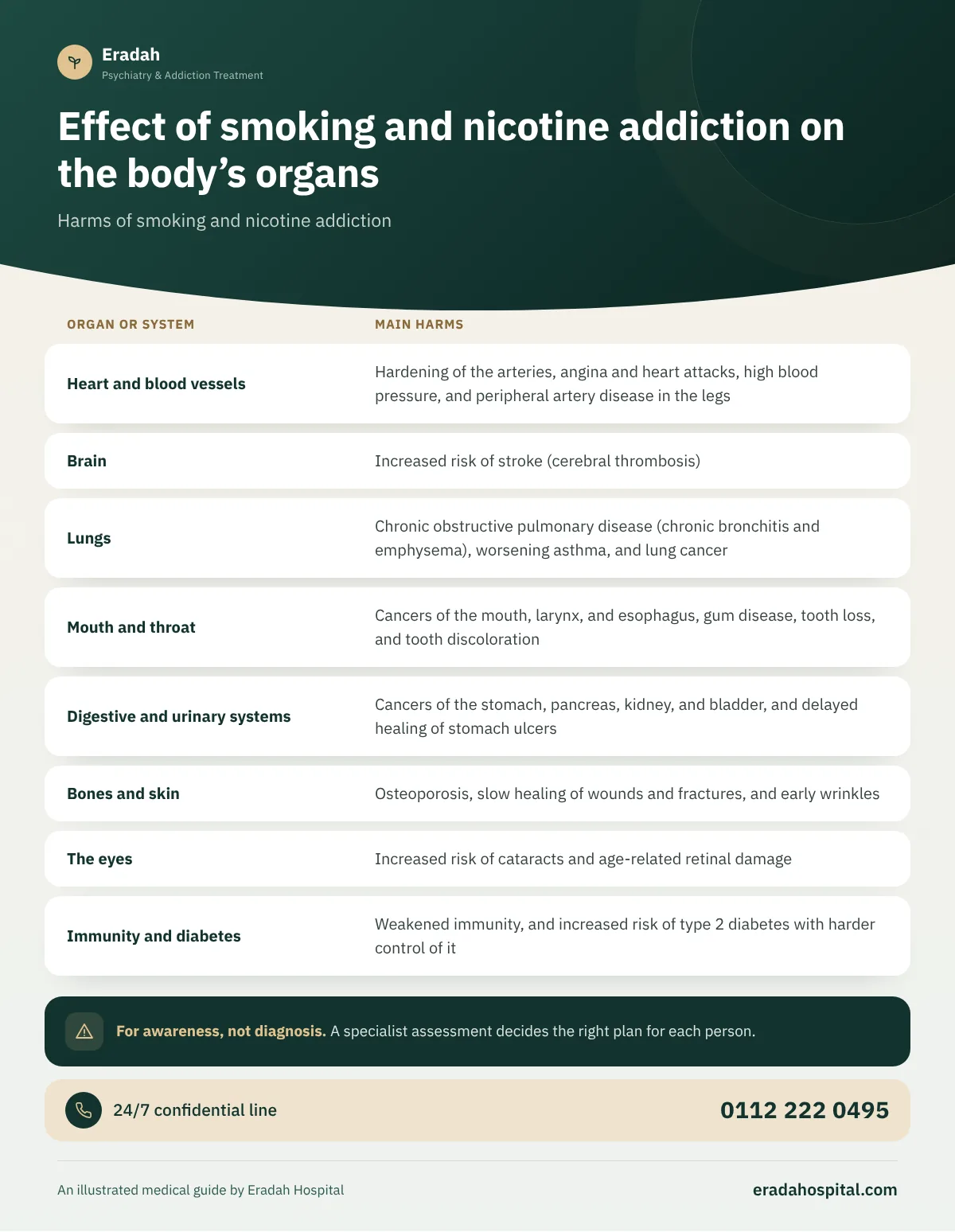
What does smoking do to the organs of the body?
| Organ or system | Main harms |
|---|---|
| Heart and blood vessels | Hardening of the arteries, angina and heart attacks, high blood pressure, and peripheral artery disease in the legs |
| Brain | Increased risk of stroke (cerebral thrombosis) |
| Lungs | Chronic obstructive pulmonary disease (chronic bronchitis and emphysema), worsening asthma, and lung cancer |
| Mouth and throat | Cancers of the mouth, larynx, and esophagus, gum disease, tooth loss, and tooth discoloration |
| Digestive and urinary systems | Cancers of the stomach, pancreas, kidney, and bladder, and delayed healing of stomach ulcers |
| Bones and skin | Osteoporosis, slow healing of wounds and fractures, and early wrinkles |
| The eyes | Increased risk of cataracts and age-related retinal damage |
| Immunity and diabetes | Weakened immunity, and increased risk of type 2 diabetes with harder control of it |
There is no “safe” number of cigarettes; even light smoking clearly raises the risk of heart disease compared with not smoking, although the risk rises with the amount and the number of years.
What are the harms of shisha, and is it milder than cigarettes?
Many people think shisha is milder, but in a single session it can expose the person to far more smoke than a cigarette. According to the US Centers for Disease Control and Prevention:
In a one-hour session a person may inhale smoke equal to 100 to 200 times the volume of a single cigarette.
A single session may expose the smoker to about nine times as much carbon monoxide as a cigarette, mainly because of the charcoal.
The smoke is still loaded with tar, heavy metals, and carcinogens after passing through the water.
Passing the mouthpiece (the hose) between people can spread mouth and respiratory infections.
Secondhand smoke carries both tobacco smoke and charcoal smoke, and harms children and café workers.
Like cigarettes, shisha is linked to heart and lung disease and to cancers of the mouth and lung, in addition to cases of carbon monoxide poisoning that show up as headache, dizziness, and fainting, especially in enclosed, poorly ventilated places.
Vapes and heated tobacco: are they less harmful?
E-cigarettes do not burn tobacco, but the World Health Organization describes them as harmful and unsafe: their aerosol carries nicotine and substances that can irritate the lungs, they cause dependence, especially in teenagers, their liquid is a poisoning hazard for small children, and many people use them together with cigarettes, combining the harms of both. Heated tobacco contains real tobacco and releases toxic emissions, many of them similar to cigarette smoke, so it should not be presented as safe.
We present the full evidence, including when vaping may help a smoker quit and when it harms, on the page E-cigarettes (Vapes): The Facts, Without Exaggeration or Understatement.
How does nicotine harm the teenage brain?
The brain keeps developing until roughly the mid-twenties. According to the US Centers for Disease Control and Prevention, nicotine can harm the parts of the brain responsible for attention, learning, mood, and impulse control. Early exposure may also make the brain more prone to addiction to other substances later.
That is why vaping at school age is an early gateway to a dependence that can last for years, and it may come with falling grades, mood swings, and anxiety, even if it looks like an “innocent experiment.”
What is the effect of smoking on pregnancy and fertility?
- It reduces fertility in both men and women, and is linked to poorer sperm quality and erectile problems.
- In pregnancy it raises the risk of miscarriage, premature birth, low birth weight, and placental problems.
- A mother’s smoking, or an infant’s exposure to smoke, is linked to a higher risk of sudden infant death.
- Exposure to smoke in childhood increases asthma attacks and ear and chest infections.
What are the harms of secondhand smoke to the family?
Secondhand smoke kills more than 1.6 million people a year according to the World Health Organization. In adults it raises the risk of heart disease and lung cancer, and in children it causes asthma attacks and repeated chest and ear infections. Opening a window or smoking in another room does not protect children adequately; the only effective solution is a smoke-free home and car.
There is also what is called “thirdhand smoke”: smoke residue that sticks to curtains, furniture, and clothes, which small children touch and then put their hands in their mouths.
Can the harms of smoking go away after quitting?
Many of them can, and some decrease gradually without disappearing completely. The risk of heart disease drops clearly within the first year, and the risk of stroke and lung cancer falls over years. Damage that has already occurred in the lungs, such as emphysema, does not return to how it was, but quitting stops it from getting worse. The full timeline of the benefits of stopping is on the smoking treatment page.
Chest pain or signs of a stroke or heart attack? Call an ambulance on 123 immediately
- Pain, pressure or heaviness in the middle of the chest that may spread to the arm, jaw or back, with cold sweat or shortness of breath
- Sudden drooping of the face, or weakness or numbness in an arm or leg, especially on one side of the body
- Sudden difficulty speaking or understanding, or blurred vision, sudden loss of vision or loss of balance
- Severe shortness of breath or blue lips in a smoker with chronic chest disease
- A child who swallowed e-cigarette liquid or a nicotine pack, then developed vomiting, dizziness or unusual drowsiness
Call an ambulance on 123 immediately and do not wait for the symptoms to pass; have the person sit or lie in a comfortable position, and do not give them food or drink. Note the time the symptoms began, because it matters greatly to doctors in treating strokes and heart attacks. If a child has swallowed nicotine liquid, take them to the nearest emergency room with the container, and do not try to make them vomit.
Ambulance 123 Mental health support line 16328