How do you know you have become dependent on nicotine?
Nicotine dependence is not measured by the number of cigarettes alone, but by how much nicotine controls your day. Some people smoke little but cannot go an hour without a cigarette, and some smoke shisha once a day but arrange their whole day around it.
- You smoke your first cigarette or take your first puff of a vape within half an hour of waking.
- You feel a strong craving that takes over your thinking if hours pass without smoking.
- You have tried to quit or cut down once or more and gone back.
- You leave a meeting or event, or wake up at night, to smoke.
- You feel irritable, anxious, or tense when you run out of cigarettes or battery charge.
- You keep smoking despite a chest illness, a doctor’s advice, or pregnancy.
- You smoke more than you intended, or you need more to feel the same effect.
Having several signs from this list points to real physical and psychological dependence. Quitting is possible, but a supported plan will serve you better than relying on “willpower alone.”
What criteria do doctors use to assess dependence?
Doctors rely on the DSM-5 diagnostic criteria for tobacco use disorder and the ICD-11 classification for nicotine dependence. We summarize them here in plain language for awareness only:
| Domain | How it shows up in daily life |
|---|---|
| Impaired control | Smoking more than planned, failing to cut down, and spending a lot of time smoking |
| Cravings | Repeated thoughts of a cigarette that are hard to ignore, especially in certain situations |
| Effect on life | Giving up activities or being late for commitments because of smoking |
| Continuing despite harm | Smoking despite a health problem the person knows smoking makes worse |
| Tolerance | Needing a larger amount, or a weaker effect from the usual amount |
| Withdrawal | Irritability, anxiety, poor concentration, and increased appetite when going without, relieved by smoking |
The doctor determines severity (mild, moderate, severe) by the number of criteria present over the past year. Details of withdrawal symptoms and how to deal with them are on the quitting smoking page.
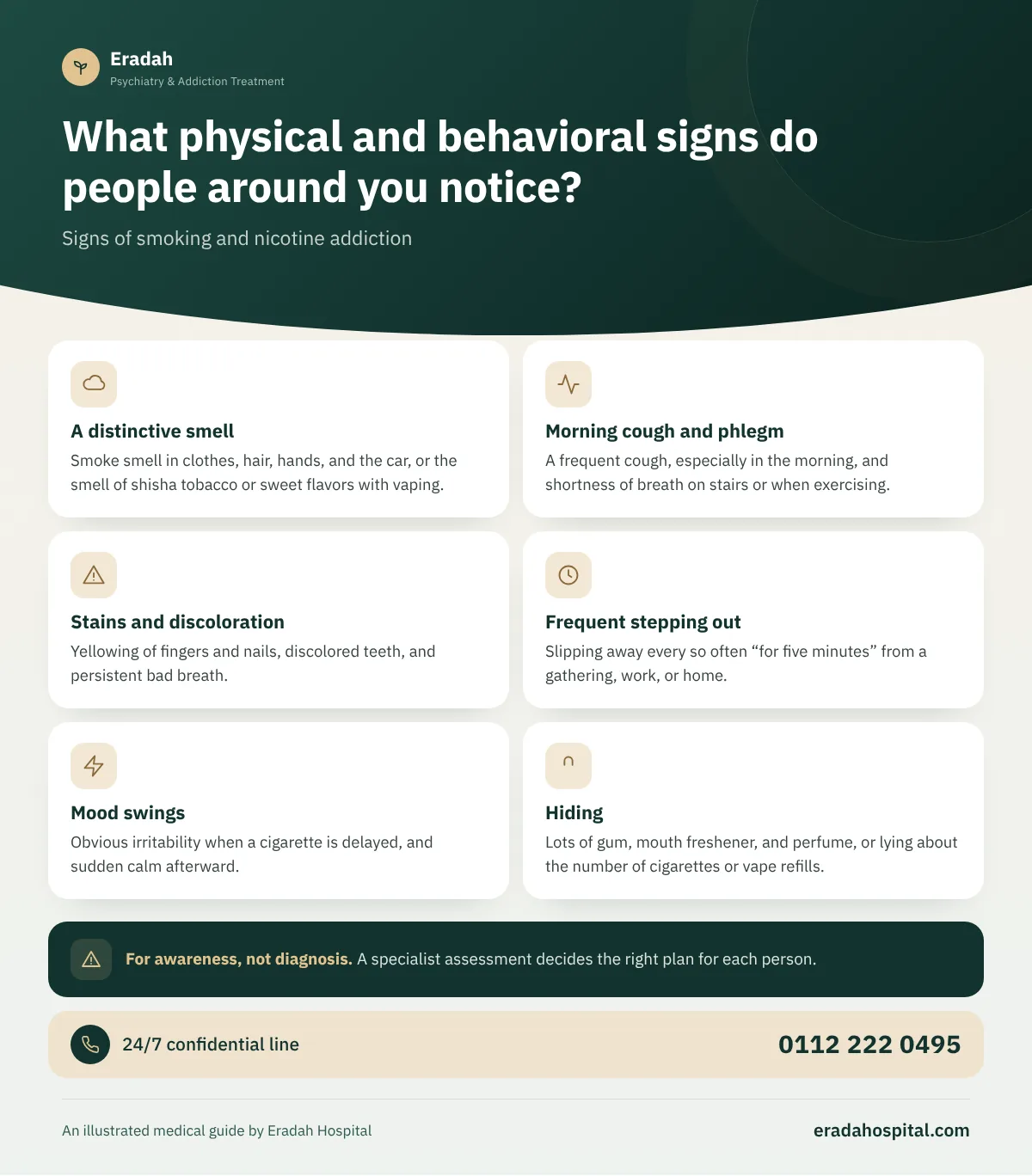
What physical and behavioral signs do people around you notice?
Smoke smell in clothes, hair, hands, and the car, or the smell of shisha tobacco or sweet flavors with vaping.
A frequent cough, especially in the morning, and shortness of breath on stairs or when exercising.
Yellowing of fingers and nails, discolored teeth, and persistent bad breath.
Slipping away every so often “for five minutes” from a gathering, work, or home.
Obvious irritability when a cigarette is delayed, and sudden calm afterward.
Lots of gum, mouth freshener, and perfume, or lying about the number of cigarettes or vape refills.
How do you know shisha has become an addiction rather than an occasional session?
Because shisha is tied to coffee and friends, it is hard for the person to admit it has become dependence. Signs worth noticing include:
- Going to the café for the “coal” rather than for your friends, even on your own.
- Getting a shisha for home so you don’t have to wait to go out to the café.
- Feeling uneasy and irritable on days you cannot smoke, such as when traveling or ill.
- Gradually increasing the number or length of sessions, or moving to a “heavier” shisha tobacco.
- Smoking despite a persistent cough, shortness of breath, or a doctor’s advice.
If you notice these signs, you are probably dependent on nicotine even if you do not consider yourself a smoker. This matters because many people quit cigarettes and then “make up for it” with shisha, so the dependence stays the same.
What are the signs a teenager is smoking or vaping?
Teenagers are more prone to rapid dependence, and vaping in particular is hard to spot because it leaves no obvious smoke smell and the devices look like pens or flash drives. Signs include:
- Small unfamiliar devices, chargers or covers you cannot account for, or colorful liquid bottles.
- An odd sweet smell (fruit, mint, candy) in the room or bag with no clear source.
- A repeated dry cough, a sore throat, or slight gum bleeding.
- Increased thirst or heavy use of energy drinks and coffee.
- Irritability, mood swings, and difficulty concentrating while studying or in class.
- Pocket money vanishing quickly, or asking for money for no clear reason.
- A new group of friends who smoke, or more time spent outside the home or in the bathroom.
Questions to help you assess your relationship with nicotine
- How many minutes pass after waking before you smoke? Is it less than half an hour?
- Is it hard for you to refrain from smoking where it is forbidden, such as on public transport or in a hospital?
- Is the first cigarette in the morning the hardest one to give up?
- Do you smoke more in the first hours of the day?
- Do you smoke even when you are ill and in bed?
- Have you tried to stop in the past year and could not last more than a few days?
These questions are inspired by the dependence assessment tools doctors use. The more yes answers you give, the stronger the dependence usually is and the clearer the need for specialist support.
How do you start the conversation with your son or partner who smokes?
- Choose a calm time, not a moment of anger or the sudden discovery of a pack of cigarettes.
- Start with concern, not accusation: “I’ve noticed you’re coughing a lot, and I’m worried about you.”
- Ask and listen: When did it start? What does he like about smoking? Has he thought about stopping?
- With teenagers, avoid threats and harsh punishment, as they push them toward hiding it.
- Offer help instead of a lecture: “If you want to quit, I’m with you and we’ll go to a doctor together.”
- Be honest about your own smoking if you smoke, because a teenager picks up on a contradiction immediately.
When do these signs call for a specialist consultation?
- After two or more failed attempts to quit without support.
- If the smoker is pregnant or has heart, chest, or diabetes problems.
- If smoking comes with anxiety, depression, or use of other substances.
- If the smoker is a teenager showing clear signs of dependence.
- If the person has moved from cigarettes to vaping or shisha and the dependence has stayed the same.
Chest pain or signs of a stroke or heart attack? Call an ambulance on 123 immediately
- Pain, pressure or heaviness in the middle of the chest that may spread to the arm, jaw or back, with cold sweat or shortness of breath
- Sudden drooping of the face, or weakness or numbness in an arm or leg, especially on one side of the body
- Sudden difficulty speaking or understanding, or blurred vision, sudden loss of vision or loss of balance
- Severe shortness of breath or blue lips in a smoker with chronic chest disease
- A child who swallowed e-cigarette liquid or a nicotine pack, then developed vomiting, dizziness or unusual drowsiness
Call an ambulance on 123 immediately and do not wait for the symptoms to pass; have the person sit or lie in a comfortable position, and do not give them food or drink. Note the time the symptoms began, because it matters greatly to doctors in treating strokes and heart attacks. If a child has swallowed nicotine liquid, take them to the nearest emergency room with the container, and do not try to make them vomit.
Ambulance 123 Mental health support line 16328