What is secondhand smoking?
“I don’t smoke near the kids, I smoke on the balcony and close the door.” It is a good intention, but it is not enough. Secondhand smoking means a nonsmoker breathing someone else’s smoke, and it is wider than most smokers think, reaching the people they love even when they try to keep away.
The UK’s National Health Service (NHS) explains that most of a cigarette’s smoke never enters the smoker’s lungs, but spreads into the surrounding air, where others breathe it. Secondhand smoke is a mixture of the smoke the smoker exhales and the smoke rising from the burning tip of the cigarette, and it contains more than 5,000 irritating, toxic, and cancer-causing substances. We cover the harms of smoking to the smoker in the Harms of Smoking & Nicotine Addiction page.
Secondhand smoke harms in numbers
The US National Cancer Institute (NCI) confirms that secondhand smoke carries many of the same harmful substances a smoker inhales, including carcinogens such as benzene, tobacco-specific nitrosamines, and cadmium, and that there is no safe level of exposure, as even low levels can cause harm.
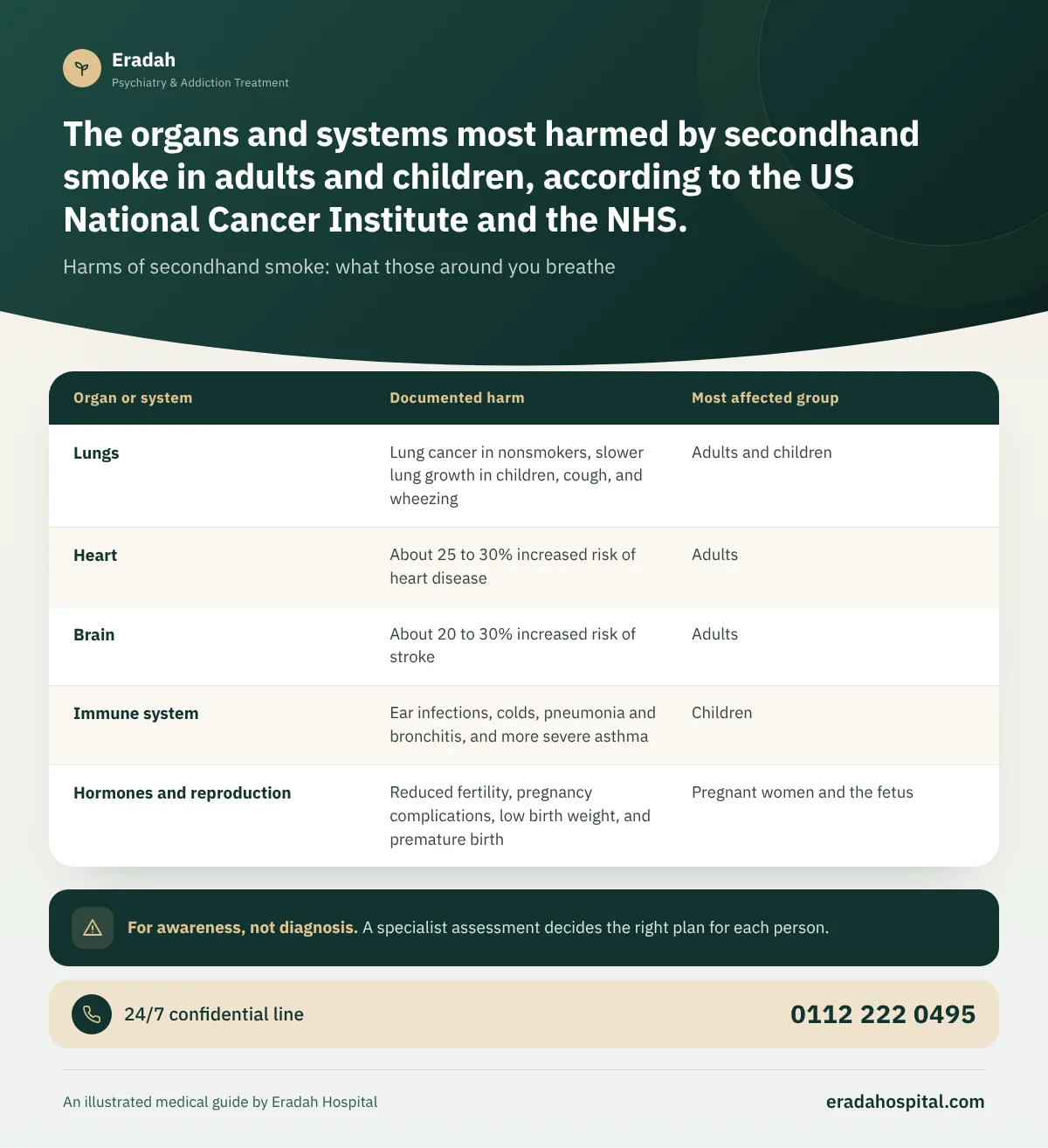
Harms of secondhand smoke to the body’s organs
| Organ or system | Documented harm | Most affected group |
|---|---|---|
| Lungs | Lung cancer in nonsmokers, slower lung growth in children, cough, and wheezing | Adults and children |
| Heart | About 25 to 30% increased risk of heart disease | Adults |
| Brain | About 20 to 30% increased risk of stroke | Adults |
| Immune system | Ear infections, colds, pneumonia and bronchitis, and more severe asthma | Children |
| Hormones and reproduction | Reduced fertility, pregnancy complications, low birth weight, and premature birth | Pregnant women and the fetus |
Secondhand smoke and children and infants
Children are harmed more because their airways, lungs, and immune systems are not fully developed, as the NHS says. The NCI notes that children exposed to smoke are more likely to suffer sudden infant death syndrome, ear infections, colds, pneumonia and bronchitis, and more severe asthma attacks, and that the smoke slows the growth of their lungs. The NHS adds meningitis to the list of risks for children who live with a smoker.
Secondhand smoke and pregnant women
A pregnant woman’s exposure to smoke, even if she does not smoke herself, is linked according to the NCI to reduced fertility, pregnancy complications, poor fetal lung development, low birth weight, and premature birth. The NHS notes that her baby is more likely to die suddenly. So a husband quitting, or at least never smoking at home, is a real gift to the mother and child.
Windows, balconies, and fans: do they really protect?
No. The NCI confirms that opening windows, fans, ventilation systems, and limiting smoking to certain rooms or times does not prevent exposure. The NHS explains that smoke can stay in the air for hours after a cigarette is put out even with a window open, that it spreads from the room to the rest of the home, and that a car is an extremely dangerous place because smoke reaches high levels there even with the windows open.
Thirdhand smoke: smoke that lingers
Even after the smoke clears, its residue remains on clothes, curtains, carpets, furniture, and dust. A review published in the journal Environmental Health Perspectives in 2011 found that this residue persists in real homes in the air, dust, and on surfaces, sometimes turns into more toxic substances, and has been linked to higher nicotine on nonsmokers’ hands and cotinine in their urine, even in homes where smokers used to live. Young children, who crawl and put their hands in their mouths, are more exposed to it, though its health effects are still being studied.
How do you protect your family from secondhand smoke?
- Make your home and car completely smoke-free, with no exceptions.
- Ask guests to smoke outside the house.
- If you smoke, wash your hands and change your outer clothes before holding the baby.
- Choose smoke-free public places and restaurants when you are with children.
- The strongest solution: quitting, which is possible at any age.
Quitting: the strongest protection for the people you love
The NHS says the best way to protect loved ones is quitting completely. If you have tried several times and failed, the problem is usually nicotine addiction, not weak willpower, and it has an effective treatment that we explain in smoking treatment. At Eradah you can book a free, confidential first consultation, especially if smoking comes together with anxiety, depression, or other substance use, as part of outpatient treatment.
An asthma attack or severe shortness of breath in a child? Get help now
- A child gasping, or with the ribs pulling in with every breath
- Bluish lips or fingernails
- Unable to speak or feed because of breathlessness
- Extreme drowsiness or difficulty waking after a coughing fit
- An infant not breathing normally or whose breathing pauses for moments
Immediately take the child out into fresh air away from any smoke, sit them in a comfortable position, and use their inhaler if one has been prescribed. Call the ambulance (123) or go to the nearest emergency room right away if they do not improve quickly or a bluish color appears. And never smoke inside the home or car after that.
Ambulance 123 Mental health support line 16328