How does the body handle nicotine?
“I quit cigarettes two days ago, has the nicotine left my body yet?” Someone who has quit usually asks this for one of two reasons: to know when the craving will ease, or because a medical test is coming up. The answer requires distinguishing between nicotine itself and its metabolite, cotinine.
A review published by the researcher Neal Benowitz and colleagues in 2009 notes that nicotine is converted mainly in the liver by the enzyme CYP2A6 and other enzymes. The official leaflet for the NICOTROL NS nasal nicotine spray explains that its main urinary metabolites are cotinine and hydroxycotinine, and that only about 10% of absorbed nicotine is excreted unchanged in the urine. We explain the effect of nicotine on the brain in the Smoking & Nicotine Addiction guide.
How long nicotine stays in the body: half-life
| Substance | Approximate half-life | What does this mean? |
|---|---|---|
| Nicotine | One to two hours | It drops quickly, which is why the smoker feels the need for a cigarette every few hours |
| Cotinine | 15 to 20 hours | It stays much longer and at about 10 times the concentration of nicotine, so tests rely on it |
Half-life is the time the body needs to get rid of half of the amount. By simple calculation, after about five half-lives the body has cleared most of the substance: that is, within roughly 5 to 10 hours for nicotine and about three to four days for cotinine in an average person. This is a calculated estimate that varies from person to person.
Nicotine in blood, urine, saliva, and hair
According to Benowitz and colleagues, cotinine is the most widely used marker for measuring nicotine exposure, and it can be measured in blood, urine, saliva, hair, and nails. Each sample type tells a different story:
- Blood and saliva: They reflect exposure over the last few days, and studies use them to tell smokers from nonsmokers.
- Urine: The most common in testing, and its cotinine concentration is higher than in blood.
- Hair and nails: They reflect cumulative exposure over a much longer period, because they grow slowly and retain the substance.
There is no single universal cutoff to distinguish smokers from nonsmokers. A review published in the International Journal of Environmental Research and Public Health in 2016 found that common cutoffs ranged from 10 to 25 nanograms per milliliter in saliva, 10 to 20 in blood, and 50 to 200 in urine, with a recent trend toward lower cutoffs. We explain the types of tests in general on the drug testing page.
Why does the time nicotine stays vary from person to person?
The Benowitz review notes that the speed of nicotine clearance is affected by many factors:
- Genetics: Differences in the CYP2A6 enzyme make some people slower or faster at clearing it, with clear differences between ethnic groups.
- Age and sex: Estrogen-containing medications, such as some birth control pills, also affect the clearance rate.
- Pregnancy: It changes the rate of nicotine metabolism.
- Kidney disease: It slows the clearance of nicotine and its metabolites.
- Food, meals, other medications, and smoking itself.
- Amount and duration of smoking: A heavy smoker needs more time for cotinine to fall.
Can nicotine show up in a nonsmoker?
Cotinine may appear at low levels in people exposed to secondhand smoke, which is why cutoffs were set to distinguish passive exposure from actual smoking. Benowitz notes that the current optimal plasma cutoff for the general US population is 3 nanograms per milliliter, far lower than it was twenty years ago because exposure to smoke has declined. You can find the harms of this exposure on the secondhand smoke harms page.
What happens after the last cigarette?
- HoursNicotine falls
Blood nicotine drops quickly, and cravings and irritability begin in people who are used to it.
- Days 1–4Cotinine falls
Cotinine declines gradually with a half-life of 15 to 20 hours, and withdrawal symptoms intensify.
- The first weekWithdrawal peak
Irritability, anxiety, difficulty concentrating, insomnia, and restlessness are at their highest.
- Weeks 2–4Gradual easing
Most symptoms subside according to a scientific review, while cravings remain with triggers.
- MonthsHair trace and habit
An old trace remains in the hair, and habit-linked triggers still need attention.
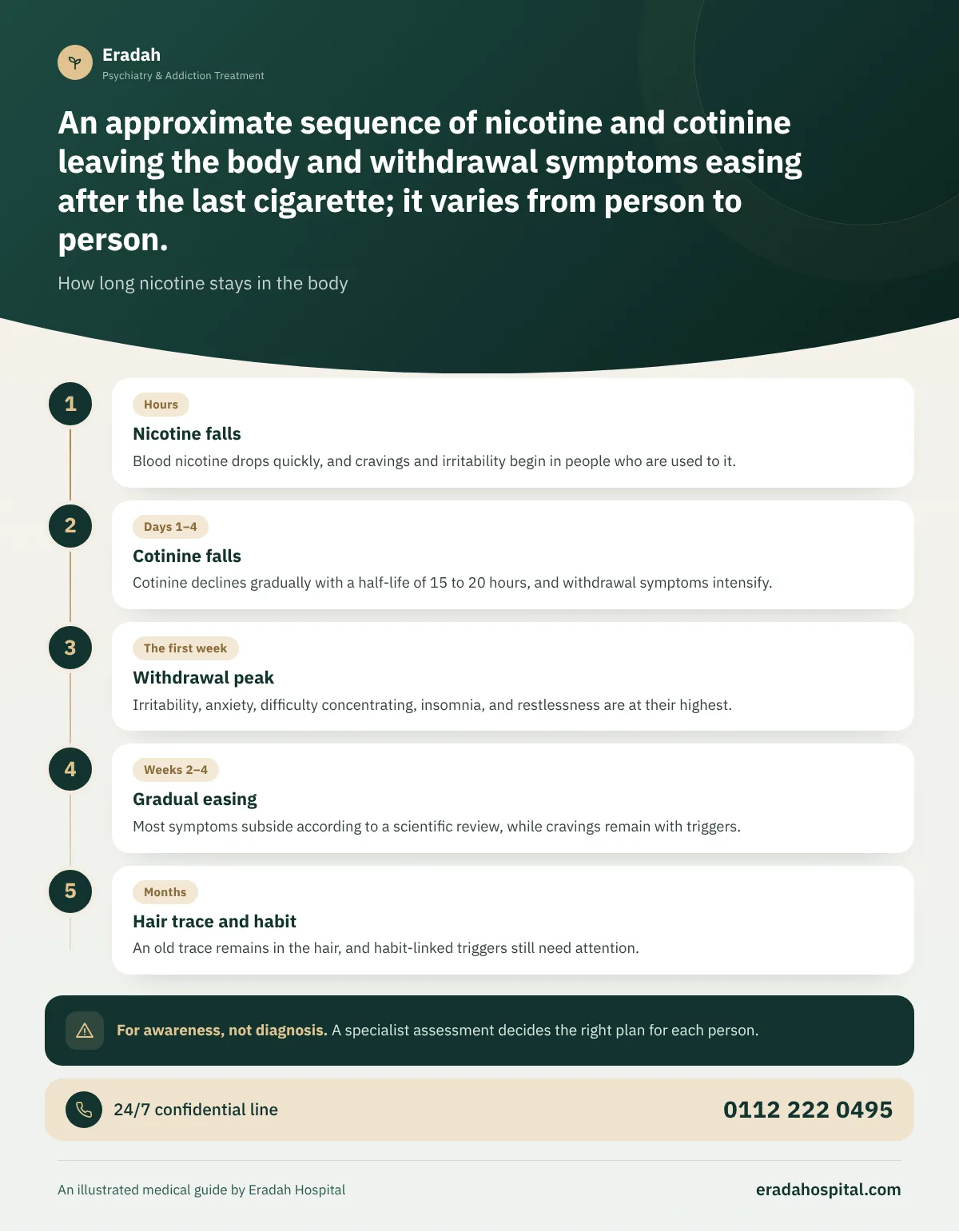
A review published in the journal Nicotine & Tobacco Research in 2007 concluded that anger, anxiety, depression, difficulty concentrating, impatience, insomnia, and restlessness are real withdrawal symptoms that peak during the first week and last from two to four weeks. We explain how to deal with them in smoking treatment.
Is there a way to speed up nicotine clearance?
If you find that getting nicotine out of your body is easy but staying away from it is hard, that is normal in nicotine addiction. At Eradah you can book a free, confidential first consultation to set up a quit plan that combines behavioral support and medication under medical supervision, especially if you are recovering from another addiction.
Nicotine poisoning in a child or adult? Get help now
- A child swallowed vape liquid, cigarette butts, gum, or nicotine patches
- Repeated vomiting, dizziness, cold sweats, and pallor after exposure
- Severe palpitations, an unusually slow pulse, or fainting
- Extreme drowsiness, seizures, or difficulty breathing
Remove the source of nicotine immediately, wash the skin with water if liquid touched it, and do not try to make the child vomit. Call the ambulance (123) or go to the nearest emergency room, and bring the container or product with you so the doctors know what happened. If quitting comes with severe sadness or thoughts of self-harm, contact the mental health support line, 16328.
Ambulance 123 Mental health support line 16328