What does “GABA deficiency” mean medically?
The phrase “GABA deficiency” is widely used online to explain tension and insomnia, and supplements are sold on that basis. The truth is that there is no common medical diagnosis called “GABA deficiency”, and GABA in a particular person’s brain cannot be measured with a routine test. What does exist are conditions in which GABA’s effect is weakened or its balance with glutamate is disturbed.
This weakening can happen because less GABA is made, because receptors are less sensitive, because the stimulating glutamate side of the balance is stronger, or because the brain adapted to an outside sedative and then lost it suddenly. In every case the result is a brain that is “less able to put on the brakes.”
Because the symptoms of weak inhibition are very general, we describe here the symptoms linked to it, while stressing that finding the cause is the doctor’s job, and that the most common problem in addiction clinics is functional GABA weakness after stopping alcohol or sedatives.
What are the common symptoms of GABA deficiency?
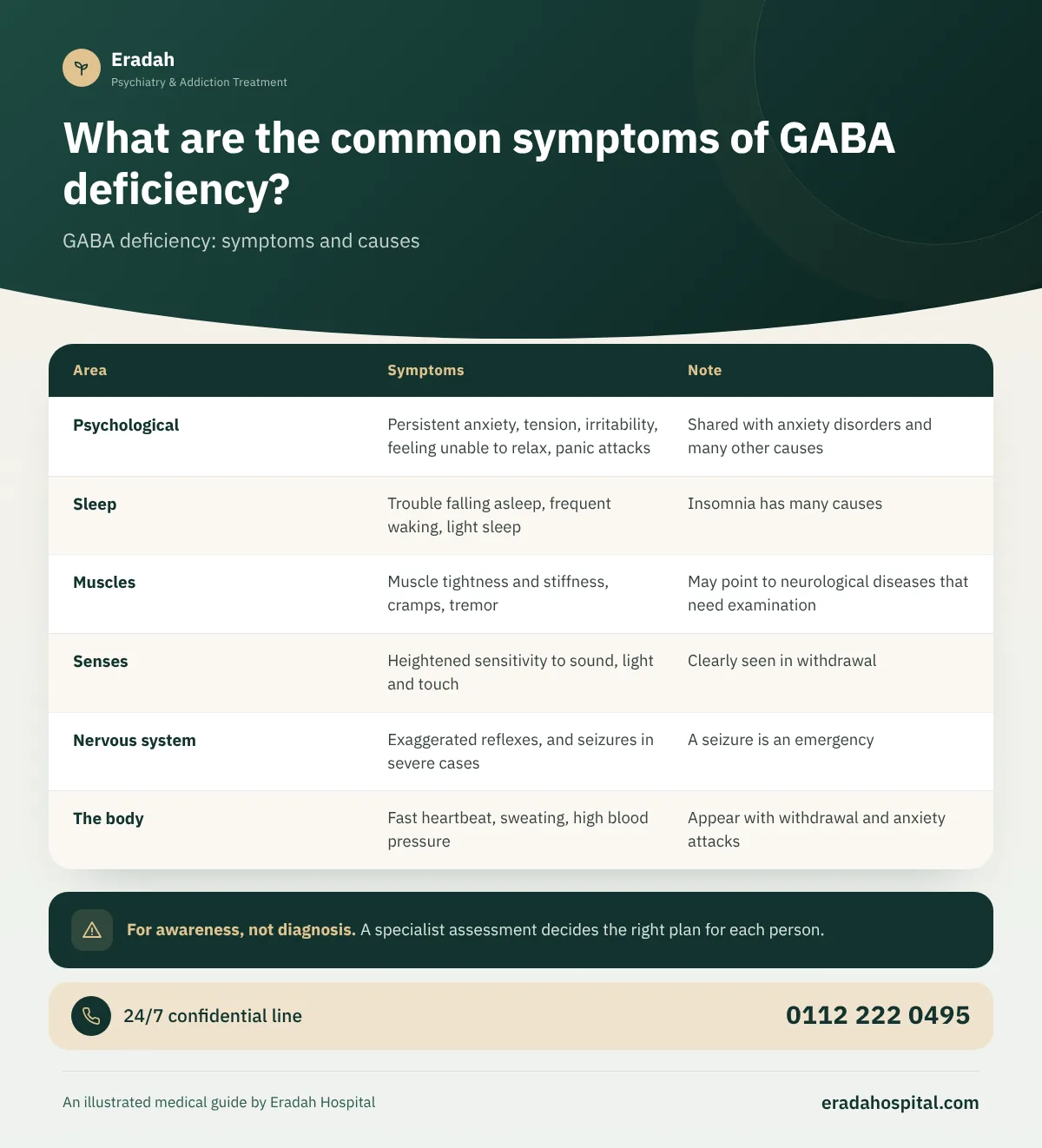
| Area | Symptoms | Note |
|---|---|---|
| Psychological | Persistent anxiety, tension, irritability, feeling unable to relax, panic attacks | Shared with anxiety disorders and many other causes |
| Sleep | Trouble falling asleep, frequent waking, light sleep | Insomnia has many causes |
| Muscles | Muscle tightness and stiffness, cramps, tremor | May point to neurological diseases that need examination |
| Senses | Heightened sensitivity to sound, light and touch | Clearly seen in withdrawal |
| Nervous system | Exaggerated reflexes, and seizures in severe cases | A seizure is an emergency |
| The body | Fast heartbeat, sweating, high blood pressure | Appear with withdrawal and anxiety attacks |
We stress that having anxiety or insomnia does not mean you have a “GABA deficiency.” These symptoms can result from generalized anxiety disorder, chronic insomnia, too much caffeine, an overactive thyroid, or the effects of medications and drugs, and each has a different treatment.
Why does stopping alcohol and sedatives suddenly reduce GABA’s effect?
This is the most dangerous and, in practice, the most common form of weak GABA activity. With chronic drinking or long-term use of benzodiazepines, the brain adapts to the outside sedative: the GABA system becomes less sensitive and glutamate activity rises. When the person stops suddenly, the brain finds itself without enough “brakes.”
What causes weak GABA activity?
Withdrawal from alcohol, benzodiazepines, pregabalin and GHB after long-term use.
Faults in the enzymes that make or break down GABA, usually appearing in childhood with developmental delay and seizures.
The enzyme that makes GABA needs it, and severe deficiency or a problem using it can cause seizures.
Such as stiff person syndrome, in which there are antibodies against the enzyme that makes GABA.
In Huntington’s disease, movement-related brain regions lose cells that release GABA.
Research suggests an effect on the balance of GABA and glutamate, and the evidence is still developing.
Genetic and autoimmune causes are very rare compared with withdrawal and anxiety disorders, and they are not diagnosed from symptoms alone but through a neurological examination and specialized tests.
Which medical conditions are linked to GABA imbalance?
| The situation | Nature of the relationship |
|---|---|
| Epilepsy | Weak inhibition allows excessive electrical activity to spread, and many epilepsy medications act on the GABA system |
| Anxiety disorders and panic attacks | Research suggests a role for GABA, but the main treatment is psychological and medication from classes that mostly do not cause dependence |
| Chronic insomnia | Some imaging studies found lower GABA in some people with the condition, and the results are not settled |
| Depression | Research found changes in GABA in some patients, within a picture with many causes |
| Stiff person syndrome | A rare autoimmune disease with antibodies against the GABA-making enzyme, causing stiffness and spasms |
| Huntington’s disease | Loss of GABA cells in movement regions causes involuntary movements |
Who is most prone to weak GABA activity?
- People who have drunk heavily for a long time, especially those who have had withdrawal episodes before.
- People who use benzodiazepines or sleeping pills daily for weeks or months.
- People who misuse pregabalin or combine it with other sedatives.
- Newborns and children with certain rare inherited metabolic diseases.
- People with a history of epilepsy or brain injury.
- People with chronic anxiety or long-standing untreated insomnia.
Is there a test for GABA deficiency?
There is no routine blood or urine test that diagnoses “GABA deficiency.” Magnetic resonance spectroscopy, which measures it in the brain, is a research tool. What the doctor does is assess your symptoms and your history of medications, alcohol and substances, carry out a neurological examination, and order tests to rule out other causes.
In certain cases targeted tests are requested: an EEG for seizures, an antibody test for the GABA-making enzyme when stiff person syndrome is suspected, or metabolic and genetic tests for children. Commercial tests that promise to reveal your “GABA level” to explain tension cannot be relied on.
How is weak GABA activity treated medically?
The doctor treats the cause, not a number. The plan differs completely depending on the diagnosis:
Safe supervised medical detox, with medications chosen by the doctor to prevent seizures and delirium, then stopped gradually.
Antiseizure medications chosen by a neurologist, which must not be stopped suddenly.
Cognitive behavioral therapy is the foundation, antidepressants are a common option, and sedatives are used only briefly and with caution.
Specialized treatment according to the cause, such as vitamin therapy in cases that depend on it, or immunotherapy.
When should you see a doctor about symptoms of GABA deficiency?
- Anxiety or tension that lasts for weeks and disrupts your work, studies or relationships.
- Persistent insomnia despite regular sleep habits.
- A wish to stop alcohol or sedatives after long-term use: consult a doctor before stopping.
- Unexplained muscle stiffness or spasms, or involuntary movements.
- Any seizure or loss of consciousness: call the ambulance on 123 immediately.
- Confusion, hallucinations or severe tremor after stopping drinking or sedatives: an immediate emergency.
Seizures or delirium after stopping alcohol or sedatives? Call an ambulance (123) immediately
- A seizure or loss of consciousness a few days after stopping alcohol, sedatives or pregabalin
- Severe confusion or not knowing where they are or who people are, or hallucinations, with tremor, sweating and fever
- A very fast heartbeat or high blood pressure with agitation that does not settle
- Extreme drowsiness and difficulty waking, or slow, shallow breathing after mixing sedatives, alcohol or opioids
- Bluish lips or nails, or vomiting with reduced consciousness
Call an ambulance (123) immediately. During a seizure, move hard objects away from the person, do not put anything in their mouth and do not try to restrain them. After it ends, place them on their side and stay with them. Do not give them alcohol or a sedative “to calm them down,” keep the medicine packaging, and tell the doctor frankly everything they were taking and when they stopped.
Ambulance 123 Mental health support line 16328