What is GABA’s role in the reward system and addiction?
In the brain’s reward circuit there are cells that release GABA whose job is to act as brakes on dopamine cells, stopping them from becoming overactive. A number of addictive substances act on these brakes: suppressing these GABA cells frees the dopamine cells from their restraint, so dopamine rises indirectly.
This mechanism is known, for example, with opioids such as heroin and tramadol, and research suggests a similar role for some sedatives. That is, GABA takes part not only in the “calming” that the person using is looking for, but in reward learning itself.
GABA has a second role that is no less important: many people with anxiety, insomnia or trauma discover that a sedative substance quickly “switches off” their tension, so the brain learns that the fastest route to relief is the substance. This is called self-medication, and it is one of the most common ways into addiction to sedatives and alcohol in Egypt.
Which addictive substances affect GABA?
| Substance | How do they affect GABA? | Most serious danger |
|---|---|---|
| Alcohol | Strengthens GABA’s effect at the A receptor and suppresses glutamate receptors | Alcohol intoxication, and withdrawal with seizures and delirium tremens |
| Benzodiazepines such as Xanax, Rivotril and Valium | Increase how often the chloride channel opens in the presence of GABA | Dependence, withdrawal that may cause seizures, and respiratory depression with opioids |
| Pregabalin | Similar to GABA in structure but acts on calcium channels, reducing the release of excitatory transmitters | Widespread misuse, and respiratory depression with opioids and tramadol |
| GHB | A substance found naturally in tiny amounts in the brain, which acts as a depressant on the GABA-B receptor and its own receptors | Sudden coma, and severe withdrawal that may need intensive care |
| Barbiturates | Strengthen GABA’s effect and may open the chloride channel directly | A narrow safety margin between effect and poisoning |
| “Z-drug” sleeping medicines | Act on the A receptor | Dependence with long-term use, and danger with alcohol |
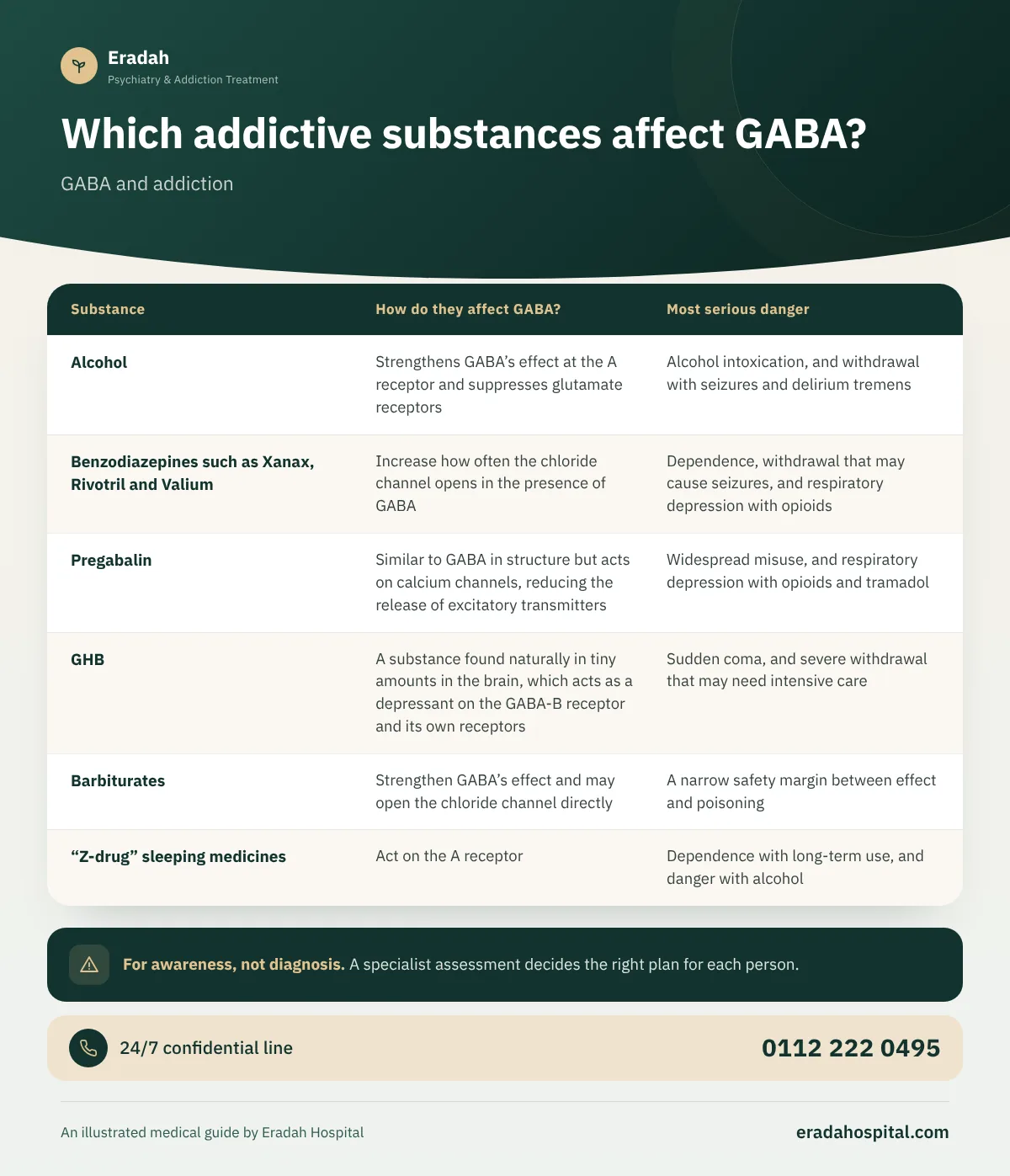
What these substances have in common is that they are central nervous system depressants. That is why the most dangerous thing a person can do is combine them, or combine them with opioids: their effect on the breathing centers multiplies, and breathing can stop during sleep.
Why is pregabalin such a big problem in Egypt?
Pregabalin, best known by its brand name “Lyrica,” is a legitimate medication for nerve pain and epilepsy. But it has spread in Egypt among people who use other substances, especially tramadol, opioids and hashish, in search of calm, or to “boost” their effect, or to ease their withdrawal symptoms.
The lesson from these numbers is that restricting one drug alone does not treat addiction; a person who depended on it may move to another substance if they do not get treatment. Since 2019 the US Food and Drug Administration has also warned of serious breathing problems with pregabalin and gabapentin, especially when combined with opioids or sedatives, or in older adults and people with lung disease.
How does the GABA system adapt to use and produce tolerance?
When the brain receives an outside sedative every day, it works to regain its balance: the makeup of GABA-A receptors and their subunits changes so they become less sensitive, natural GABA production falls, and at the same time activity of the excitatory glutamate rises to offset the excess inhibition.
The person needs a larger amount for the same calming or sleep effect.
The presence of the substance becomes necessary for the brain to work “normally,” and withdrawal appears when it is absent.
Anxiety or insomnia returns worse between doses, so the substance seems like the only solution.
Sedatives impair memory and concentration, making it hard to learn alternative skills for coping with stress.
Physical dependence can occur even with regular medical use over a long period, without misuse. That is why doctors usually prescribe benzodiazepines for short periods and plan to stop them from the start.
Why does withdrawal from GABA substances cause seizures?
When a person suddenly stops, the brain is left with less sensitive GABA receptors and more active glutamate, meaning weak brakes and a pressed accelerator. The result is overexcitation that begins with tremor, anxiety, insomnia, sweating and a fast heartbeat, and may progress to hallucinations, seizures and delirium. Medical references describe withdrawal from alcohol, benzodiazepines and barbiturates as among the life-threatening kinds of withdrawal.
| Substance | When does it usually start? | Most serious complications |
|---|---|---|
| Alcohol | Within hours of the last drink, with seizures usually within 48 hours | Seizures, then delirium tremens, which can be fatal |
| Benzodiazepines | Two to ten days later depending on how long the drug stays in the body, and it may last weeks | Seizures, delirium and severe anxiety |
| GHB | Soon after stopping repeated use, and it may extend to two weeks | Severe agitation and disturbed vital signs, which may need intensive care |
| Pregabalin | Within days of sudden stopping | Insomnia, anxiety, sweating and nausea, and seizures have been reported |
The time frames are approximate and vary with the substance, length of use, amount, health status and history of previous withdrawal episodes. Details for each substance are on the pages alcohol withdrawal symptoms, Xanax withdrawal and pregabalin withdrawal.
Why is safe medical detox needed for GABA substances?
Because seizures and delirium can happen suddenly, and the family at home cannot monitor vital signs or give the right medications at the right time. In medical detox, the team assesses the severity of dependence and the risks, then uses medications chosen by the doctor to prevent seizures and delirium and tapers them gradually according to a plan, while treating nutritional deficiency and dehydration and monitoring continuously.
- Do not suddenly stop alcohol, sedatives or pregabalin after long daily use without consultation.
- Do not make up your own tapering plan from the internet; the plan differs by substance and by case.
- Do not swap one substance for a “milder” one without a doctor; you may move from one dependence to another.
- If you have a history of seizures or delirium in a previous withdrawal, supervision inside a medical facility is essential.
- Tell the doctor everything you use; a mixture changes the withdrawal plan completely.
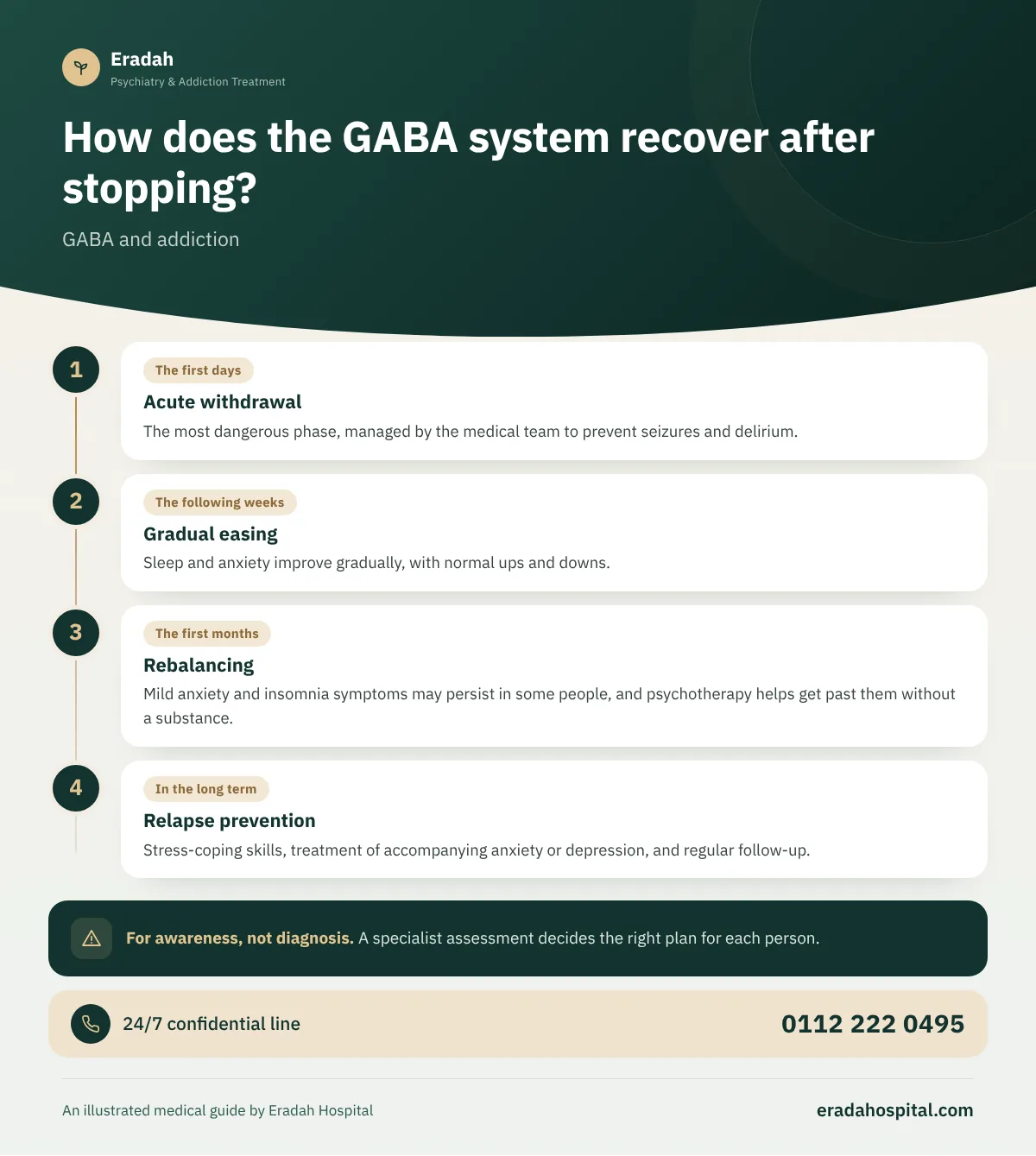
How does the GABA system recover after stopping?
The brain is able to regain its balance. After safe detox, GABA receptors gradually begin to regain their sensitivity and glutamate activity settles. Acute symptoms usually fade within days to weeks, while some people, especially after long-term benzodiazepine use, go through a prolonged phase of anxiety and sleep disturbance that improves slowly over weeks or months.
- The first daysAcute withdrawal
The most dangerous phase, managed by the medical team to prevent seizures and delirium.
- The following weeksGradual easing
Sleep and anxiety improve gradually, with normal ups and downs.
- The first monthsRebalancing
Mild anxiety and insomnia symptoms may persist in some people, and psychotherapy helps get past them without a substance.
- In the long termRelapse prevention
Stress-coping skills, treatment of accompanying anxiety or depression, and regular follow-up.
How does treatment help with addiction to GABA substances?
Medical detox is the beginning, not the whole treatment. Someone who has been calming their anxiety with a substance needs to learn new ways, which cognitive behavioral therapy helps with, along with treatment of accompanying anxiety, insomnia and trauma with non-dependence-forming medications when needed, plus relapse prevention programs. This is called dual diagnosis treatment.
Some people may turn to compulsive behaviors to calm anxiety instead of substances, such as smoking or excessive phone use, and they benefit from the Smoking and Nicotine Addiction guide and other behavioral addictions within a comprehensive recovery plan.
How should the family act with a person with an addiction to alcohol or sedatives?
- Don’t force them to stop suddenly at home, and don’t suddenly hide their medication; this can cause dangerous withdrawal.
- Learn the emergency signs: seizure, severe confusion, hallucinations, extreme drowsiness and slow breathing, and call 123 immediately.
- Keep sedative medications in the home stored away and tracked, and don’t share your medications with anyone.
- Talk calmly about the anxiety and insomnia underlying the use, not only about “weak willpower.”
- Ask for specialist consultation even if the person refuses at first; family guidance alone changes a great deal.
At Eradah we provide safe medical detox under a specialist team for alcohol, benzodiazepines, pregabalin and mixed substances, followed by psychological and drug treatment of accompanying conditions and a relapse prevention program with family involvement, in complete confidentiality.
Seizures or delirium after stopping alcohol or sedatives? Call an ambulance (123) immediately
- A seizure or loss of consciousness a few days after stopping alcohol, sedatives or pregabalin
- Severe confusion or not knowing where they are or who people are, or hallucinations, with tremor, sweating and fever
- A very fast heartbeat or high blood pressure with agitation that does not settle
- Extreme drowsiness and difficulty waking, or slow, shallow breathing after mixing sedatives, alcohol or opioids
- Bluish lips or nails, or vomiting with reduced consciousness
Call an ambulance (123) immediately. During a seizure, move hard objects away from the person, do not put anything in their mouth and do not try to restrain them. After it ends, place them on their side and stay with them. Do not give them alcohol or a sedative “to calm them down,” keep the medicine packaging, and tell the doctor frankly everything they were taking and when they stopped.
Ambulance 123 Mental health support line 16328