Lists of “how to raise your happiness hormone in 5 minutes” circulate on social media, and most mix fact with exaggeration. Below is what each chemical actually does, what science supports for boosting them, and why addiction exploits these same systems.
What are the happiness hormones?
“Happiness hormones” is a popular label, not a scientific one. A good mood is not made by one chemical, but by an interaction among neurotransmitters, hormones and whole circuits in the brain. Yet four chemicals come up again and again in this conversation because each has a clear role in feeling content, pleased or at peace. Scientific accuracy requires saying that dopamine and serotonin act mainly as neurotransmitters inside the brain, while oxytocin is both a hormone and a transmitter, and endorphins are a group of natural opioids that the body produces.
The four happiness hormones and the role of each
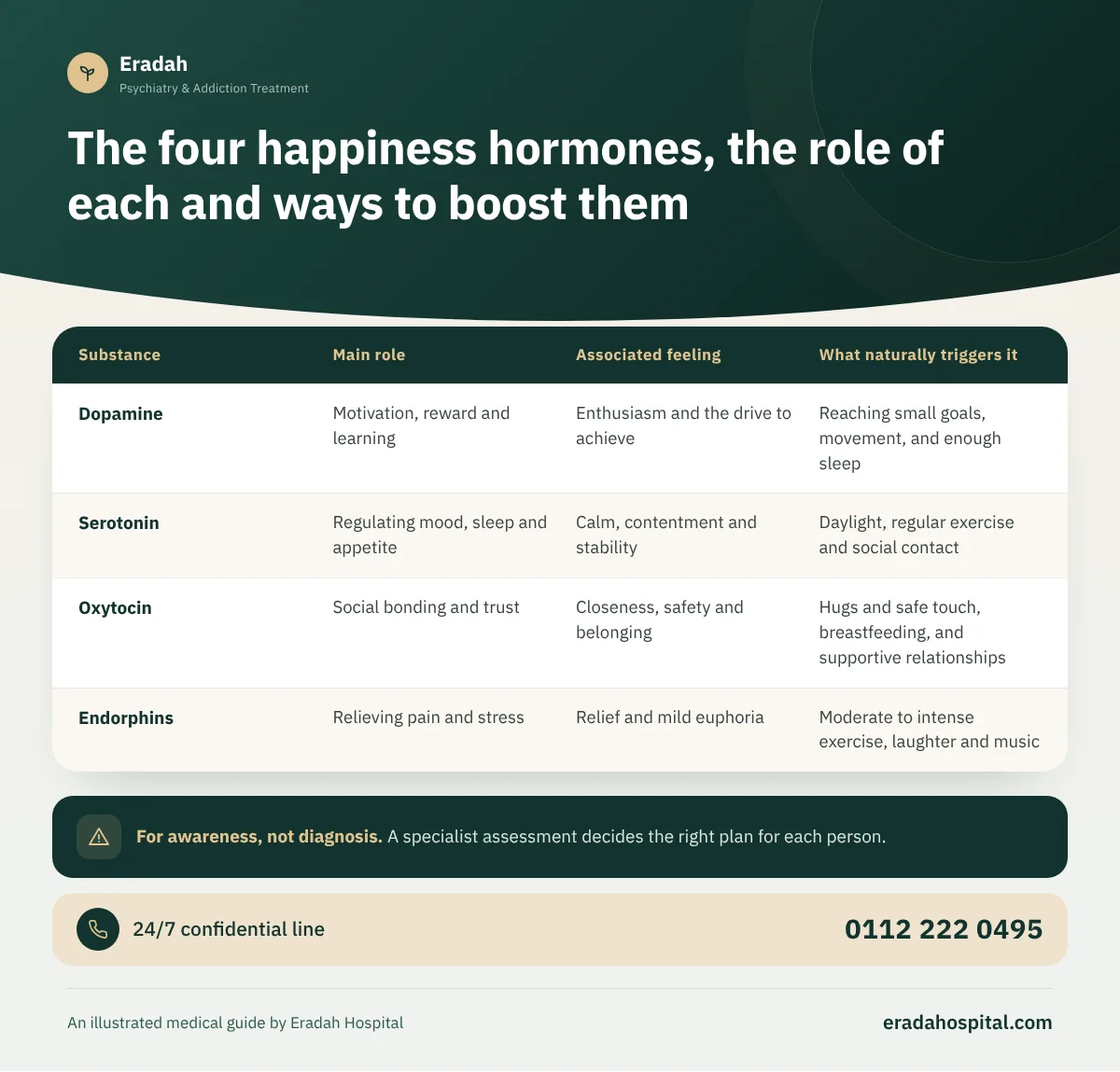
| Substance | Main role | Associated feeling | What naturally triggers it |
|---|---|---|---|
| Dopamine | Motivation, reward and learning | Enthusiasm and the drive to achieve | Reaching small goals, movement, and enough sleep |
| Serotonin | Regulating mood, sleep and appetite | Calm, contentment and stability | Daylight, regular exercise and social contact |
| Oxytocin | Social bonding and trust | Closeness, safety and belonging | Hugs and safe touch, breastfeeding, and supportive relationships |
| Endorphins | Relieving pain and stress | Relief and mild euphoria | Moderate to intense exercise, laughter and music |
What is the real happiness hormone?
There is no single happiness hormone. Dopamine is famous for the nickname, but it is really closer to a transmitter of “wanting and seeking” than of “contentment.” This explains how a person can feel intense longing for something without actually being made happy when they get it. The feeling of stability and calm is closer to the work of serotonin, and warmth with the people we love is closer to oxytocin. That is why lasting happiness is a balance among them all.
How do you boost the happiness hormones naturally?
These are the methods best supported by evidence, ordered roughly by the strength of their effect on overall mood:
Lack of sleep lowers the sensitivity of dopamine receptors and upsets mood the next day.
Exercise raises endorphins and improves mood and depression, with strong evidence.
Morning sunlight sets the body clock and supports serotonin.
Closeness and talking with someone you trust stimulate oxytocin and protect against depression.
Completing short, clear tasks gives regular doses of reward.
Group laughter and music you love are linked to endorphins and dopamine.
You will find the details on each chemical and the strength of evidence for each method on the pages Raising dopamine naturally, Raising serotonin naturally and Raising endorphins naturally.
Common myths about the happiness hormones
| The myth | The truth |
|---|---|
| Chocolate and bananas raise the happiness hormone in the brain | They may improve mood for a moment through taste and pleasure, but there is no evidence that they raise these chemicals in the brain to any meaningful degree. |
| Serotonin and dopamine supplements treat sadness | Most do not cross easily into the brain, some are dangerous with antidepressants, and they should not be taken without a doctor. |
| The more dopamine, the more happiness | Excessive amounts are linked to anxiety, impulsivity and even psychosis; what matters is balance. |
| Depression is just a shortage of the happiness hormone | Depression is a complex condition involving genetics, stress and multiple brain systems, not one chemical. |
The happiness hormones and addiction
Drugs and addictive behaviors exploit these same systems. Stimulants such as crystal meth (shabu) and cocaine release far more dopamine than natural rewards do, and opiates mimic endorphins. With repetition the brain lowers its sensitivity, natural pleasures become dull, and the person needs the substance to feel “normal.” This explains the flatness and boredom after stopping, and why the brain needs months to regain its balance.
When is boosting the happiness hormones not enough?
If sadness, loss of pleasure, or disturbed sleep and appetite last more than two weeks, or affect work and relationships, or thoughts of death appear, the matter is bigger than a “missing hormone” treated with walking and sunshine. It may be depression, which needs assessment and treatment. Healthy habits remain an important part of treatment, not a substitute for it.