What is oxytocin?
Oxytocin is a small molecule made of nine amino acids, and it was one of the first hormones whose structure scientists worked out and synthesized in the lab. It works in two ways: as a hormone released into the blood that reaches the uterus and breast, and as a neurotransmitter released by brain cells directly into areas of emotion, reward and social memory.
Its name comes from two Greek words meaning "swift birth," because the first function discovered was speeding up uterine contractions. It was later found to have roles in breastfeeding, in maternal behavior, and in social bonding in animals and humans, and these are the roles that gave it its media fame.
Oxytocin is present in men and women alike. It is true that its clearest functions are tied to childbirth and breastfeeding, but its receptors are spread through the brain, the heart and other organs, and in everyone it takes part in social responses and in modulating stress.
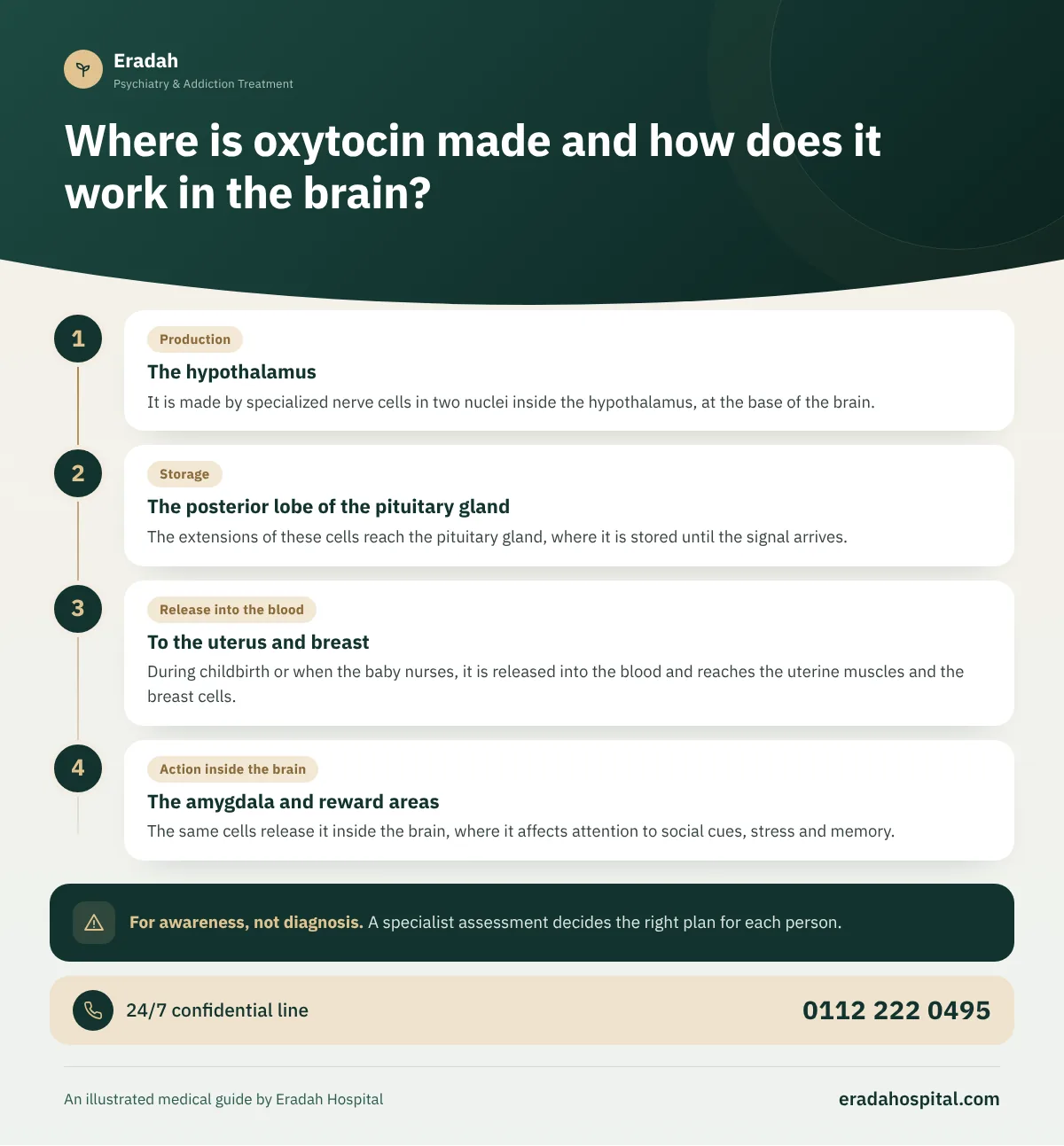
Where is oxytocin made and how does it work in the brain?
- ProductionThe hypothalamus
It is made by specialized nerve cells in two nuclei inside the hypothalamus, at the base of the brain.
- StorageThe posterior lobe of the pituitary gland
The extensions of these cells reach the pituitary gland, where it is stored until the signal arrives.
- Release into the bloodTo the uterus and breast
During childbirth or when the baby nurses, it is released into the blood and reaches the uterine muscles and the breast cells.
- Action inside the brainThe amygdala and reward areas
The same cells release it inside the brain, where it affects attention to social cues, stress and memory.
Oxytocin binds to a specific receptor on the surface of cells, and its action overlaps with dopamine in the reward circuits and with the stress system led by cortisol. That is why researchers see its role as making the brain more attentive to social cues, positive or negative, rather than "creating" love or trust.
What is the role of oxytocin in childbirth and breastfeeding?
This is its most firmly established role. During labor the baby's head presses on the cervix, sending a signal to the brain that increases the release of oxytocin, which strengthens the contractions, which increases the pressure, which increases the release. This is a rare "positive feedback loop" in the body, which continues until the baby is born, and afterward the contractions help the uterus shrink back and limit bleeding.
In breastfeeding, two hormones share the task: prolactin makes the milk, and oxytocin releases it through what is called the "milk let-down reflex." When the baby nurses, the signal reaches the brain, oxytocin is released, and the cells surrounding the milk glands contract. A mother may feel uterine cramps while nursing in the first days, and this too is an effect of oxytocin.
Is oxytocin used as a medicine?
Yes, and synthetic oxytocin is one of the most important medicines in maternity units. Doctors use it in hospital to induce or strengthen labor in specific situations, and to prevent and treat postpartum hemorrhage. The World Health Organization considers it the preferred choice for preventing this bleeding, which is one of the leading causes of maternal death worldwide.
But it is a powerful medicine, given by injection or intravenous drip under continuous monitoring of the mother and baby, because too much can cause strong, rapid contractions that stress the baby, or a disturbance in the body's salts. That is why it is used only on medical decision inside a hospital, and there is no place for any home use or use "to speed up labor" outside medical care.
Why is oxytocin called the "love hormone" and is that accurate?
The nickname came from exciting research: prairie voles, which live in stable pairs, need oxytocin to form their bonds, and early human experiments found that a nasal spray of it increased trust in economic games. Headlines spread: "love hormone," "trust hormone," "cuddle hormone."
But the more accurate picture is more complicated. Later studies found that its effect depends on context: in one study published in 2011, oxytocin increased participants' preference for their own group over strangers, meaning it may strengthen bias rather than general affection. And in people who have had insecure relationships it may increase their sensitivity to rejection instead of reassuring them. That is why many researchers prefer to describe it as the "social-cue attention hormone".
| What the nickname suggests | What the research says |
|---|---|
| Creates love and trust | Increases attention to social cues, and the outcome depends on the person and the situation |
| Always positive | It may strengthen bias toward the close group or sensitivity to rejection |
| Specific to women | Present in men and women, and works with other hormones and neurotransmitters |
| Can be raised with a dose to improve relationships | No dose or product improves relationships, and the nasal spray has not been shown to be of benefit for personal use |
Does research show that oxytocin spray treats mental illness?
Not so far. The nasal spray has been tried in autism, social anxiety, schizophrenia and addiction, and early results from small studies were encouraging. But a systematic review published in 2016 pointed out that most of these studies were small with low statistical power, and that many of the positive results may be due to chance. And in 2021 the New England Journal of Medicine published a large trial in children and adolescents with autism that found no clear difference between oxytocin and placebo in social interaction.
In addiction specifically, animal experiments showed that oxytocin may reduce drug-seeking and withdrawal symptoms, but human trials, especially in alcohol addiction, had mixed results, and it has not been approved as an addiction treatment in any medical guideline. The bottom line: an important area of research, but do not buy a spray online hoping to treat anxiety or addiction.
How is oxytocin related to stress and recovery from addiction?
Research indicates that oxytocin helps calm the stress response, and that real social support from someone we trust eases the rise in stress hormones in pressured situations. This matches what therapists see every day: a person in recovery who finds a supportive family, safe relationships and a support group is better able to resist relapse.
This does not mean oxytocin alone is the cause; supportive relationships work through many psychological, social and biological pathways. But the practical idea is clear: repairing relationships and involving the family in treatment is an essential part of restoring the brain's balance. The cortisol and addiction guide explains the role of stress in relapse in detail.
Can oxytocin be measured with a blood test?
There is no useful routine oxytocin test in clinics. It is released in short bursts and breaks down quickly, its blood level does not necessarily reflect what is happening inside the brain, and even the research methods for measuring it have given varying results. So be wary of any provider offering a "love hormone test" to assess your relationship or your mental state.
Myths and facts about oxytocin
- Myth: Oxytocin spray makes other people trust you. Fact: There is no reliable evidence for this, and selling it for this purpose is exploitation.
- Myth: A lack of oxytocin causes loneliness and depression. Fact: There is no diagnosis called "oxytocin deficiency" in ordinary medical practice, and loneliness and depression have multiple causes and known treatment.
- Myth: Certain foods raise the love hormone. Fact: No food has been shown to raise it in any useful way.
- Myth: Cesarean birth or formula feeding prevents bonding with the baby. Fact: Bonding is built through care, touch and time, and millions of families achieve it regardless of how the baby was born or fed.
Oxytocin guide: everything you need to know
We have gathered everything about oxytocin into 1 page, which answers one question in detail. Choose what you are looking for:
After childbirth: heavy bleeding or thoughts of self-harm? Get help now
- Heavy vaginal bleeding that soaks a pad within an hour or less, or passing large blood clots
- Severe dizziness, fainting, a racing heart, or paleness and coldness after childbirth
- A severe headache with blurred vision, or sudden swelling of the face and hands
- Severe sadness and hopelessness, or thoughts of death or of harming herself or the baby
- Severe confusion, hearing voices, or unusual strange thoughts after childbirth
For heavy bleeding, dizziness or fainting, call the ambulance (123) or go to the nearest obstetrics emergency room immediately. If thoughts of harming herself or the baby appear, do not leave the mother alone, listen to her without blame, and call the ambulance (123) or the mental health support line 16328 (24 hours). These conditions are treatable, and asking for help is nothing to be ashamed of.
Ambulance 123 Mental health support line 16328