Before you start: do you really need to raise dopamine?
Phrases like “boost your dopamine” and “recharge the happiness hormone” have spread on social media, as if dopamine were an empty tank we can fill. The truth is that the brain regulates dopamine precisely, and we have no natural way to “raise” it the way a piece of candy raises blood sugar.
What we can do is create the conditions in which the reward system works efficiently: sleep that preserves the sensitivity of its receptors, movement that activates it, goals that give it something to pursue, and varied relationships and healthy pleasures that no single source drains. These habits benefit mood and general health even when dopamine is not the only mechanism.
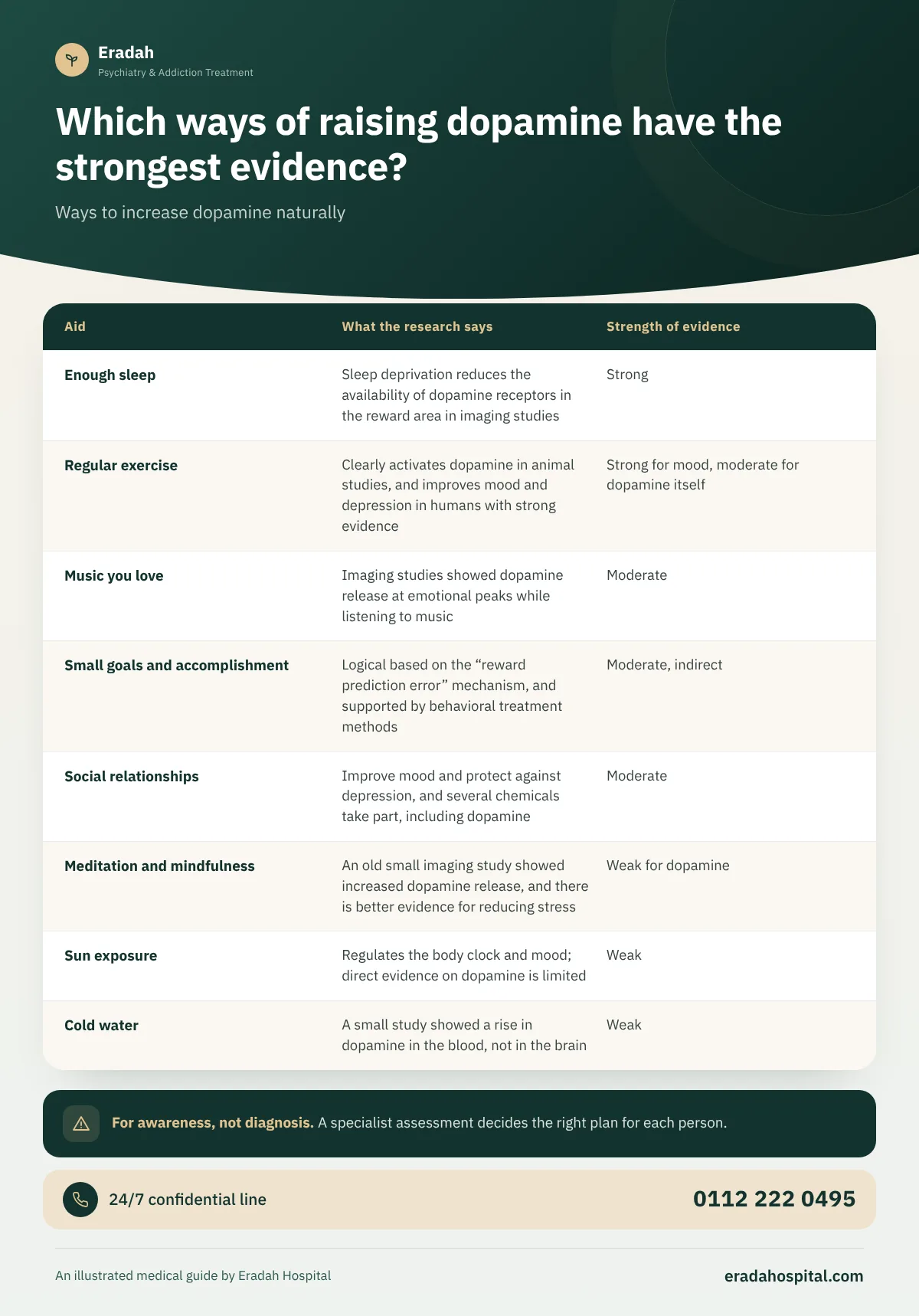
Which ways of raising dopamine have the strongest evidence?
We have rated the common methods candidly by the strength of the research on their effect on dopamine, or on the mood and motivation linked to it:
| Aid | What the research says | Strength of evidence |
|---|---|---|
| Enough sleep | Sleep deprivation reduces the availability of dopamine receptors in the reward area in imaging studies | Strong |
| Regular exercise | Clearly activates dopamine in animal studies, and improves mood and depression in humans with strong evidence | Strong for mood, moderate for dopamine itself |
| Music you love | Imaging studies showed dopamine release at emotional peaks while listening to music | Moderate |
| Small goals and accomplishment | Logical based on the “reward prediction error” mechanism, and supported by behavioral treatment methods | Moderate, indirect |
| Social relationships | Improve mood and protect against depression, and several chemicals take part, including dopamine | Moderate |
| Meditation and mindfulness | An old small imaging study showed increased dopamine release, and there is better evidence for reducing stress | Weak for dopamine |
| Sun exposure | Regulates the body clock and mood; direct evidence on dopamine is limited | Weak |
| Cold water | A small study showed a rise in dopamine in the blood, not in the brain | Weak |
| Specific foods (bananas, chocolate) | No evidence that they raise brain dopamine to any meaningful degree | Myth |
How does sleep help balance dopamine?
In an imaging study published in 2012, a single night of sleep deprivation led to reduced availability of dopamine receptors in the reward area, linked to increased sleepiness. This partly explains why things seem dull and focus is hard after a sleepless night, and why a tired person asks for a “quick reward” from sugar or the phone.
- Fix your wake-up time even on days off; it is the strongest regulator of the body clock.
- Keep the phone away from the bed; late-night scrolling steals sleep and drains attention.
- Cut back on caffeine in the second half of the day, as its effect on sleep lasts for hours.
- If insomnia lasts for weeks, see the page on chronic insomnia; it can be treated without relying on sleeping pills.
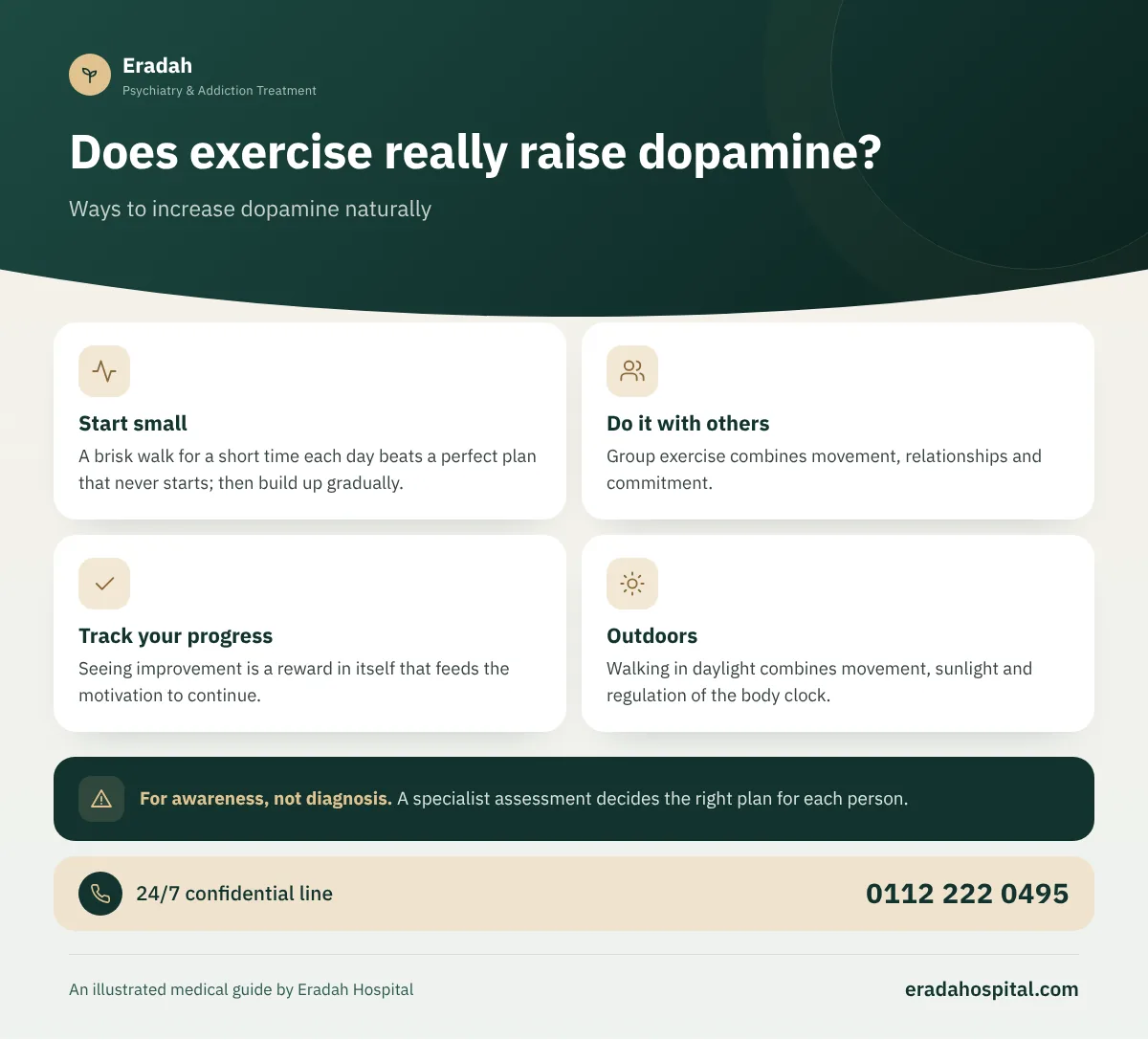
Does exercise really raise dopamine?
In animal studies, regular physical activity increases dopamine release and improves receptor sensitivity. In humans, the strongest evidence is for the outcome rather than the mechanism: a large review published in 2024 concluded that walking, light jogging, yoga and strength training ease the symptoms of depression to a meaningful degree, with higher intensity being more beneficial.
A brisk walk for a short time each day beats a perfect plan that never starts; then build up gradually.
Group exercise combines movement, relationships and commitment.
Seeing improvement is a reward in itself that feeds the motivation to continue.
Walking in daylight combines movement, sunlight and regulation of the body clock.
Exercise is especially helpful in addiction recovery, because it provides a regular healthy reward at a time when the brain is experiencing flatness after stopping the substance.
How do music and small goals help raise dopamine?
A well-known imaging study in 2011 showed that listening to music a person loves releases dopamine in two regions: the first during the anticipation of the emotional moment, and the second when reaching it. In a later study, enjoyment of music increased when dopamine was boosted with medication and fell when it was blocked, confirming its role.
As for goals, dopamine responds to progress and to positive surprise. So breaking a big goal into clear small steps and celebrating each one provides a series of “rewards” that feed motivation, instead of waiting for a single distant reward that may never come. This idea is the basis of “behavioral activation,” one of the proven treatments for depression.
- Write down three small tasks each day that you can actually finish, and tick each one off when done.
- Vary your sources of pleasure: a hands-on hobby, meeting a friend, an activity where you learn a new skill.
- Set aside time for music you love, not as background to scrolling.
- Cut back on repeated quick rewards such as endless scrolling, so that slower pleasures stay appealing.
Is there a food that raises dopamine naturally?
Dopamine is made from tyrosine, found in proteins such as eggs, dairy, legumes and poultry, and its production needs iron and other vitamins. But the enzyme that controls the speed of production usually works close to its capacity, so eating more of these foods does not raise brain dopamine in a healthy person.
The realistic advice is a balanced diet that provides protein, vegetables and whole grains, along with treating iron deficiency if present. Lists promising “foods that raise the happiness hormone” are marketing exaggeration, and may distract from the real causes of flatness.
Does a “dopamine detox” reset the brain?
The idea of “dopamine fasting” or “dopamine detox” spread as abstaining from every pleasure for days until the brain is “cleaned.” The name is scientifically misleading: dopamine is not a toxin to be flushed out, and it does not fall because you put your phone down for a day. The originator of the idea clarified that it is an application of cognitive behavioral therapy principles, not an actual lowering of dopamine.
The useful part is controlling triggers: identifying one behavior that bothers you (such as late-night scrolling), setting clear limits on it, replacing it with a healthy activity, and tracking the effect. Blanket deprivation of every pleasure has no evidence of benefit and may end in relapse. For behavioral addictions such as phone addiction and social media addiction the treatment evidence is clearer.
Are dopamine supplements safe?
Supplements are sold that contain tyrosine or plant sources of L-DOPA, marketed to raise dopamine and focus. The evidence for their benefit in a healthy person is limited, while their risks are real:
- Drug interactions: they may interact with MAOI antidepressants and dangerously raise blood pressure, and with Parkinson’s medications, antipsychotics and thyroid medications.
- Plant sources of L-DOPA contain an actual drug substance in uncontrolled amounts, and may cause nausea, palpitations, involuntary movements or psychiatric symptoms.
- Groups that need special caution: pregnant and breastfeeding women, children, people with heart disease or high blood pressure, and those with a history of psychosis or mania.
When are natural ways of boosting dopamine not enough?
Healthy habits improve general well-being, but they do not treat illnesses. See a doctor if flatness and loss of pleasure last more than two weeks, if movement symptoms such as tremor and slowness appear, if your studies or work clearly decline, or if you are going through the period after stopping a drug. If thoughts of death or self-harm appear, seek help immediately through 123 or the mental health support line 16328; these thoughts are a symptom of a treatable condition.