What does melatonin deficiency mean?
The phrase “melatonin deficiency” is common, but in usual practice it is not a stand-alone medical diagnosis. What doctors usually mean is one of two things: weaker release than normal at night, or release at the wrong time that does not match when the person wants to sleep.
The second is far more common. A young person who stays up every night until dawn in front of screens usually does not lack melatonin; their body clock has shifted late, so the body releases it late. That is why doctors call these cases circadian rhythm sleep-wake disorders and treat them by adjusting timing, not by replacing a “deficiency.”
It is also important not to reduce all insomnia to melatonin. Anxiety, depression, pain and stopping drugs are among the most common causes of insomnia, and in them melatonin is often normal while the problem is hyperarousal. Insomnia in general is covered in our insomnia guide.
What are the symptoms of melatonin deficiency or mistimed melatonin?
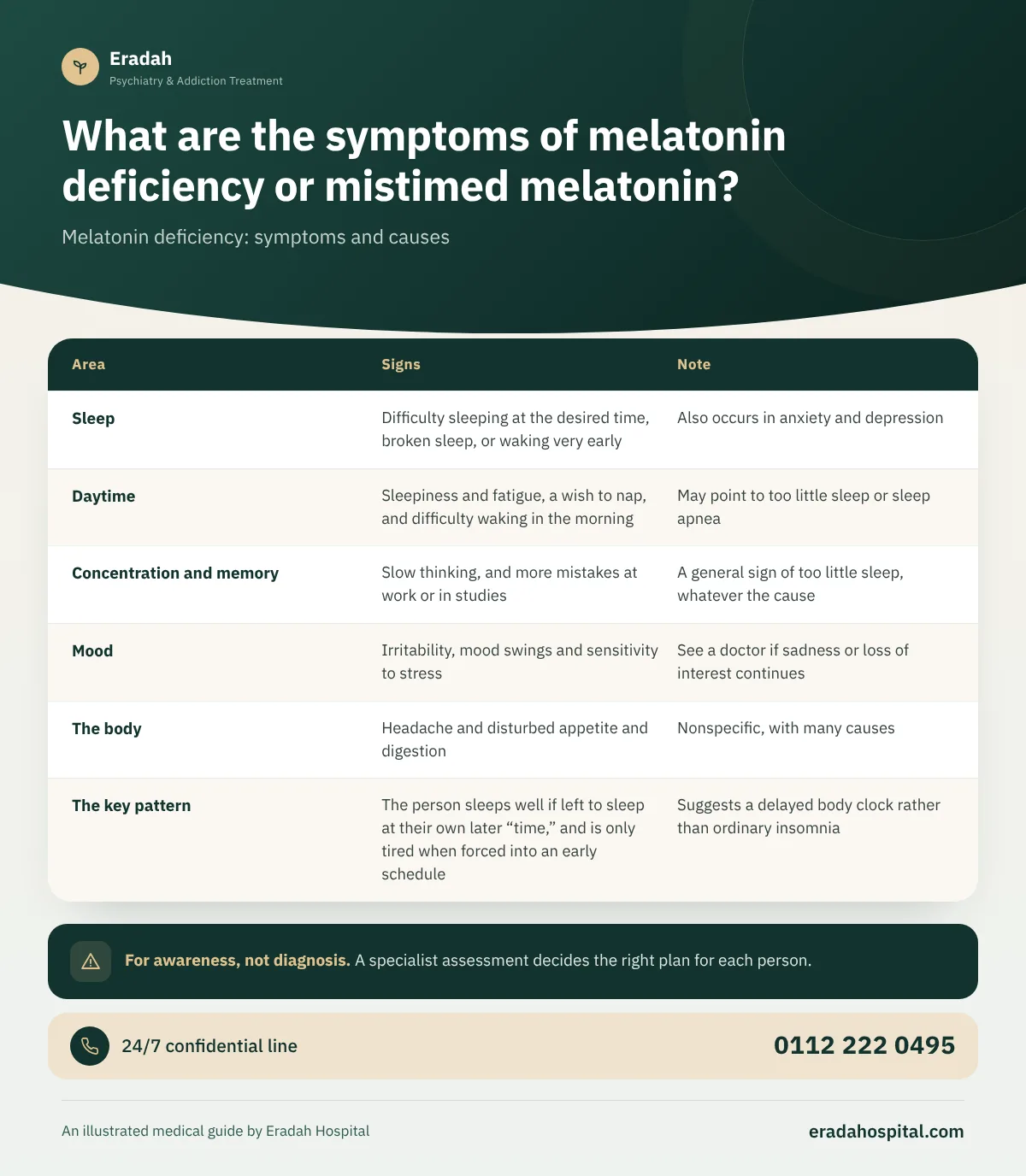
| Area | Signs | Note |
|---|---|---|
| Sleep | Difficulty sleeping at the desired time, broken sleep, or waking very early | Also occurs in anxiety and depression |
| Daytime | Sleepiness and fatigue, a wish to nap, and difficulty waking in the morning | May point to too little sleep or sleep apnea |
| Concentration and memory | Slow thinking, and more mistakes at work or in studies | A general sign of too little sleep, whatever the cause |
| Mood | Irritability, mood swings and sensitivity to stress | See a doctor if sadness or loss of interest continues |
| The body | Headache and disturbed appetite and digestion | Nonspecific, with many causes |
| The key pattern | The person sleeps well if left to sleep at their own later “time,” and is only tired when forced into an early schedule | Suggests a delayed body clock rather than ordinary insomnia |
What causes melatonin deficiency?
Strong lighting and screens before bed suppress melatonin and delay when it is released.
Sleeping and waking at changing times confuses the body clock, especially on holidays and in Ramadan.
Working at night and sleeping by day works against the natural light signals.
Jet lag leaves the internal clock behind or ahead of local time.
Melatonin release at night falls in many older adults.
Such as beta blockers used for blood pressure and the heart, and other medications that may affect sleep; do not stop them without your doctor.
It weakens melatonin release and disrupts sleep structure in the second half of the night.
Total blindness, some neurological diseases such as dementia, and rare diseases affecting the pineal gland.
Why do teenagers fall asleep late, and does it have to do with melatonin?
In adolescence the body clock naturally shifts later, so melatonin release starts later than in children and adults. This is a real biological change and not laziness. But when it combines with screens in bed, games and chatting at night, sleep is pushed later still, and then the teenager wakes for school sleep-deprived.
The condition may develop into what is called “delayed sleep phase disorder,” where the person cannot fall asleep before the early hours of the morning even if they want to. The solution starts with morning light, fewer screens in the evening and a fixed wake-up time, with a doctor’s visit if it does not improve. Our pages on video game addiction and social media addiction explain how screens steal sleep.
How does night work cause melatonin deficiency?
Doctors, nurses, security staff, factory workers, drivers and others work at night under lighting, so light suppresses melatonin at the time it should be rising, and then they try to sleep by day while the sun tells the brain to “wake up.” The result in some is “shift work sleep disorder”: insomnia when trying to sleep and severe sleepiness at work.
The sleepiness here goes beyond a matter of rest to a real danger when driving after a shift and in delicate work. A person with this problem needs a plan with a doctor to regulate light and sleep, and in some cases medications may be used under medical supervision. Practical daily steps are on our page on how to increase melatonin naturally.
Do alcohol and drugs reduce melatonin?
Alcohol weakens melatonin release and ruins sleep quality: it may make it easier to doze off at first, but it causes repeated waking in the second half of the night and unrefreshing sleep. With chronic use the insomnia itself becomes a reason to drink more, in a vicious circle explained on our alcohol page.
Stimulants such as crystal meth (shabu) and Captagon completely upend the daily rhythm through days without sleep, and then their withdrawal brings excessive sleep or insomnia. Withdrawal from opioids and sedatives is linked to severe insomnia that can last weeks. In these cases the answer is not a sleep supplement but treating the addiction itself, with a sleep plan under medical supervision. Do not use sleep supplements with alcohol or sedatives.
Who is most prone to melatonin disturbance?
- People who work night or rotating shifts.
- Teenagers and young adults, especially with night-time screen use.
- Older adults, and people with dementia and some neurological diseases.
- Frequent travelers across time zones.
- People with total blindness, in whom the light signal does not reach the body clock.
- People who use alcohol or drugs, or who are in withdrawal and recovery.
- People who take medications that may affect sleep, such as beta blockers.
Can melatonin deficiency be tested in a lab?
There is no routine test you can request at any lab that reveals “melatonin deficiency.” In specialized sleep centers, repeated saliva or blood samples can be taken in the evening under dim light to determine when its release starts, which is useful for diagnosing timing disorders but is not a common test.
- Medical history: Sleep and wake times on workdays and days off, screens, caffeine, medications and substances.
- Sleep diary: A daily record for at least two weeks that shows the real pattern.
- Activity tracker: Sometimes worn on the wrist to record periods of activity and rest.
- Ruling out other causes: Anxiety, depression, sleep apnea, restless legs syndrome and thyroid problems.
- Lab sleep study: When sleep apnea or other sleep disorders are suspected.
How is melatonin deficiency treated medically?
Treatment depends on the cause, and this is a general overview:
- Regulating timing and light: Exposure to light at set times and avoiding it at others is the foundation of treating body clock disorders, and the doctor may use “light therapy” with dedicated devices.
- Cognitive behavioral therapy for insomnia: The first-line treatment for chronic insomnia in medical guidelines, and it helps more than medications in the long term.
- Melatonin or medications that act on its receptors: The doctor may prescribe them for timing disorders or for some older adults or children with special needs, at a time and amount the doctor sets. The American Academy of Sleep Medicine does not recommend it as a treatment for chronic insomnia in adults.
- Treating the cause: Adjusting a medication with the doctor’s knowledge, or treating sleep apnea, anxiety and depression, or addiction.
When should you see a doctor about melatonin deficiency and sleep disturbance?
- Difficulty sleeping three nights a week or more for three months.
- Daytime sleepiness that causes dozing while driving or at work.
- Loud snoring with pauses in breathing during sleep, as those around you notice.
- A child or teenager whose sleep is badly delayed and whose school performance suffers.
- Insomnia during withdrawal from alcohol, sedatives or drugs; this needs medical supervision.
- Persistent sadness, hopelessness or thoughts of death along with insomnia: ambulance 123 or the mental health support line 16328.
A child swallowed sleep supplements, or extreme drowsiness after mixing them with sedatives? Call an ambulance (123)
- A child swallowed a quantity of melatonin pills or “sleep gummies,” even if they seem normal now
- Extreme drowsiness or difficulty waking the person
- Slow or difficult breathing, or bluish lips
- Taking sleep supplements with alcohol, sedatives or opioid painkillers, followed by confusion or unsteadiness
- Long-standing insomnia with severe despair or thoughts of death or self-harm
Call an ambulance (123) or go to the nearest emergency department immediately, bring the product packaging so the contents are known, and do not try to induce vomiting. If the person is asleep and breathing, place them on their side and stay beside them until help arrives. If there are thoughts of death or self-harm, do not leave them alone and call the mental health support line 16328 (24 hours).
Ambulance 123 Mental health support line 16328