How do you raise melatonin without supplements?
The body makes melatonin automatically every night, and most people need only to remove what disrupts it. The principle is simple: the brain reads light, so if you give it bright light by day and darkness at night, it sets its clock and releases melatonin on time.
The problem in modern life is that we spend the day indoors under dim lighting, and the night under strong lights and screens. That is, we give the brain the opposite message: a dull day and a bright night. Most of the steps below put that message back the right way round.
What are the scientifically proven ways to increase melatonin naturally?
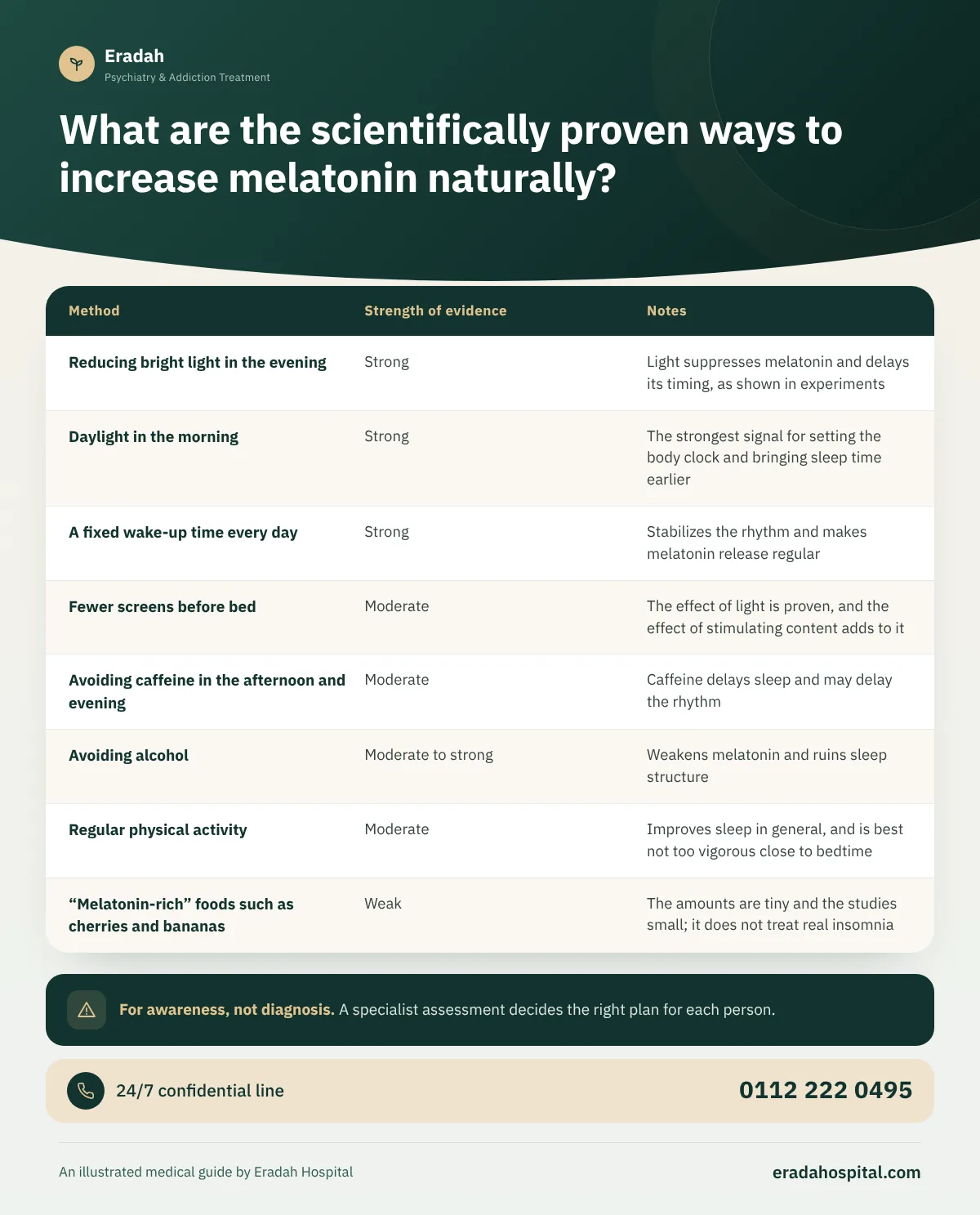
This is our general assessment of the strength of evidence based on the available medical references, and it may change with research:
| Method | Strength of evidence | Notes |
|---|---|---|
| Reducing bright light in the evening | Strong | Light suppresses melatonin and delays its timing, as shown in experiments |
| Daylight in the morning | Strong | The strongest signal for setting the body clock and bringing sleep time earlier |
| A fixed wake-up time every day | Strong | Stabilizes the rhythm and makes melatonin release regular |
| Fewer screens before bed | Moderate | The effect of light is proven, and the effect of stimulating content adds to it |
| Avoiding caffeine in the afternoon and evening | Moderate | Caffeine delays sleep and may delay the rhythm |
| Avoiding alcohol | Moderate to strong | Weakens melatonin and ruins sleep structure |
| Regular physical activity | Moderate | Improves sleep in general, and is best not too vigorous close to bedtime |
| “Melatonin-rich” foods such as cherries and bananas | Weak | The amounts are tiny and the studies small; it does not treat real insomnia |
| Night mode on a screen alone | Weak | Changes the color of the light but does not remove the brightness or the stimulating content |
Why does morning light help increase melatonin at night?
It may seem strange that light helps the hormone of darkness, but morning light sets the body clock so that melatonin release starts at a better time in the evening. That is why exposure to daylight after waking is one of the most important treatments for delayed sleep.
- Step onto the balcony or walk in the street within the first hour after waking, even on cloudy days.
- Open the curtains and sit near a window during breakfast or work.
- Sunlight outdoors is far stronger than room lighting, even in the shade.
- Do not look directly at the sun; being somewhere bright is enough.
How do you prepare your home in the evening for melatonin release?
In the two hours before bedtime, melatonin begins to rise if the lighting allows it. So:
- Dim strong white lighting at home in the evening, and use warmer, less bright bulbs.
- Make the bedroom dark with heavy curtains, or use an eye mask.
- Turn off the television and side lights while sleeping.
- If you need a night light for children or for trips to the bathroom, keep it dim and low.
- Keep the room quiet and at a moderate temperature.
How do you handle screens to protect melatonin?
In a Harvard experiment published in 2015, reading on a light-emitting tablet before bed suppressed melatonin, delayed the body clock and made it harder to wake in the morning, compared with a printed book. But light is not the whole story; messages, games and short videos keep the brain excited and alert.
- Set a “screens off time” well before bed, preferably at least an hour.
- Charge the phone outside the bedroom, and use an ordinary alarm clock.
- If you must use a screen, lower the brightness, turn on night mode and choose calm content.
- Replace browsing with a quiet activity: reading on paper, family conversation or breathing exercises.
- For children and teenagers: agree on screen rules as a family, and set an example. If stopping is hard, see our phone addiction guide.
How can a night-shift worker protect melatonin?
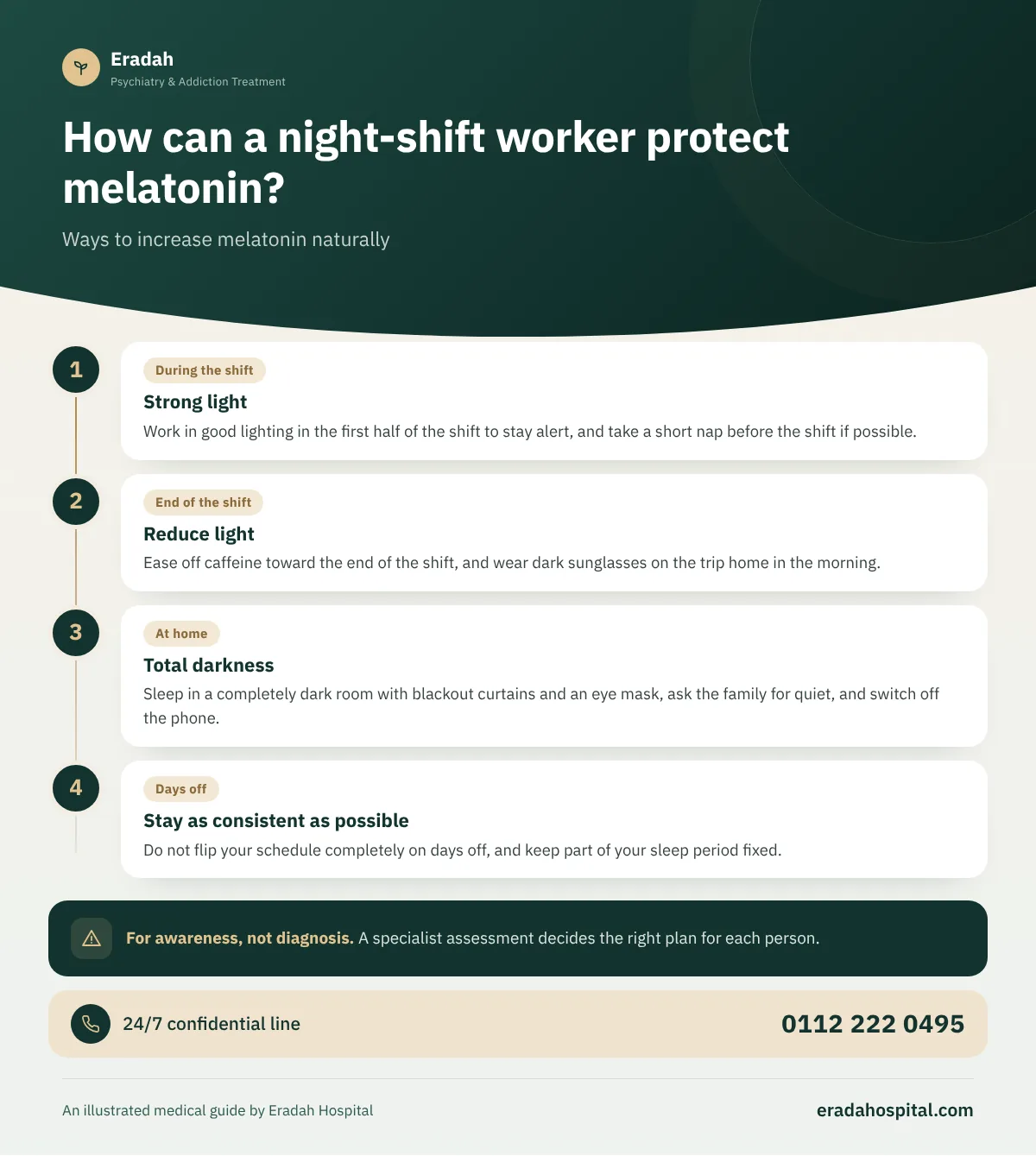
Night work goes against the natural signals, but its effect can be reduced with a light and sleep plan. These are general tips to adapt to the nature of your work and best discussed with a doctor:
- During the shiftStrong light
Work in good lighting in the first half of the shift to stay alert, and take a short nap before the shift if possible.
- End of the shiftReduce light
Ease off caffeine toward the end of the shift, and wear dark sunglasses on the trip home in the morning.
- At homeTotal darkness
Sleep in a completely dark room with blackout curtains and an eye mask, ask the family for quiet, and switch off the phone.
- Days offStay as consistent as possible
Do not flip your schedule completely on days off, and keep part of your sleep period fixed.
What sleep routine supports melatonin?
- Fix your wake-up time every day, even on holidays; it matters more than bedtime itself.
- Do not go to bed before you feel sleepy, and if you do not fall asleep within a long time, get out of bed for a quiet activity in dim light and then return.
- Cut back on long naps late in the day because they lower sleep pressure at night.
- Caffeine: Tea, coffee and energy drinks are better in the morning than in the afternoon and evening.
- Dinner: Avoid heavy meals close to bedtime, and avoid alcohol completely.
- Movement: Regular physical activity during the day, preferably outdoors so you combine movement and light.
In Ramadan and the summer holidays the rhythm changes a lot in Egypt, so try to keep one main sleep period fixed, and return gradually to your usual times a few days before school or work starts.
Are melatonin supplements a safe way to increase it?
Melatonin supplements exist and are used medically in specific situations, such as jet lag, delayed sleep phase, some older adults and some children with special needs. But they are not a solution for every insomnia, and they come with important cautions:
- Children: The American Academy of Sleep Medicine has warned against giving them to children without a doctor, and the US Centers for Disease Control and Prevention recorded an increase of about 530% in reports of children ingesting melatonin between 2012 and 2021, most involving young children who found sleep “gummies.” Keep them out of children’s reach.
- Pregnancy and breastfeeding: There is not enough safety data, so they are used only on a doctor’s decision.
- Contents not guaranteed: A 2023 US study showed that most melatonin gummy products contain amounts different from what is on the label.
- Interactions: With blood thinners, epilepsy medications, sedatives, blood pressure and diabetes medications, immunosuppressants and some antidepressants.
- Chronic illness: People with liver disease, epilepsy, immune diseases and depression should consult the doctor first.
When are natural ways of increasing melatonin not enough?
If you apply these steps regularly for several weeks and sleep stays disturbed, the problem is probably not melatonin alone. Chronic insomnia needs cognitive behavioral therapy for insomnia, the first-line treatment in guidelines, and behind it there may be anxiety, depression, sleep apnea or chronic pain. See our insomnia guide, or ask for a medical assessment.
If the insomnia is part of withdrawal from alcohol, sedatives or drugs, do not treat it with supplements or pills from the pharmacy without supervision; at Eradah Center, sleep disturbance is treated within the full recovery plan, because improving sleep is one of the strongest factors in preventing relapse. If the insomnia comes with hopelessness or thoughts of death, call the ambulance on 123 or the mental health support line 16328.