How common is addiction among people with schizophrenia?
Studies agree that substance use disorders are far more common in people with schizophrenia than in the general population, and many studies estimate them at about half of patients over their lifetime when tobacco, alcohol, cannabis and others are counted. Tobacco is the most widespread, followed by alcohol and cannabis in its various forms.
The U.S. National Institute of Mental Health emphasizes that having a program that treats schizophrenia and substance use together is important, because each condition affects the other. At Eradah, this overlap is the core of our daily work.
Why do people with schizophrenia turn to drugs and smoking?
Some patients feel the substance eases their tension or silences the voices for a while, which is called "self-medication," but the effect rebounds quickly with worse symptoms.
Some use stimulants, caffeine or tobacco to fight the sluggishness and drowsiness caused by certain medications.
Negative symptoms, unemployment and isolation make a substance a way to fill time or feel part of a group.
Research points to genetic and brain factors shared by schizophrenia and addiction, especially in the reward system and dopamine.
Patients may be more vulnerable to peer pressure or to exploitation by drug dealers who take advantage of their vulnerability.
Understanding these reasons helps treat the substance use without accepting it: if the driver is sluggishness from medication, the medication can be adjusted; if it is boredom, the solution lies in rehabilitation, work and activities.
How do cannabis and Strox affect someone with schizophrenia?
Hashish and bango are among the most widespread substances among young people with schizophrenia, and also among the most harmful to the course of the illness: continuing to use after the first episode is linked to more relapses, more hospital admissions and more severe symptoms. The risk is higher with high-potency types and daily use.
Synthetic cannabinoids such as Strox and Voodoo are even more dangerous, because their compounds are far stronger than natural hashish and their composition is unknown, and they are linked to severe agitation and psychosis that can occur even in people with no mental illness, let alone someone with schizophrenia.
What do stimulants such as shabu and cocaine do to someone with schizophrenia?
Stimulants such as crystal meth (known in Egypt as shabu), Captagon and cocaine raise dopamine sharply, the very neurotransmitter that antipsychotics try to regulate. That is why using them works in exactly the opposite direction to treatment: it brings back hallucinations and suspiciousness, increases agitation and insomnia, and can lead to violent or dangerous behavior.
The long sleepless nights and loss of appetite that come with stimulants also increase the patient's fragility and make relapse faster and more severe. It can sometimes be hard for an emergency doctor to tell a schizophrenia episode from stimulant-induced psychosis, which is why being honest with the doctor about any substance use is essential.
Why is smoking so common among people with schizophrenia?
Smoking rates among people with schizophrenia are far higher than in the general population, and many of them smoke heavily. The reasons are several: nicotine may temporarily improve attention, ease some side effects and fill empty time, in addition to the culture of smoking in some treatment settings in the past.
Smoking is the biggest cause of the heart and lung disease that shortens patients' lives. Tobacco smoke also speeds up the breakdown of some antipsychotics, such as clozapine and olanzapine, lowering their level in the blood. That is why quitting smoking or going back to it requires telling the doctor so the plan can be reviewed. This does not mean postponing quitting; guidelines strongly recommend supporting it.
What about alcohol, tramadol and sedatives?
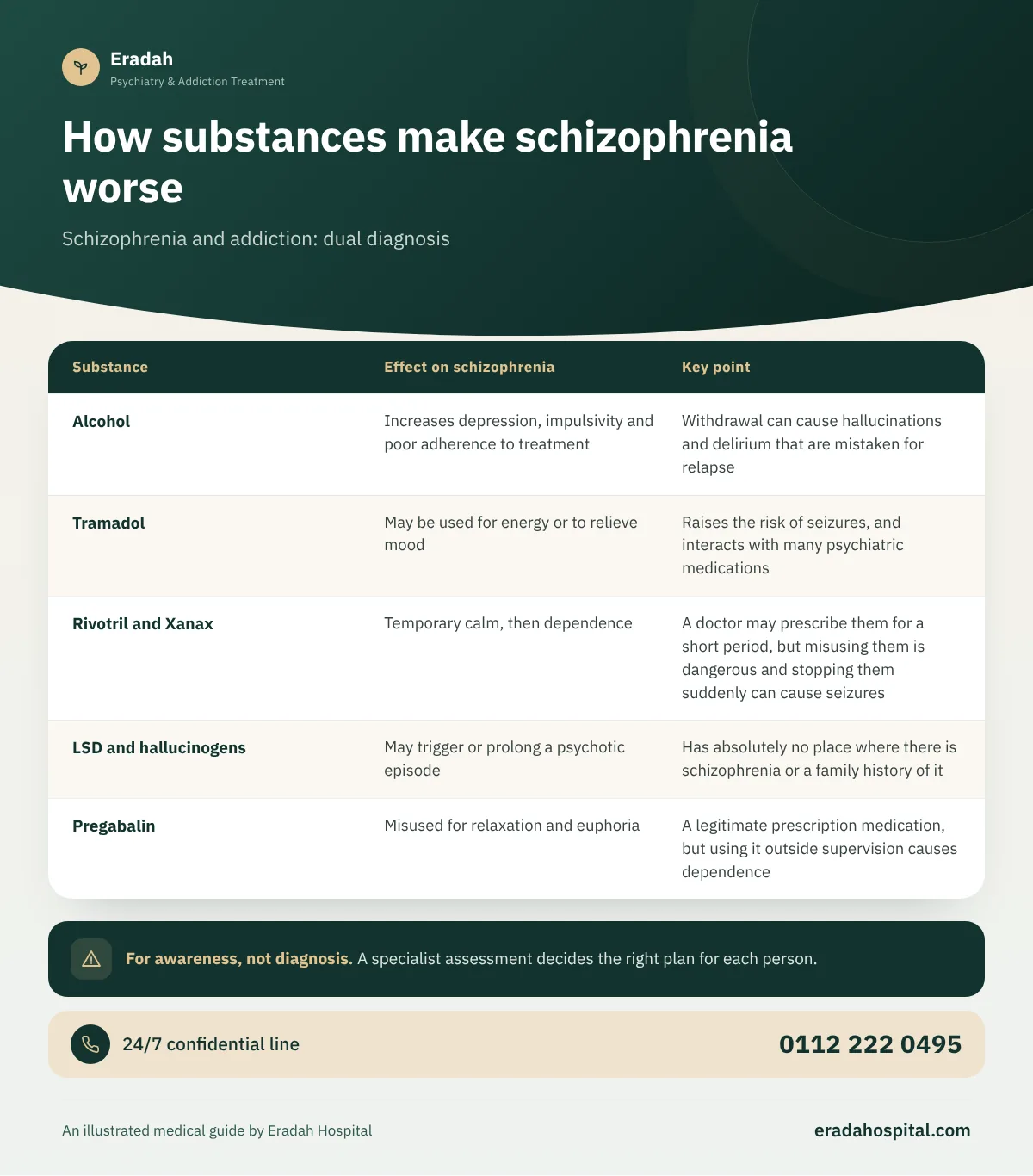
| Substance | Effect on schizophrenia | Key point |
|---|---|---|
| Alcohol | Increases depression, impulsivity and poor adherence to treatment | Withdrawal can cause hallucinations and delirium that are mistaken for relapse |
| Tramadol | May be used for energy or to relieve mood | Raises the risk of seizures, and interacts with many psychiatric medications |
| Rivotril and Xanax | Temporary calm, then dependence | A doctor may prescribe them for a short period, but misusing them is dangerous and stopping them suddenly can cause seizures |
| LSD and hallucinogens | May trigger or prolong a psychotic episode | Has absolutely no place where there is schizophrenia or a family history of it |
| Pregabalin | Misused for relaxation and euphoria | A legitimate prescription medication, but using it outside supervision causes dependence |
How do substances increase schizophrenia episodes and weaken treatment?
- Frequent relapse: substance use is among the strongest predictors of returning episodes and hospital admission.
- Poor medication adherence: the person forgets the medication or deliberately stops it so it will not "clash" with the substance.
- Drug interactions: some substances change the blood level of medications or increase their side effects.
- Higher risk of violence and suicide: substances increase impulsivity, despair and agitation.
- Social and legal problems: debts, family conflict, run-ins with the law, and loss of housing or work.
- Harder diagnosis: doctors find it hard to tell what is caused by the illness and what by the substance.
What is integrated treatment for schizophrenia and addiction?
The old model sent the patient to an addiction center that refused to treat psychosis, then to a psychiatric hospital that did not deal with addiction, so the patient was lost between the two. Integrated treatment, by contrast, treats both conditions in one program with one team, which is what current guidelines recommend:
- A comprehensive assessment of psychotic symptoms, the pattern of substance use and the degree of physical dependence together.
- Safe detox under medical supervision when needed, especially with alcohol and sedatives.
- Adjusting the antipsychotic to take substance use and interactions into account, and reviewing side effects that may drive substance use.
- Motivational interviewing to strengthen the patient's own wish to change, instead of confrontation and blame.
- Cognitive behavioral therapy and relapse prevention to deal with cravings and triggers.
- A smoking cessation program coordinated with the treating doctor.
- Social and vocational rehabilitation that fills the void the substance used to fill.
Improvement here usually comes in stages: a patient may start by cutting down before stopping completely, and the important thing is not to drop out of follow-up if they stumble. You can find more about this concept on the page about dual diagnosis.
What signs warn a family that a person with schizophrenia is using substances?
- A return of suspiciousness or voices despite apparently taking medication regularly.
- Money or belongings disappearing from the house, or insistent requests for money.
- A sudden change in sleep, between long nights awake and excessive sleeping.
- A strange smell, or new friends they refuse to talk about.
- Missed appointments and refusal of follow-up tests.
How should a family deal with schizophrenia and addiction together?
Having both conditions together is exhausting for a family, and may push it toward threats, expulsion or concealment. But experience shows that calm firmness with ongoing support works best: set clear boundaries, such as not giving money without knowing where it goes, without closing the door to treatment. And tell the doctor what you notice about substance use; this is clinical information, not informing on them.
At Eradah, we work with the patient and the family together on a plan that treats psychosis and addiction at the same time, with residential programs for cases that need them, long outpatient follow-up afterward, and complete confidentiality.