How is alcohol broken down inside the body?
After drinking, alcohol is absorbed from the stomach and intestines into the blood, and the liver then breaks down most of it in two stages: it is first converted into toxic acetaldehyde, then into a less harmful substance called acetate. A small portion leaves unchanged through breath, urine and sweat, and this is the basis of breath testing.
The liver works at a roughly constant rate, so clearing alcohol cannot be sped up with coffee, cold water, exercise or vomiting. This explains why a person may still be affected the next morning despite sleeping for hours.
How long alcohol stays by type of test
Mental health
Blood (alcohol itself)
Urine (ethyl glucuronide)
Blood (phosphatidylethanol)
Hair
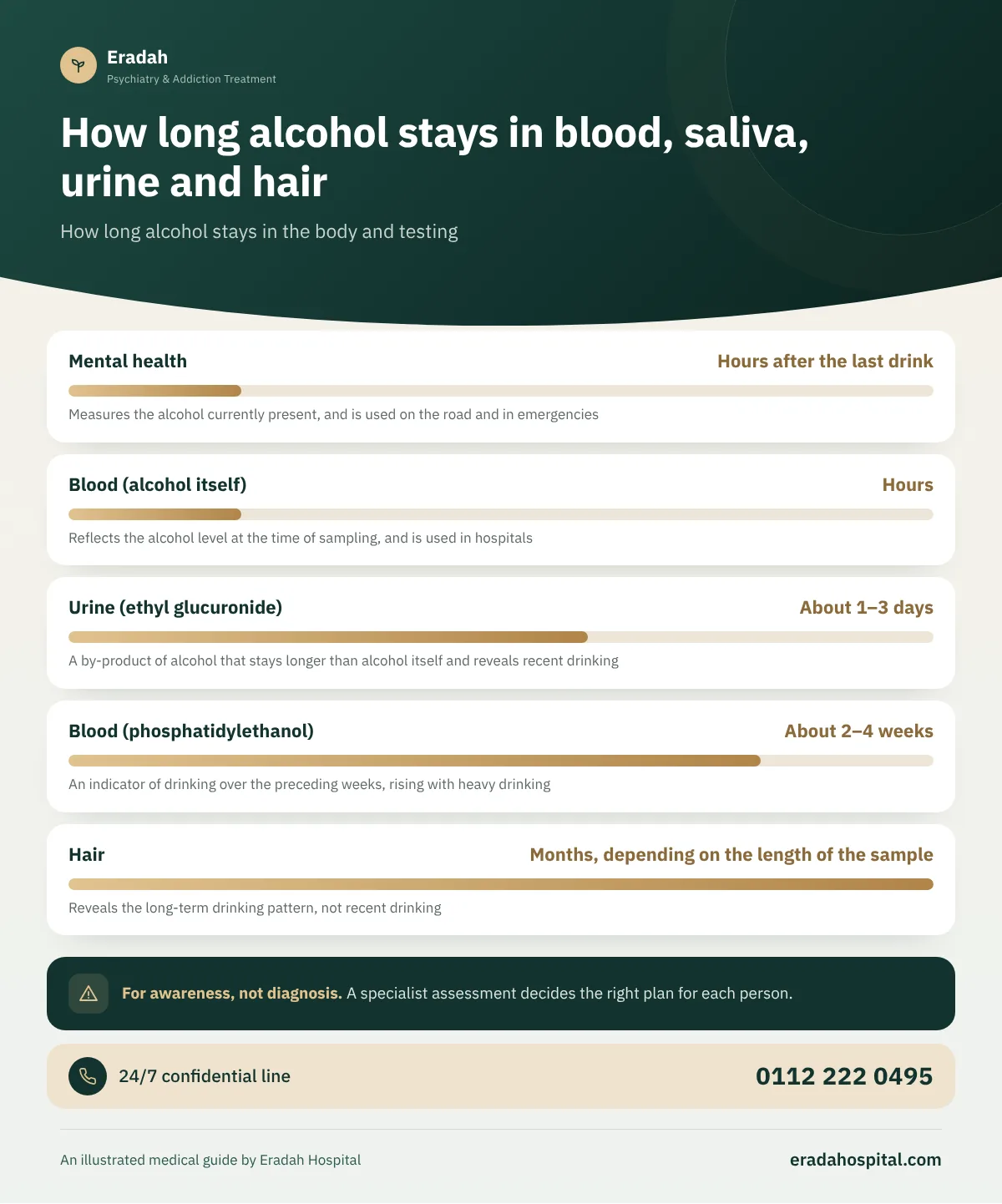
The periods are approximate and vary with the laboratory, the sensitivity of the test, and the amount and frequency of drinking. To interpret a particular result, consult the doctor or the laboratory.
What are the alcohol markers in tests?
A direct by-product formed only when alcohol is in the body, and it is often detected in urine after the alcohol itself has gone.
A compound formed in the membranes of red blood cells when drinking, useful for estimating drinking over recent weeks.
Indirect markers that may rise with heavy, prolonged drinking, but may also rise for other reasons.
Factors that affect how long alcohol stays
- Amount and speed of drinking: larger amounts take longer and raise alcohol by-products in tests.
- Weight and sex: the proportion of water in the body affects alcohol concentration, and women are often affected by a higher concentration.
- Liver function: a weak liver slows the breakdown of alcohol.
- Food in the stomach: slows absorption but does not speed up clearance.
- Age and medicines: some medicines interfere with the breakdown of alcohol, and clearance slows with age.
- Drinking pattern: chronic heavy drinking lengthens the detection window of some markers, such as phosphatidylethanol.
Can a positive result appear without drinking?
It can happen with highly sensitive tests such as ethyl glucuronide in urine; SAMHSA guidance notes that exposure to alcohol in everyday products such as hand sanitizers, mouthwash and some cosmetics can cause a slight rise in the result. For this reason a single test is not relied on alone as conclusive evidence, and results are interpreted with the medical history and other tests.
Screening test and confirmatory test
Some rapid tests give a preliminary result that can be falsely positive, so references recommend confirming results in a specialized laboratory with precise instruments that identify the substance and its amount accurately. This matters especially when treatment or professional decisions depend on the result.
When are alcohol tests requested?
- In emergencies when alcohol poisoning is suspected or there is unexplained confusion.
- At the start of a treatment program, and during it to monitor adherence and support the patient.
- Before some operations or when assessing liver disease.
- In traffic checks and some workplace procedures.
What is the difference between a breath test and a blood test?
A breath test is quick and painless, and measures the alcohol in exhaled air to give an estimate of its concentration in the blood at that moment, which is why it is used on the road and in some workplaces. A blood test is the most accurate and is done in hospitals, especially when poisoning is suspected or when someone has lost consciousness for an unknown reason.
Both tests measure only the alcohol present now, that is, they answer the question "Is there alcohol now?" and not "Does this person drink regularly?" To learn the drinking pattern over weeks, the doctor turns to the longer markers such as phosphatidylethanol.
How are alcohol tests used to follow treatment?
In treatment programs a test is not a tool of punishment but a way of supporting the patient and building trust with their family. Successive negative results give the patient tangible evidence of progress, and a positive result alerts the treatment team early to a relapse that needs a change in the plan, before it turns into a full return to heavy drinking. Repeated liver tests also help track the liver's recovery after stopping.
What does an alcohol test result mean for the family?
A positive result is information that helps start the conversation and treatment, and it is not a verdict on the person. A negative result does not rule out a problem if the signs are clear, because the detection window for alcohol itself is short. More important than the test is the specialist assessment, which looks at the whole picture.