What is bango?
Bango is the common name in Egypt for the herbal form of the cannabis plant: leaves and flowering tops that are dried and crumbled, appearing as green or brownish herbs, sometimes mixed with seeds and small stems.
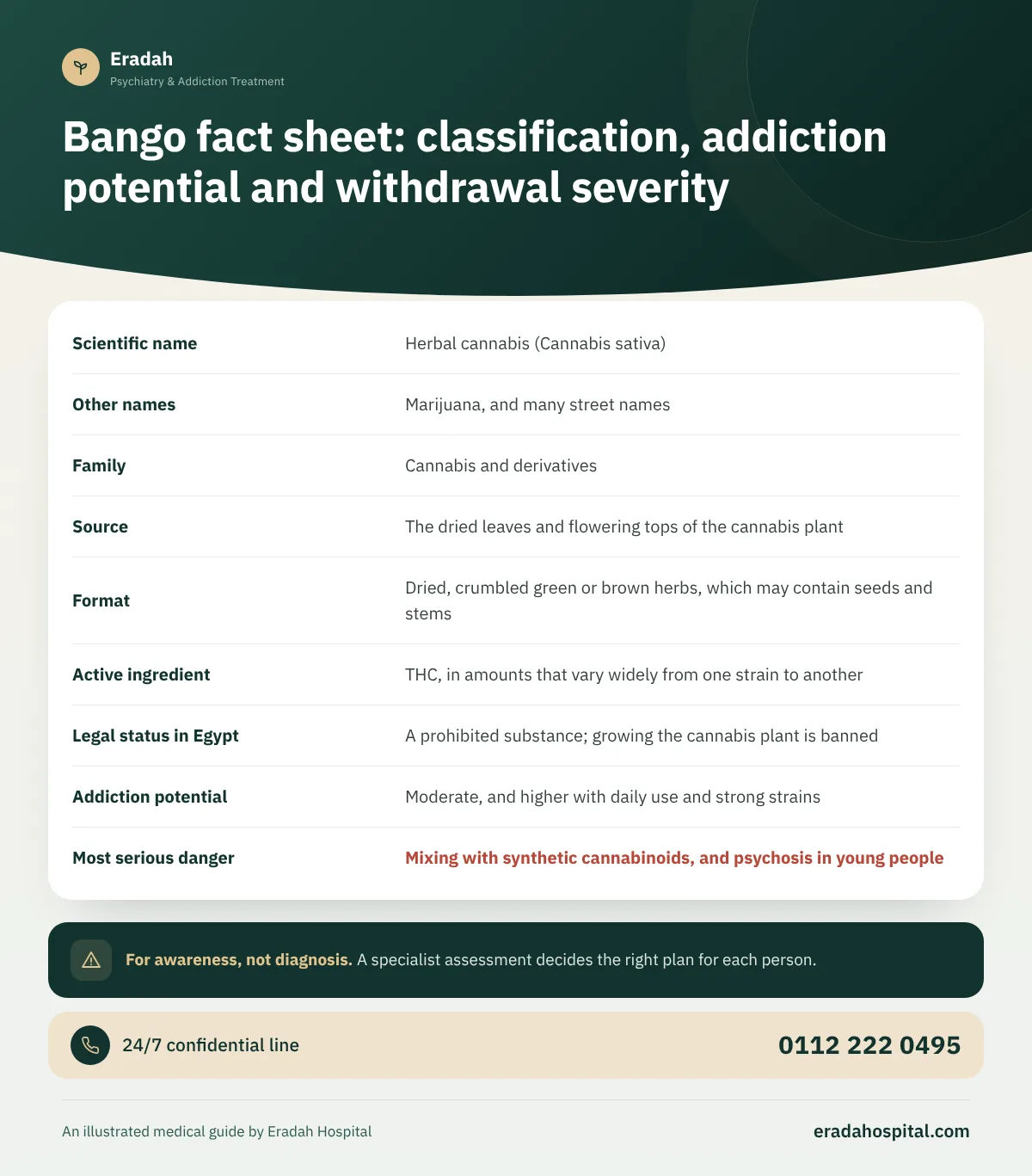
In most countries this form is known as marijuana, while the name hashish is given to the resin extracted from the same plant. Both forms contain THC, the compound responsible for the psychoactive effect, but in different concentrations and proportions.
In popular memory, bango has been seen as the “poor man’s drug” or a weaker version of hashish, but that picture is no longer accurate. Some recently cultivated strains are very potent, and the illicit market sometimes mixes the herbs with far more dangerous substances.
Where does bango come from?
The cannabis plant grows quickly and tolerates a wide range of climates, which is why it is grown illegally in many parts of the world, including remote areas inside Egypt, in addition to what is smuggled in. The highest levels of THC are concentrated in the flowering tops of the female plant, while the large leaves and stems contain lower levels.
The most concentrated part of the plant, used to produce the strong strains.
Less concentrated, and often mixed with the flowering tops in the bango that is sold.
They contain almost no active ingredient, but their presence among the herbs tends to catch a family’s attention.
Are marijuana, bango and skunk different names for the same thing?
Marijuana and bango are two names for the herbal form of cannabis. “Skunk,” on the other hand, is a name given to hybrid strains that are high in THC and very low in CBD. British health sources say this type carries a greater risk to mental health, because CBD, which may ease anxiety and suspicion, is almost absent from it. A person who uses it cannot tell which strain they have just by looking.
What does bango do in the brain?
When bango is smoked, THC passes from the lungs into the blood and then to the brain within minutes, where it binds to cannabinoid receptors that regulate memory, mood, appetite and movement. The result is relaxation or laughter in some people, and anxiety and tension in others, along with slowed reactions and a distorted sense of time.
With repeated use, the brain reduces its sensitivity to this substance, so the person needs more and feels distress when it is not available. This is the biological beginning of dependence, and it is the same for bango and hashish.
What is the difference between bango and hashish?
| Point of comparison | Bango | Hashish |
|---|---|---|
| Part used | Dried leaves and flowering tops | Resin extracted from the tops |
| Format | Crumbled green or brown herbs | Brown to black pieces or slabs |
| Average THC in Europe in 2023 | About 11% | About 23% |
| CBD | Varies, and very low in the strong hybrid strains | Varies, and may be higher in some varieties |
| Main added risk | Herbs may be sprayed with synthetic chemicals | High concentration and the possibility of adulteration |
| Addiction and withdrawal | Both possible | Both possible |
The figures above come from European Union Drugs Agency data. There are no comparable published figures for the Egyptian market, but they show that a lower average does not make bango “safe”; its strong strains come close to hashish or exceed it. For more, see the hashish guide.
Is bango less addictive because it is a “natural herb”?
This belief rests on two mistaken ideas: that anything plant-based is safe, and that bango is a diluted version of hashish. But addiction is determined by the active ingredient and the pattern of use, not by the form of the substance. A person who smokes bango daily is exposed to THC regularly, just like someone who uses hashish, and can develop the same tolerance, dependence and withdrawal symptoms.
In fact, the feeling that bango is “mild” can lead a person to use more of it and more often, and delay admitting that there is a problem. That is why clinics see severe cannabis use disorder in people who have used nothing but bango.
What is the difference between bango and industrial hemp grown for fiber?
In some countries, varieties of the cannabis plant containing only very small amounts of THC are grown to produce fiber, fabric, rope and edible oils from the seeds, and are sometimes called industrial hemp. These varieties differ in composition from the bango used for intoxication, and their existence does not mean bango is “legitimate” or safe. Growing cannabis of every variety is also banned in Egypt.
Is bango the same as Strox?
No, and confusing the two is dangerous. Strox and Voodoo are manufactured chemicals called synthetic cannabinoids, sprayed onto worthless dry herbs, so that anyone who sees them assumes they are a drug plant similar to bango. The European Union Drugs Agency explains that these substances bind to cannabinoid receptors much more strongly than THC, and that their composition and quantity differ from one package to the next.
Who is most at risk from bango?
A brain that is still developing, and a higher risk of addiction, psychosis and declining school performance.
A greater risk that an episode of suspicion or hallucinations becomes a chronic illness.
An added burden on the heart and irritation of the airways.
THC reaches the fetus and is linked to lower birth weight.
Bango under Egyptian law
Bango is a prohibited substance in Egypt under Law No. 182 of 1960 on drug control, and the law also bans growing the cannabis plant. On the other side, the Fund for Drug Control and Treatment of Addiction offers free, confidential treatment to anyone who asks for it through hotline 16023.
This is general educational information and not legal advice.
You found dried herbs in your son’s room: what do you do?
- Do not act in a moment of anger; take time to calm down and think about how to approach the conversation.
- Do not assume what the substance is; it may be bango or herbs sprayed with a synthetic chemical, and the difference matters medically.
- Talk to him about your concern for his health before talking about punishment.
- Ask how often he uses and since when, and about any strange symptoms he has experienced.
- If he shows signs of psychosis, seizures or loss of consciousness, call emergency services immediately.
- Seek a confidential specialist consultation for assessment and a plan suited to his age and condition.
Bango Guide: Everything You Need to Know
We have gathered everything about bango into 5 pages, each answering one question in detail. Choose what you are looking for:
Harms of bango
The effect of its smoke on the lungs and heart, the risk of psychosis with strong strains, the harms of sprayed herbs, and its effect on studies and pregnancy.
Symptoms of bango addiction
How a family can notice bango use, when it becomes addiction, and how to tell it apart from Strox.
Hashish and bango withdrawal symptoms
Withdrawal is the same for both because the substance is the same: irritability, insomnia and loss of appetite that settle within about two weeks.
Hashish and bango addiction treatment
Behavioral and motivational therapy and family support, treatment of accompanying anxiety and depression, and a relapse prevention plan.
How long bango stays in the body
From days to weeks in urine depending on frequency of use, and why its test does not detect synthetic substances.
When does a person who uses bango need emergency care? Call ambulance (123) immediately
- Severe panic, hallucinations, or suspicion and aggression that do not settle
- Chest pain, a strong pounding heartbeat or fainting
- Continuous vomiting with signs of dehydration such as intense thirst and passing little urine
- Seizures, rigidity or sudden loss of consciousness, signs that the herbs may be sprayed with a synthetic substance such as Strox
- A child who swallowed or was exposed to a cannabis product and seems very drowsy, unsteady or is having trouble breathing
Call ambulance (123) and stay with the person. If they are vomiting or unconscious, place them on their side (recovery position) so they do not choke, and keep what is left of the substance or its packaging to show the medical team. Do not use any home remedies.
Call the ambulance 123